

Challenges of transitioning from one political culture to another

By Thilini Meegaswatta
The National People’s Power (NPP) party’s spectacular win at the 2024 parliamentary elections has been seen by many as the political culmination of the aragalaya, which ousted the Rajapaksa dynasty and categorically rejected traditional political parties and their corruption.
Still riding the euphoria of the aragalaya, Sri Lankans have high hopes.
We expected a lot, especially because it was a rare occasion where the North and the South were visually united on the electoral map in their choice of government without the ghost of ethnonationalist division. The ethnic divide that persisted in the presidential election was bridged by the time parliamentary election came around. The central government was finally something both the North and the South could claim as theirs.
Despite the united support from the North and the South and the super majority it gained with 159 seats in Parliament, the NPP government has thus far been cautious, conservative and focused on stability, which has meant that it continued with policies as well as certain institutional structures and practices that it has vocally and passionately criticized on the electoral stage. It had to negotiate with the International Monetary Fund (IMF) and accept its overall framework. The executive presidency still survives.
However, the NPP has delivered on one key promise; it has brought about a shift in political culture which has been termed as a decent turn in politics. For instance, there has been a notable lack of spectacle or what Achille Mbembe has called aesthetics of vulgarity, be it in the abandonment of hackneyed king-cum-father tropes or ostentatious swearing in and opening ceremonies. More importantly, there has been a welcome change in terms of abuse of power and undue political interference.
The proposed 22nd Amendment and the discourse surrounding it is a discussion for another day but there have been examples in recent years for the seeming absence of interference with the judiciary as perhaps best showcased in the death sentence issued in early 2026 on 12 protesters who were involved in the killing of MP Amarakeerthi Athukorala and his bodyguard in 2022. These deaths occurred amid the country-wide backlash against the MPs of the Rajapakse government and their supporters (to term it more accurately, thugs) who carried out an unprovoked attack on MynaGoGama and GotaGoGama protest sites on May 9, 2022 violently assaulting unarmed protesters and setting GotaGoGama on fire.
Given the context of the deaths and the divided verdict, the death penalty has been criticized, especially on social media platforms, as a warning issued to protesters involved in the aragalaya in general and as the culmination of the pseudo judicial processes selectively set in motion against protesters by Ranil Wickremesinghe, whose presidency was the byproduct of the fall of the Rajapaksa dynasty in the face of escalating protests.
In the aftermath of this verdict, an interesting observation was the critique directed against the government on social media platforms: they were seen as betraying the aragalaya. Given that the NPP capitalized on the shift in popular political sentiment effected by the aragalaya, the expectation was that the government would flex its muscles to ensure that protesters were unpunished. Criticism pointed out that the retaliatory legal machinations set in motion under President Wickremesinghe continue to haunt protesters whereas the perpetrators of violence against them on May 9 have not yet been punished. The government has been accused of being ineffectual, indecisive and far too slow in delivering justice to attacked protesters.
One can argue that this is a sign that the NPP government is not intervening to expedite legal proceedings in a way that would cater to the pro-aragalaya sentiments as would suit its political interests. We did ask for independent judiciary, we did ask for impartial justice and we rallied against political power being above the rule of law. But having received from the NPP what we demanded, now we do seem to be a bit uncomfortable, unhappy, disgruntled and perhaps a bit unsettled even.
Why? Because change is difficult. It is uncomfortable. Political interference and impunity are embedded in our collective psyche. To judge by the dissatisfaction expressed over NPP’s inertia, there are still expectations of interference to bend rules and laws to obtain favourable outcomes for their supporters. Being aligned with the ruling party meant being above the law. We have seen murderers pardoned by the president and politicians unleash terror and humiliation against individuals in broad daylight without facing the consequences. Now the practice seemed to have stopped and those who demanded change seem to be paying the price more visibly. Maybe it is a legitimate grievance; how can you fault ordinary NPP supporters who may have been a protestor or feels a kinship with the sentenced protestors for feeling that they have been denied their turn of being above the law?
Interestingly even when the legal arm is not raised against protesters but against the political class, the same disbelief seemed to surface, albeit largely inflected by class affiliations.
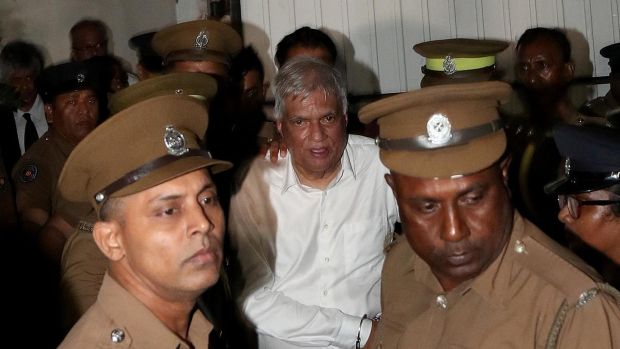
The NPP flipped the script of elite political impunity and immunity, quite shockingly in the case of Wickremesinghe, who has for long represented the echelon of elite political class and maintained a reputation as Mr. Clean despite quite a few financial scandals during his time as prime minister and president. His arrest on charges of misuse of public funds “marked the first time a former head of state has ever been detained in Sri Lanka, shattering the longstanding assumption that those at the top of the country’s politics remain forever beyond the reach of the law”. The arrest and detention of the former president shocked supporters and surprised opponents alike. It showed that accountability was finally threatening the entire political class.
In this context it was understandable that politicians would band together, largely ruffled by the unequivocal indication of their own vulnerability under the NPP government. Allies and opposition figures called the arrest politically motivated and said that it was some form of petty revenge taking.
But what was surprising was the sense of unease and discomfort ordinary people seem to feel. This was observable in lots of different circles. You were likely to hear from a daily wage earner that perhaps arresting the former president was going a bit too far or a professional would suggest that the accusations were not that serious in comparison to the track records of other politicians. Some expressed the opinion that maybe the former president shouldn’t have been arrested without really being able to explain why not. The idea of elite impunity, connected to but slightly different from political impunity, is entrenched in our psyche. Seeing a former president held accountable and in cuffs is shocking precisely because we have never seen it; it was beyond the realms of possibility.
But this is what the aragalaya did – brought about change that seemed impossible. At one point the fall of the Rajapaksa dynasty was unfathomable, yet in the face of the non-violent popular uprising, it had to affect a most disgraceful exit from political power. Soon after Gotabaya Rajapaksa was elected president, there was a spate of court cases settled in favour of numerous Rajapaksas. In the aftermath of aragalaya, in a landmark ruling in 2023, three Rajapaksa brothers were among those held responsible for the country’s bankruptcy. It was symbolic; the Rajapaksas were only condemned and not punished. Even then, it signaled a turn towards equal treatment before the law which has been emphatically reiterated with the legal proceedings initiated against Wickremesinghe.
We have had a political culture of elite impunity where powerful politicians have never been held accountable. This is slowly but surely changing. But clearly this has ruffled a few feathers and if the popular response to the verdict given to the 12 protesters is any indication, the decent turn in politics, especially in relation to non-interference, has been an uncomfortable change even for NPP supporters. How will we respond in a time of transient political loyalty? I hope that my countrymen and women will reconcile with change that is perhaps uncomfortable but more than ever, needed. I hope that disappointment will not set in and that the NPP works to match the symbolic rupture of the aragalaya through tangible delivery in terms of accountability, progress, institutional reforms, economic reform and combating corruption, clientelism and nepotism. I hope that the aspirations of aragalaya will not give way to cynicism, disillusionment and disengagement.
-This article was originally featured on groundviews.org

Comments are closed, but trackbacks and pingbacks are open.