

Post-poll violence in Bengal exposes BJP’s politics of intimidation and the ECI’s failure

By Joydeep Sarkar
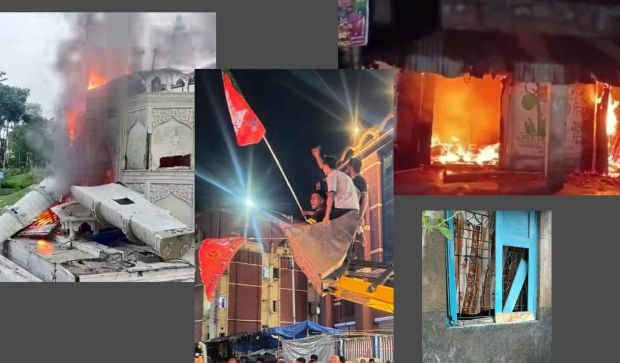
KOLKATA – West Bengal has witnessed widespread political violence, arson, vandalism, intimidation, and communal tension in the 48 hours since there was a change in political power. From Kolkata to Birbhum, covering stretches of Howrah, Murshidabad, South 24 Parganas, Hooghly, Jalpaiguri and Cooch Behar, reports point to a pattern of attacks on opposition workers, members of the Muslim community, student activists, hawkers and party offices. The violence has raised serious questions about the Bharatiya Janata Party’s (BJP) conduct after its victory, but more importantly, about the Election Commission of India’s failure to ensure law and order during a volatile transition.
Two deaths were reported from Udaynarayanpur in Howrah and Beliaghata in Kolkata. Though the dead were claimed to be supporters of rival parties, no written complaints had reportedly been filed in these cases. In Birbhum’s Nanur, BJP workers were accused of hacking farmer Abir Sheikh to death in broad daylight on the road. Another person, Chandu Sheikh, was injured and hospitalized.
In Murshidabad’s Domkal, CPI(M) local leader Safikul Islam was shot from close range by three miscreants. Threats had allegedly been issued since the start of the election to the CPI(M)’s only victorious candidate in Bengal.
The violence was not confined to one party or one district, but several allegations repeatedly named BJP workers or supporters. In South 24 Parganas, the Officer-in-Charge of Nazat police station was shot while trying to stop a Trinamool-BJP clash. In the violent area of Khanakul, Hooghly, BJP was accused of attacking a CPI(M) office. In Sonarpur, homes and shops of CPI(M) workers were vandalized, and CPI(M) supporter Sanju Majumdar was severely beaten. In Howrah’s Jagatballavpur, houses of Trinamool workers were reportedly set on fire.
“The initial effect of the change that the people of the state wanted has begun! Many people have fled their homes in fear. A terrible situation has been created,” alleged senior TMC MP Kalyan Banerjee.
Krishna Das, TMC candidate from Jalpaiguri, told The Wire, “With a group of people, BJP is occupying club buildings and attacking the homes of those with opposing views. If someone belongs to a different religion, they are abusing them; even if someone wears a lungi, they are calling him Muslim. I defended myself, but how many can be protected from this frenzy?”
The Election Commission’s role deserves scrutiny as well. Despite the deployment of security forces, reports said police or army personnel were absent or ineffective in several places. In a state with a long history of post-poll violence, such administrative failure cannot be dismissed as an accident. The ECI had a responsibility to anticipate retaliation and ensure a peaceful transition, yet the ground situation suggests a dangerous vacuum.
The most alarming aspect of the violence is its communal character. In Kolkata’s famous New Market area, BJP workers allegedly gathered with bulldozers and DJ music near the Nizam’s restaurant while poor Muslim hawkers were threatened and forced to rush away. Shops on pavements were damaged and traders were reportedly told that no one could do business there without BJP’s permission. The use of bulldozers as a tool of intimidation signals the import of BJP’s majoritarian “bulldozer politics” into the state.
The symbolism was disturbing. In Dinhata, Cooch Behar, BJP workers allegedly demolished and set fire to a Taj Mahal replica. In Barasat, North 24 Parganas the name of Masjid Bari Road was reportedly changed. In Birbhum’s Kankalitala, a, one of West Bengal’s important religious sites, BJP supporters put up a flex declaring, “No one except Hindus will be allowed to enter.”
In Suri’s Karamkal village, after minority families were attacked, BJP MLA Jagannath Chattopadhyay reportedly apologized, but also told Muslims, “This time you will have to erase the name of Trinamool from your minds!”
Damage control
Addressing the media, state BJP president Samik Bhattacharya attempted damage control, saying, “A few scattered incidents have taken place. Someone or some people are creating disorder while carrying our party flag. If they are people of our party, they will be expelled from the party. It is the administration’s responsibility to maintain peace and order.”
The post-result blame game also took a communal turn within TMC circles. On X, TMC MP Mahua Moitra’s now-deleted reply blaming voters for splitting TMC support and aiding BJP gains elsewhere sparked widespread criticism.
The unfolding situation raises two urgent questions. First, whether BJP’s victory has emboldened sections of its cadre and allied groups to use violence, bulldozers, religious intimidation, and coercion to reshape local power equations. Second, why the ECI and security forces failed to anticipate and prevent such unrest, especially in a politically polarised state where post-poll violence was a predictable risk.
What Bengal is witnessing is a dangerous assertion of power through violence, communal intimidation and institutional silence. Taken together, the incidents point to a political transition marked not by restraint and accountability, but by revenge, communal provocation, and the visible weakening of law and order.
– thewire.in

Comments are closed, but trackbacks and pingbacks are open.