

Supreme Court clears 22nd Amendment without referendum; key anti-corruption clause requires referendum

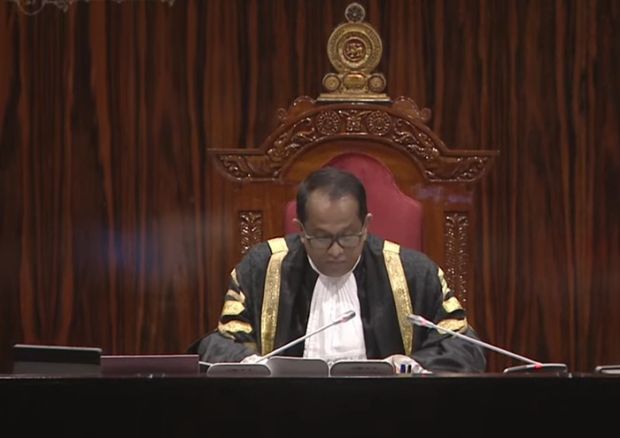
COLOMBO – Sri Lanka’s Supreme Court has determined that the proposed 22nd Amendment to the Constitution does not require approval at a referendum and may be enacted with a two-thirds majority in Parliament, Speaker Dr Jagath Wickramaratne announced on Tuesday (22).
The Court’s determination was presented to Parliament at the commencement of the day’s sitting. The Bill, which seeks to extend the retirement age of judges and increase the number of Court of Appeal judges from 20 to 25, had been challenged before the Supreme Court under Article 121(1) of the Constitution.
The Court, however, directed that specific changes be made to the Bill, determining that the phrase ‘upon attaining the age of 67 years’ in the proviso to Clause 2 should be replaced with ‘upon completing the age of 67 years’.
It also directed that a second proviso be added to Clause 2 stating that the six-year term limit would not apply to a person serving as Chief Justice on the date the proposed Act comes into operation.
The 22nd Amendment Bill was presented to Parliament on August 18 by Justice and National Integration Minister Harshana Nanayakkara. A total of 67 petitions challenging the Bill were subsequently filed before the Supreme Court.
The petitions were considered by a five-member bench comprising Chief Justice Preethi Padman Surasena and Justices Achala Wengappuli, Arjuna Obeyesekere, Sampath Abeykoon and Gihan Kulatunga. The hearings concluded on September 2, following which the Court’s determination was referred to the Speaker.
The parliamentary debate on the 22nd Amendment Bill and the Judicature (Amendment) Bill is scheduled for September 24 and 25, with the Second Reading debate allocated from 11.30 a.m. to 7 p.m. on both days.
Separately, the Supreme Court has determined that several provisions of the Anti-Corruption (Amendment) Bill are inconsistent with the Constitution and require a two-thirds majority in Parliament.
Most provisions of the Bill can proceed with a simple majority, but the Court identified specific clauses requiring the higher parliamentary threshold.
Significantly, the Court ruled that Clause 17, in its present form, can become law only if it is approved by a two-thirds majority in Parliament and subsequently endorsed by the people at a referendum.
The determination states that Clause 17 is inconsistent with Article 4(c) read with Article 3 of the Constitution, with Article 13(2) also relevant to the Court’s determination.
The Court also found that certain other provisions concerning asset declarations and related anti-corruption measures require a special parliamentary majority, while provisions that were found constitutionally consistent may be passed by a simple majority.
–ENCL

Comments are closed, but trackbacks and pingbacks are open.