


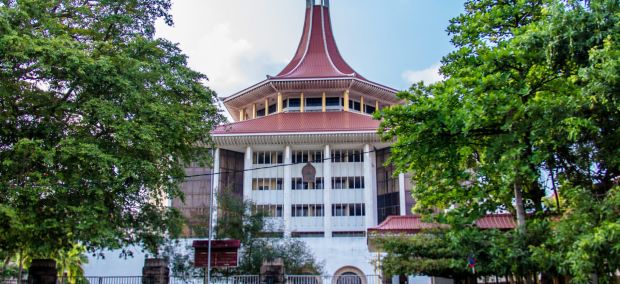
COLOMBO – Sri Lanka’s Supreme Court on Tuesday (Sept 1) rejected a request to have petitions challenging the proposed 22nd Amendment to the Constitution heard by a full bench comprising all sitting Supreme Court judges.
The petitions were taken up before a five-judge bench headed by Chief Justice Preethi Padman Surasena, and comprising Justices Achala Wengappuli, Arjuna Obeyesekere, Sampath Abeykoon and Gihan Kulatunga.
The proceedings initially commenced in Court Hall No. 502, where counsel for the petitioners, including President’s Counsel M.A. Sumanthiran, requested that the hearing be moved to a larger courtroom due to limited seating.
Counsel said the case had attracted significant public interest and requested that the proceedings be moved to Court Hall No. 501, where members of the public would have greater access to the hearing.
The bench subsequently ordered that the proceedings be transferred to Court Hall No. 501.
After the hearing resumed, Sumanthiran and several other counsels appearing for the petitioners requested that the matter be heard by a full bench of all sitting Supreme Court judges, arguing that the proposed amendment directly affected the judicial establishment and the independence of the judiciary.
President’s Counsel Saliya Peiris, Ali Sabry, Geoffrey Alagaratnam, Eraj de Silva, Srinath Perera, Anur Medegoda and Maithri Gunaratne also supported the request.
Appearing for the Attorney General, Additional Solicitor General Viraj Dayaratne opposed the request, arguing that the Constitution vested the authority to determine the composition and size of the bench for such proceedings with the Chief Justice.
He referred to Article 132 of the Constitution and submitted that the determination of the number of judges to hear the matter was within the Chief Justice’s constitutional authority.
Counsel for petitioner-intervenor Nigel Hatch submitted that there was no legal impediment to the Chief Justice constituting an appropriately sized bench to hear the petitions.
Following the submissions, the bench adjourned proceedings for 15 minutes before determining that the petitions would proceed before the existing five-judge bench.
During the substantive submissions, counsel for the petitioners argued that the proposed amendment could have serious implications for judicial independence and the constitutional separation of powers.
Sumanthiran, appearing for the Bar Association of Sri Lanka (BASL), argued that the proposed changes affected fundamental aspects of the constitutional structure and judicial independence. He submitted that amendments affecting such provisions should require approval at a national referendum in addition to the required parliamentary majority.
He said the BASL had considered the issue at a meeting and had unanimously decided to challenge the proposed amendment before the Supreme Court.
Appearing for former minister and petitioner G.L. Peiris, President’s Counsel Ali Sabry argued that the proposed amendment threatened judicial independence and was inconsistent with constitutional provisions governing the judiciary and the separation of powers.
He referred to previous Supreme Court determinations concerning constitutional amendments, including the 18th and 19th Amendments, and argued that changes affecting fundamental aspects of the constitutional structure should be subjected to a referendum.
Counsel including Arjun Parakrama, Jayampathi Wickramaratne, Thishya Weragoda and Thisath Abeygunawardena also made submissions on behalf of other petitioners.
Abeygunawardena, appearing for the United People’s Power, argued that provisions contained in Clause 2 of the proposed Bill were inconsistent with the Constitution and that extending the terms of sitting Supreme Court judges by two years would have a direct impact on judicial independence and the constitutional structure.
He urged the court to determine that the proposed amendment required approval by the people at a referendum, warning that the changes could create a permanent constitutional alteration that would be difficult to reverse in the future.
The Supreme Court is currently considering several petitions challenging the constitutionality of the proposed 22nd Amendment, which seeks, among other matters, to extend the retirement age or term of service of judges.
-ENCL

Comments are closed, but trackbacks and pingbacks are open.