


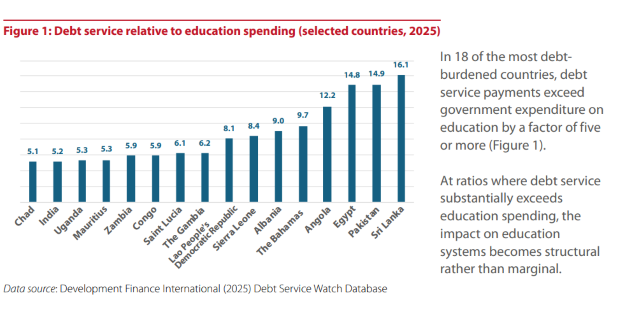
COLOMBO – Sri Lanka spent up to 16 times more on debt repayments than on education last year – the widest gap of any of the world’s most indebted countries – a new UN report revealed, highlighting how developing nations are being trapped in a spiral of debt servicing and eroding public services.
The finding, from UNESCO’s Global Education Monitoring Report, places Sri Lanka at the extreme end of a pattern now affecting most of the developing world. Across 113 developing countries, governments spent more on servicing foreign debt than on education in 2025. In sub-Saharan Africa, the ratio averaged 3.6 times more spent on debt than on education. Among the 18 most heavily indebted countries, the average was five times more, with Sri Lanka’s 16-to-1 ratio standing well above the rest.
The gap comes as aid to education is itself being cut. Low- and lower-middle-income countries have already lost 21% of the education aid they received in 2023, and UNESCO warns losses could reach 30% by 2027. Afghanistan, Mali, Niger and Liberia have each lost more than 40% of their education aid in three years.
Min Jeong Kim, director of UNESCO’s education division, said the current approach to debt “really keep[s] countries trapped in a cycle of austerity, underinvestment and stalled development,” adding that it was “weakening countries’ stances on economic growth, eroding domestic revenue mobilization and ultimately also diminishing their ability to handle their debt over time.”
For Sri Lanka specifically, the figures underline how the aftershocks of the 2022 economic collapse and subsequent debt restructuring continue to constrain the state’s ability to invest in its own recovery. A 16-times gap between debt servicing and education spending means classrooms, teacher salaries and school infrastructure are competing for a shrinking share of public revenue against creditor obligations, even as the country has been held up internationally as a restructuring success story.
The pattern is global, but the mechanics are consistent. According to the UK-based Debt Justice campaign, developing-country debt repayments hit a 35-year high last year, with 56 countries spending nearly a fifth of total government revenue on servicing loans. Tim Jones, the group’s policy director, said repayments had “ballooned following a series of shocks from Covid, energy price and interest rate rises and climate disasters,” and that in the worst-affected countries this was “leading to cuts in spending on essential services such as health and education.”
Aid cuts by the US and Europe have compounded the pressure: global funding for education fell by $600m in 2024, the most recent year for which figures exist, and is expected to have fallen further in 2025.
The combined effect, shrinking aid and rising debt costs, is already disrupting education systems on the ground, with schools left without operating funds and teachers going unpaid. UNESCO warns of a longer-term trap: weakened education systems undermine the very economic growth that would let indebted countries manage their debt burdens in future.
The report calls for a structural shift in how debt relief is designed, away from short-term relief and toward long-term arrangements that let countries keep funding public services. Jones argued that reform must also address the role of private creditors, often based in Britain and the US, who have blocked or diluted relief deals to protect their own returns, as bondholders did in Ethiopia’s recent restructuring, ultimately securing a better return than the government itself received. “The UK needs to use its presidency of the G20 in 2027 to get major changes to the debt-relief process, including more debt cancellation and a faster process,” Jones said. “Central to this is incorporating the process into English law, so that private creditors can no longer disrupt and hold out from the debt relief.”
-ENCL

Comments are closed, but trackbacks and pingbacks are open.