

Respect the robe, uphold the law

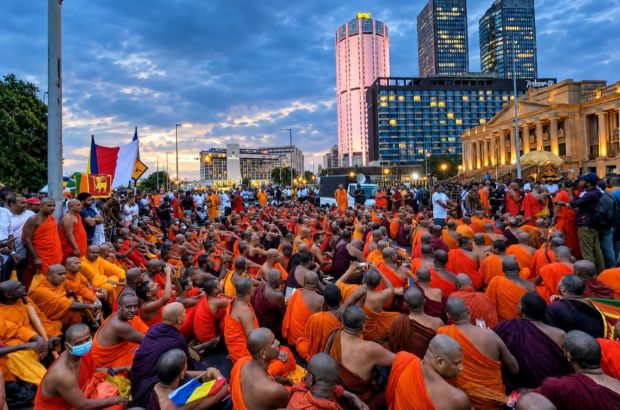
Saffron-robed monks, who had arrived in Colombo on Thursday (15) after a six-day march billed as ‘Justice for the Saffron Robe, March for Freedom’, stood in the rain outside the Presidential Secretariat demanding Galagoda Aththe Gnanasara Thera be pardoned and returned to his robes.
They staged a sit-out, calling on President Anura Kumara Dissanayake to provide written assurances that their demands would be met. They also sought guarantees that the religious rights of monks would be protected and that the saffron robe would be treated with due respect.
The marchers should be heard, but they should also be answered plainly. This is not justice for the robe. It is a demand for exemption from the law, wrapped in the colour of renunciation.
The facts are not in dispute. Gnanasara Thera was convicted of contempt of court, and was freed on a presidential pardon in 2019 that many saw as a slap at the judiciary. That pardon has now been struck down. The Supreme Court invalidated it, and he is back in prison serving the remainder of a six-year sentence. The courts did their job. They examined an act of executive clemency and found it wanting. That is what an independent judiciary is for. It is the one institution that can tell a president that power has limits, and that no one, whatever their rank, robe or following, is beyond the reach of the law.
Those who now call for another pardon are asking the executive to undo what the judiciary has just corrected. They are asking the state to repeat the very abuse the Supreme Court has already rejected. A country that pardons the powerful after the courts have spoken does not have the rule of law. It has rule by favour.
The Buddha’s cīvara is the sign of one who has stepped away from power, wealth and worldly quarrel. It asks for humility, restraint and compassion. It is worn by those who have renounced the world, not by those who wield influence over it. The robe is tarnished when it is used as a political banner, and when it is worn in the service of hatred against fellow citizens. It is tarnished when it is held up as a reason a man should not answer to a court.
The robe is not dishonoured when a convict is made to wear prison clothes. It is dishonoured by the conduct that put him there. Gnanasara Thera faces another case over remarks that allegedly insulted Islam, set for further hearing on October 23. A monk’s behaviour that drags the robe into contempt of court, intimidation and communal provocation has done more damage to Buddhism than any prison officer ever could.
The government says his robes were removed under the Prisons Ordinance, as has been done for all 63 Buddhist monks currently serving sentences, with no special exception made. That is the principle at stake. If this one monk is granted special treatment because of his fame or the size of his following, then the other 62 are being told that the law is applied by rank. Equality before the law cannot mean that the quiet and unconnected are treated as ordinary prisoners while the loud and well-supported are treated as exceptions.
The prelates have raised a real question, and it deserves a real answer. The chief prelates of the Nikayas have said that only the relevant Sangha Sabha can disrobe a monk. That is a legitimate matter of monastic discipline and prison regulation. It should be settled by lawful, transparent process, with the prison authorities explaining the legal basis for their rules and the courts testing it if need be. It is a question about how a prisoner is dressed. It is not a ground for freeing him. The Sangha may decide who is a monk. It does not decide who is guilty.
To the extent that the marchers are defending the dignity of the yellow robe, they should ask what actually injures it. They might ask why a man convicted of contempt of court became the face of a ‘Justice for the Saffron Robe’ campaign, and why the pilgrims’ energy is not directed at monks who live by the Vinaya. Buddhism has endured in this island for over two thousand years because it has stood for the Dhamma, not for the privilege of any individual. It does not need a pardon for one monk to survive. It needs a Sangha confident enough to say that no one is above the law, including its own.
The government must hold firm. It should not bargain with a march or bend to pressure from the pulpit or the street. It should apply the Prisons Ordinance equally and explain it openly. It should let the appeals and the pending trial run their course without interference, and not repeat the mistake of 2019.
Those who truly love the Buddha Sasana should want a Sri Lanka in which the courts are strong, the law is the same for everyone, and the robe stands for what it was meant to stand for. A country that respects its judges cannot also demand that they be overruled whenever the accused wears saffron. That is the choice before us. The law has spoken, and Sri Lanka must listen.
–ENCL

Comments are closed, but trackbacks and pingbacks are open.