

Breaking the silence on government and LTTE atrocities

By Pitasanna Shanmugathas
Academic and linguist Noam Chomsky once wrote: “If we adopt the principle of universality: if an action is right (or wrong) for others, it is right (or wrong) for us. Those who do not rise to the minimal moral level of applying to themselves the standards they apply to others – more stringent ones, in fact – plainly cannot be taken seriously when they speak of appropriateness of response; or of right and wrong, good and evil.” This principle of morality has guided my work as a filmmaker and journalist from my documentary NEELAN: UNSILENCED about the life and legacy of constitutional scholar Neelan Tiruchelvam, to Truth to the Powerless, my six-part documentary series investigating Canada’s foreign policy. As a Sri Lankan Tamil and Canadian citizen, my conscience compels me to speak out not only about government atrocities but also about crimes committed by those who claim to represent me and my communities.
The principle of morality
The government’s crimes against Tamil civilians are well documented. During the war’s final stages in 2009, an estimated 40,000 civilians were killed. The UN documented how “The Sri Lankan army relentlessly shelled hospitals, the United Nations hub, food distribution lines, as well as ships near the International Committee of the Red Cross (ICRC) that were coming to pick up the wounded”. The government engaged in enforced disappearances, extrajudicial killings and torture. Tiruchelvam, speaking in Parliament in 1997, noted that according to the US State Department, “In excess of 300 individuals are believed to have disappeared in the Jaffna Peninsula in the second half of the year” alone. These atrocities demand accountability, and I have never hesitated to condemn them.
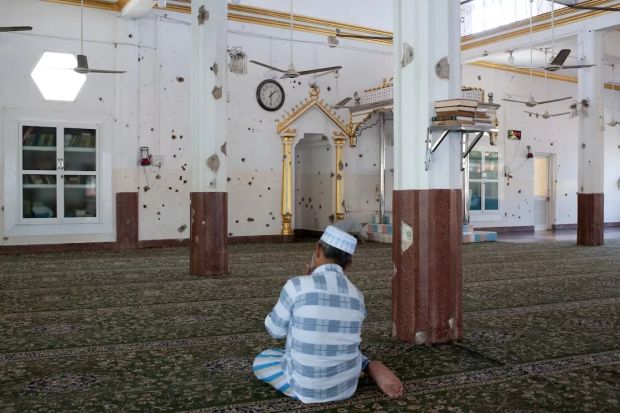
But an armed rebel group, the Liberation Tigers of Tamil Eelam (LTTE), undemocratically appointed itself as the sole representative of the Tamil-speaking people and committed its own catalogue of crimes that I cannot ignore. On August 3, 1990, the LTTE massacred over a hundred Muslim men and boys praying at a mosque in Kattankudy. Just months later, on October 30, 1990, they orchestrated the ethnic cleansing of 72,000 Muslims from the Northern Province.
At LTTE checkpoints, Jaffna Monitor’s Kaniyan Pungundran wrote in his article that “Muslim women had gold earrings torn from their lobes, the metal ripping through flesh. Wedding rings were wrenched from fingers – fingers that resisted until they bled”. The LTTE’s justification was chilling: “Whatever is earned in Tamil Eelam belongs to Tamil Eelam.” These were our neighbours, our classmates, our friends – people who had lived alongside Tamils for centuries.
The LTTE also systematically eliminated Tamil voices offering democratic alternatives to peacefully end the civil war. On July 29, 1999, they assassinated Tiruchelvam, a Harvard Law-educated constitutional scholar who helped draft proposals that, as he stated, “Represented the boldest attempt to redress the imbalance in the relationship between the different ethnic groups through devolution of power to the regions”. In one of his final speeches to Parliament, Tiruchelvam spoke words that echo with tragic prescience: “I wish to reiterate that non-violence is the central article of our political faith. We cannot glorify death, whether on the battlefield or otherwise. We, on the other hand, must celebrate life, and are fiercely committed to protecting and securing the sanctity of life, which is the most fundamental value without which all other rights and freedoms become meaningless.” For championing democracy over violence, the LTTE used a suicide bomber to kill him.
In 1998, the LTTE killed Jaffna’s first democratically elected female mayor, Sarojini Yogeswaran. Nine years earlier, in 1989, they had assassinated her husband, Vettivelu Yogeswaran, along with former opposition leader Appapillai Amirthalingam in Colombo. The LTTE lured these leaders of the Tamil United Liberation Front (TULF), a democratic Tamil political party, to their deaths by exploiting Yogeswaran’s commitment to Tamil unity, with the LTTE making repeated overtures to Yogeswaran about wanting to discuss “Ways and means of achieving Tamil unity” and arranging what appeared to be a reconciliation meeting at the victims’ Colombo residence. After a cordial conversation about forging unity among Tamil groups, the LTTE operatives suddenly drew their weapons and opened fire, killing both leaders. These people were not traitors; they were Tamil leaders who devoted their lives to Tamil rights but believed the path forward lay in negotiation and democracy. Tiruchelvam consistently condemned government atrocities, raising concerns and demanding accountability in Parliament about allegations of mass Tamil graves in the North, reportedly carried out by the army. He was no apologist for state violence. Yet the LTTE labelled him a traitor because he dared imagine a Sri Lanka where all communities could coexist with equal rights.
Tiruchelvam’s August 3, 1995, proposals, championed by President Chandrika Kumaratunga, offered unprecedented power-sharing arrangements, including meaningful autonomy and devolution of land, police, financial and education powers to the regions, along with robust constitutional safeguards to prevent unilateral central government encroachment and a permanent commission on devolution to resolve intergovernmental disputes. The LTTE, however, refused to engage with these proposals and ultimately assassinated Tiruchelvam in 1999 for his role in its drafting. Like Amirthalingam before him, Tiruchelvam was killed because the LTTE regarded his efforts to achieve a negotiated constitutional settlement within a united Sri Lanka as a betrayal of the Tamil Eelam dream of a separate ethnically Tamil state and because Tiruchelvam’s political credentials and international stature posed a threat to the LTTE’s claim to be the sole legitimate representative of the Tamil people.
Tamil vilification continues
In my documentary on Tiruchelvam, the current leader of the TULF, Veerasingham Anandasangaree, asserted, “For the LTTE, anyone who don’t agree with them, they brand them as traitor. More than the LTTE, the people who pretend to be supporting the LTTE are the ones who should be held responsible”. In the documentary, journalist Ignatius Selliah recalled how “The Tamil media never gave any publicity to [Neelan’s] devolution proposals” while vilifying Neelan. “They took Neelan independently, defamed him, and vehemently wrote articles, editorials, and cartoons, portraying him as a traitor.”
M.A. Sumanthiran dismantles the “traitor” discourse in the documentary, noting how it justified the killings of those who devoted their lives to the Tamil cause. Neelan “was condemned with this label both before and after his death”. But as political anthropologist Sharika Thiranagama observed, “Since the LTTE never pursued a democratic path, being labelled a ‘traitor’ by them is viewed by some Tamils as a badge of honour”.
When I speak about my documentary and write about acknowledging all perpetrators of violence, including the LTTE, I am vilified by segments of the Tamil diaspora, called a traitor and accused of betraying the Tamil cause. I strongly disagree with their labelling of me as a traitor. It is precisely because I support the rights of all Tamils that I speak out against any atrocities committed against them, regardless of who commits them, especially when a particular group claiming to be the sole representative of members of my own community committed them in my name. The principle of morality, therefore, requires that I condemn the LTTE’s atrocities.
Holding my government accountable
The principle of morality also demands that, as a Canadian citizen, I hold my own government to the same standards. This compelled me to create Truth to the Powerless, examining Canada’s role from supporting apartheid in South Africa and Israel to participating in coups in Haiti and Honduras to wars in Iraq, Yugoslavia, Afghanistan and Libya. As Canadian foreign policy journalist Yves Engler wrote in his review of the documentary series, “While anti-imperialist critiques have gained little official political traction, the first step to change is information. It’s essential to build the critical consciousness needed to reject Canada’s foreign policy establishment. Truth to the Powerless: An Investigation into Canada’s Foreign Policy is an important contribution to that struggle”.
Canada played a central role in imposing the unjust 1947 UN partition plan, enabling Zionist ethnic cleansing in Palestine. Canada maintained close ties with apartheid South Africa while publicly opposing it. Canada participated in the 2011 NATO bombing of Libya, contributing to the destabilization of the country. Canada played a key role in the 2004 coup ousting Haiti’s first democratically elected president. These actions demand the same accountability I demand for Sri Lankan crimes.
I cannot demand justice for Tamil victims of atrocities by the government while ignoring certain atrocities committed against Tamils and Muslims by the LTTE. I cannot condemn US imperialism while excusing Canadian complicity in the empire. When the LTTE committed atrocities, they did so in my name as a Tamil. When Canada commits atrocities abroad, it does so in my name as a Canadian citizen with my tax dollars. This gives me a moral obligation to speak out.
Following Dr Martin Luther King Jr’s example
I draw strength from Dr Martin Luther King Jr.’s April 4, 1967 speech, titled ‘Beyond Vietnam: A Time to Break Silence’. King delivered the speech condemning the US’ war in Vietnam exactly one year to the day before his assassination. King knew he would be condemned for speaking out against the war in Vietnam. King said that people told him, “Peace and civil rights don’t mix”. But King understood his moral calling required speaking for all victims as he asserted, “I could never again raise my voice against the violence of the oppressed in the ghettos without having first spoken clearly to the greatest purveyor of violence in the world today: my own government.”
As King said in the speech, “A time comes when silence is betrayal”. He explained: “We are called to speak for the weak, for the voiceless, for the victims of our nation, for those it calls ‘enemy,’ for no document from human hands can make these humans any less our brothers.”
Tiruchelvam embodied this calling. In parliamentary speeches, he demanded accountability from all sides. In a 1998 Parliamentary speech, he stated, “The rule of law must be upheld independent of the identity of the perpetrator or victim”. Speaking about a Tamil woman, Krishanti Kumaraswamy, allegedly killed by police, he declared, “The public has the right to a full, impartial and professional investigation”. He applied the same standard to LTTE atrocities, acknowledging in a 1999 Parliamentary speech that torture was perpetrated “by Tamil militant groups operating in the North-East. Some are political parties represented in Parliament. I would urge them to make an unequivocal commitment to end torture as a routine practice in their interrogations”.
In emergency parliamentary debates, Tiruchelvam catalogued suffering on all sides – displaced persons, the disappeared and civilians trapped in camps. “We must express our shock and outrage at the very cruel fate of these unfortunate persons, who are the victims of the intensification of the military confrontation,” he declared. In June 1999, barely a month before his assassination, one of his final parliamentary speeches involved calling for an end to internecine killings by Tamil groups, condemning acts of torture and enforced disappearances carried out by state actors and championing the sanctity of life over the machinery of war.
Genuine transitional justice requires acknowledging all perpetrators
As I wrote in my article on the 10th anniversary since the end of the civil war: “In order to truly understand why a political settlement [to peacefully end the civil war] did not occur, it is required that the wrongdoings of both the Sri Lankan government as well as the LTTE are analyzed.” Furthermore, in my article on achieving transitional justice, I asserted that meaningful transitional justice requires “a holistic approach encompassing truth-seeking, reconciliation efforts, and structural reforms”. This means acknowledging all victims and all perpetrators.
Understanding the origins of violence is not the same as excusing its evolution into brutality. The state bears enormous responsibility for the conditions that gave rise to the conflict. As Tiruchelvam acknowledged, “The AK-47 became the answer” to oppression; he understood why armed resistance emerged. But counter-violence against oppression is one thing; massacring civilians in mosques, ethnically cleansing entire communities and assassinating democratic leaders offering alternatives – these are crimes that cannot be justified.
Similarly, understanding geopolitical context doesn’t excuse Canadian complicity. For too long, as Engler asserted, even left-wing commentators stated, “Canada usually does good internationally except for” whatever topic they criticized. But as Engler observed, “When repeated over and over again, the ‘usually good but not this time’ formulation is incorrect.” Universal principles demand examining the full scope of actions, not cherry picking, while excusing the rest.
The path forward
Dr King declared, “We still have a choice today: nonviolent coexistence or violent co-annihilation.” He insisted, “A true revolution of values will lay hands on the world order and say of war: This way of settling differences is not just”. Tiruchelvam echoed this. In June 1999, in one of his final speeches to Parliament before his murder, Tiruchelvam said, “We can no longer offer empty platitudes and meaningless slogans such as peace through war to a long-suffering people.”
For Sri Lanka, we can continue cycles of violence, selective memory and refusing to acknowledge crimes by “our side”, or we can choose Tiruchelvam’s path – acknowledging all victims, demanding accountability from all perpetrators and building a future based on shared power and mutual respect. As President Kumaratunga said about Dr Tiruchelvam, “His legacy was to convey to his people, to the entire country, and to the world that all problems could be resolved democratically through negotiations.”
For Canada, we can continue mythologizing our role, selectively condemning while excusing our complicity in empire and war, or we can demand our government genuinely support democracy and human rights rather than corporate interests and imperial power.
The civil war ended in May 2009 with tens of thousands of Tamil civilian deaths. If the LTTE and political parties had implemented the constitutional proposals Tiruchelvam helped formulate, the war could have ended sooner, saving countless lives. Similarly, if Canada genuinely supported democracy rather than corporate interests, countless lives might have been saved, and democratic movements strengthened.
My work, through NEELAN: UNSILENCED, Truth to the Powerless, my journalism and research, is guided by Chomsky’s principle. I apply to my own communities and government the same standards I apply to adversaries. I speak against Sri Lankan government atrocities, Indian Peacekeeping Forces’ atrocities in Sri Lanka, LTTE atrocities and Canadian foreign policy atrocities with equal clarity. This is not betrayal. This is the only path to genuine justice, accountability and healing.
As Dr King said, “We must speak with all the humility that is appropriate to our limited vision, but we must speak”. For Sri Lanka and Canada alike, the time has come to acknowledge all our crimes; only then can we build futures worthy of our people’s sacrifices. The principle of morality demands nothing less.
-Pitasanna Shanmugathas is a documentary filmmaker and writer whose work explores international human rights, foreign policy, and social justice. This article was originally featured on groundviews.org

Comments are closed, but trackbacks and pingbacks are open.