


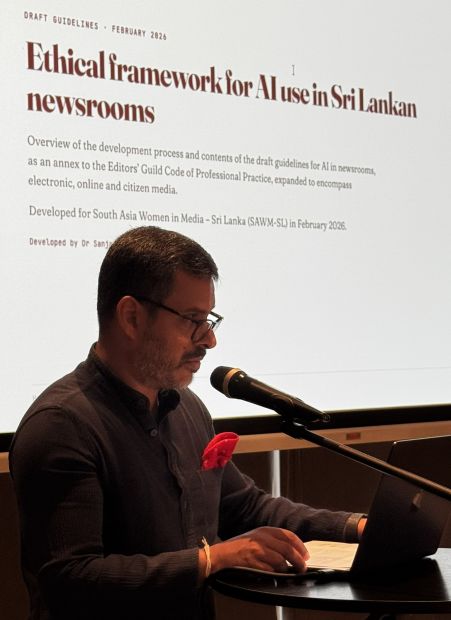
COLOMBO – South Asian Women in Media – Sri Lanka (SAWM-SL) convened a roundtable discussion on Draft Guidelines for the Ethical Use of Artificial Intelligence in Media on Tuesday (23), bringing together editors, journalists, representatives of media organizations, and media professionals at the Courtyard by Marriott, Colombo.
The event marked a significant milestone in Sri Lanka’s efforts to promote the responsible and ethical use of AI in journalism and concluded the country’s first dedicated initiative on AI literacy, safety, and ethical governance for women journalists, supported by the Embassy of the Kingdom of the Netherlands in Sri Lanka.
The trilingual draft guidelines, available in Sinhala, Tamil, and English, are the outcome of an extensive consultative process involving media institutions, journalists, digital rights advocates, and other key stakeholders. They build on a comprehensive body of research undertaken by Dr Sanjana Hattotuwa for SAWM-SL in 2025, including The Ethical Use of AI by Media: A Case for Sri Lankan Guidelines, as well as a companion report examining the impact of artificial intelligence and technology-facilitated gender-based violence (TFGBV) on the media sector, particularly on women journalists.
As part of the broader initiative, SAWM-SL also conducted a series of training programs for women journalists and media professionals on the responsible use of generative AI tools in journalism, newsroom workflows, and digital content production.
The draft framework, presented by Dr Hattotuwa at the roundtable, proposes a practical model for integrating AI into journalistic work while protecting editorial values, accountability, ethical standards and public-interest obligations. It makes clear that human editorial judgment must remain paramount and that while AI may assist with tasks such as story ideation, headline generation, research, translation, and transcription, final editorial responsibility must stay with qualified human editors.
It also recommends a two-tier disclosure system: content substantially generated, altered, translated, or summarized by AI should be clearly disclosed to audiences, while routine uses such as transcription, administrative support, or research assistance may be covered by broader transparency statements.
Given the current limitations of AI in Sinhala and Tamil, the guidelines call for stricter verification standards for AI-assisted content in local languages. They stress that all AI-generated output should be treated as unverified material and subjected to rigorous editorial review before publication.
Among the institutional measures proposed is an independent AI Ethics Review Panel made up of journalists, AI researchers, digital rights advocates, and Sinhala and Tamil language technology specialists. The panel would be gender-balanced and include representation from outside Colombo to broaden national participation in AI governance.
The framework also recognizes the different capacities of media organizations and proposes proportionate compliance measures so that smaller and provincial newsrooms can meet transparency and auditing requirements through collaborative support from professional and industry bodies.
Participants engaged in a constructive discussion, welcoming the draft as a timely and necessary intervention on the future of AI in Sri Lanka’s media sector. While there was broad support for its core principles, participants also highlighted areas that need further refinement as the technology continues to evolve.
SAWM-SL said it will revise the draft based on the feedback received and circulate the updated version to participants and the wider media community for further consultation before presenting a final version for broader industry consideration and adoption.
About SAWM-SL
South Asian Women in Media – Sri Lanka (SAWM-SL) is a network of women media professionals committed to promoting gender equality, media freedom, ethical journalism, and the professional advancement of women in the media sector. Through advocacy, research, capacity building, and policy engagement, SAWM-SL works to strengthen an inclusive, rights-based, and accountable media environment in Sri Lanka.
-SAWM-SL

Comments are closed, but trackbacks and pingbacks are open.