

Supreme Court rules Deshabandu violated Aragalaya activist’s rights

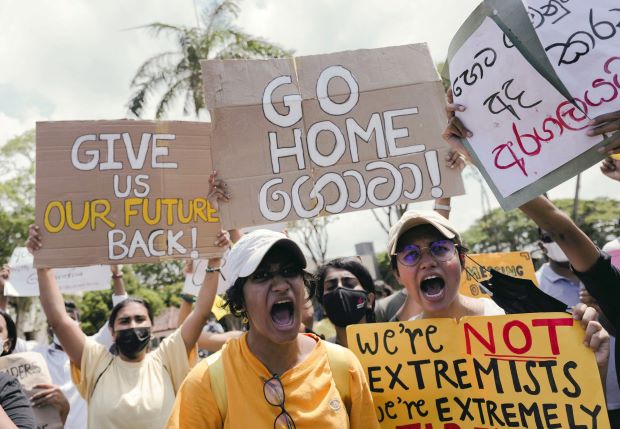
COLOMBO – Sri Lanka’s Supreme Court has ruled that former Senior Deputy Inspector General of Police (DIG) Deshabandu Tennakoon and another senior police officer violated the fundamental rights of social activist Anuruddha Bandara through his arbitrary arrest during the 2022 ‘Aragalaya’ protest movement.
The judgment was delivered on Thursday (23) following hearings of a fundamental rights petition filed by Bandara over his arrest on April 2, 2022.
The petition was heard before a three-judge bench comprising Justices Janak de Silva, Menaka Wijesundera and Sobitha Rajakaruna, with Justice Rajakaruna delivering the unanimous judgment.
Bandara told the court that officers attached to the Colombo North Special Investigation Unit searched his residence, seized his passport and examined his mobile phone, laptop, email account and social media profiles before questioning him about posts related to the ‘GoHomeGota2022’ campaign and a peaceful protest planned for April 3, 2022.
He alleged that he was arrested without reasonable grounds on the basis that his Facebook posts were critical of the government. He was subsequently taken to several police locations, including Mutwal Police Station, the Colombo Crimes Division and the Criminal Investigation Department, where he was detained for about 24 hours before being produced before the Colombo Additional Magistrate in the early hours of April 3 and released on bail.
Bandara later petitioned the Supreme Court, alleging that his arrest and detention violated his fundamental rights.
In its ruling, the court held that Tennakoon, who was serving as Senior DIG in charge of the Western Province at the time, and Nalin Priyantha, then Officer-in-Charge of the Colombo North Special Investigation Unit, had acted arbitrarily and abused their police powers in ordering and carrying out the arrest.
The bench found that police lacked reasonable grounds to arrest the petitioner and concluded that the arrest was motivated by Bandara’s political dissent and criticism of the government rather than any legitimate criminal investigation.
The court noted that the arrest had been made under Section 120 of the Penal Code, which relates to offences against the State, but found there was no material before the court to establish reasonable suspicion or evidence that Bandara had committed an offence under that provision.
The judgment held that an arrest under Section 120 must be supported by reasonable suspicion based on credible evidence, and that the respondents had failed to satisfy that legal threshold.
The Supreme Court ruled that the arbitrary arrest violated Bandara’s right to freedom from arbitrary arrest and detention under Article 13(1) of the Constitution, as well as his right to the equal protection of the law under Article 12(1).
President’s Counsel Saliya Peiris appeared for the petitioner, while Senior State Counsel Sajith Bandara represented the respondents.
-ENCL

Comments are closed, but trackbacks and pingbacks are open.