

Sri Lanka protests oppose contentious judicial reforms

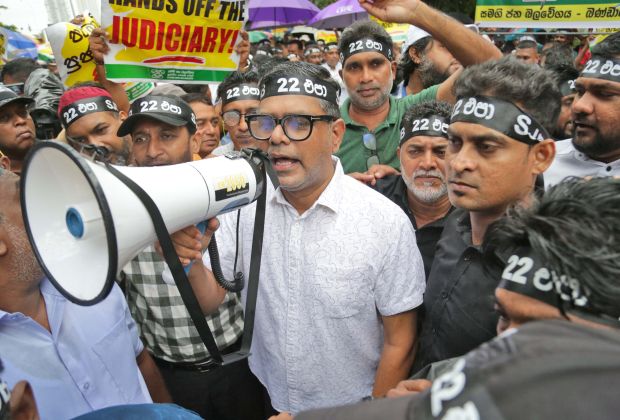
COLOMBO – Sri Lanka’s main opposition took to the streets on Thursday (24) to protest against judicial reforms, including raising the retirement age for judges, that the government says are needed to reduce legal delays.
Opposition leader Sajith Premadasa told thousands of supporters outside Parliament that the legislation proposed by President Anura Kumara Dissanayake’s left-wing administration would “annihilate” judicial independence.
The government unveiled two Bills in August to increase the number of courthouses, create new appellate courts outside the capital, raise the retirement age of all judges by two years and recruit additional magistrates and staff.
Increasing the mandatory retirement age of superior court judges requires a constitutional amendment, which can be passed by a two-thirds parliamentary majority that Dissanayake’s government enjoys.
A vote has been scheduled for Friday (25) after two days of debate.
“The 22nd Constitutional Amendment is being executed to destroy democracy in our country and completely annihilate the independence and freedom of the judiciary,” Premadasa said.
He said he was joining other opposition parties in seeking to defeat the constitutional amendment “in the minds of the people”, even if they do not have the votes in Parliament to achieve it in practice.
The government has argued that the reforms are necessary to clear a backlog of 1.1 million cases.
Criminal proceedings usually take more than 17 years, while civil cases can take generations to conclude.
Sri Lanka’s influential Bar Association has also opposed the constitutional amendment, calling it an attempt to prolong the tenure of Chief Justice Preethi Padman Surasena.
Surasena, 64, is due to retire in November unless his term is extended under the 22nd Amendment.
Dissanayake told the association in August that he planned to recruit 10,000 police constables, hundreds of forensic staff and court clerks in a bid to speed up the criminal justice system.
“This is part of a much broader process,” Dissanayake said. “It forms part of an approach that looks at the entire process, beginning with investigations and continuing through the judicial process.”
Several opposition parties have accused Surasena, who was elevated to chief justice in 2025, of being biased in favour of the government.
Dissanayake’s administration denies the claim, as well as accusations that it seeks to influence the judiciary, saying that the changes are needed to improve efficiency and reduce delays.
The judicial overhaul comes as the authorities intensify corruption investigations involving former president Mahinda Rajapaksa and members of his family.
They deny any wrongdoing.
-AFP

Comments are closed, but trackbacks and pingbacks are open.