

Chemmani mass grave toll rises to 262 as excavations resume

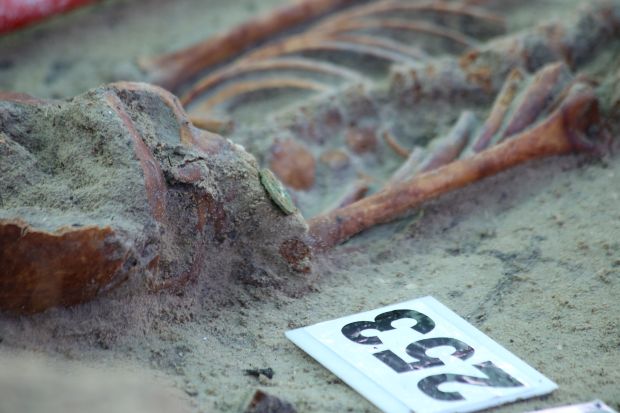
COLOMBO – The court-supervised excavations at the Chemmani-Siththupathy mass grave site in Jaffna resumed on Monday (June 1), with investigators uncovering another human skeleton and bringing the total number of skeletal remains identified at the site to 262.
The latest discovery came on the thirteenth day of excavation activities, following a temporary suspension after the completion of the first twelve days of work under the third phase of investigations.
Legal experts monitoring the excavations said one additional set of human remains was formally identified on the first day after operations resumed. Of the 262 skeletal remains identified at the site so far, 260 have now been fully excavated.
Investigators also recovered a new artefact associated with the latest skeleton, bringing the total number of artefacts discovered at the site to 99.
Among the items recovered was a neck chain bearing a coin-shaped pendant. Legal experts at the site stated that further examination of the artefact may assist efforts to establish the identity of the victim.
A complete coconut shell was also found alongside the newly uncovered remains.
Officials noted that several additional skeletal remains partially exposed during Monday’s excavation have yet to be formally identified, documented and catalogued.
The current phase of excavations resumed on Monday after work was temporarily halted in early May following the completion of the initial twelve days of operations under the third phase of the investigation.
This latest stage began on April 28 under judicial supervision and has continued despite difficult weather conditions, including heavy rainfall and flooding within sections of the excavation zone.
The Chemmani mass grave has become one of the most significant mass grave investigations in the Tamil homeland. The site has attracted growing international attention as increasing numbers of human remains continue to be uncovered.
Chemmani first gained international prominence in the late 1990s following testimony by a Sri Lankan soldier who alleged that hundreds of Tamils who had disappeared in military custody had been killed and buried in the area. Although limited excavations were carried out at the time, families of the disappeared and human rights advocates have long argued that the full extent of the grave site was never properly investigated by the Sri Lankan government.
The ongoing excavations have renewed calls from families of the disappeared, civil society organisations and international human rights groups for comprehensive forensic investigations, independent oversight and international accountability for those responsible for wartime atrocities.
As excavations continue, each newly uncovered set of remains adds to mounting evidence of large-scale abuses and reinforces demands from victims’ families for truth, justice and answers regarding those who never returned home.
-TG

Comments are closed, but trackbacks and pingbacks are open.