

Germany’s Vitra Museum opens Sri Lankan Geoffrey Bawa exhibit

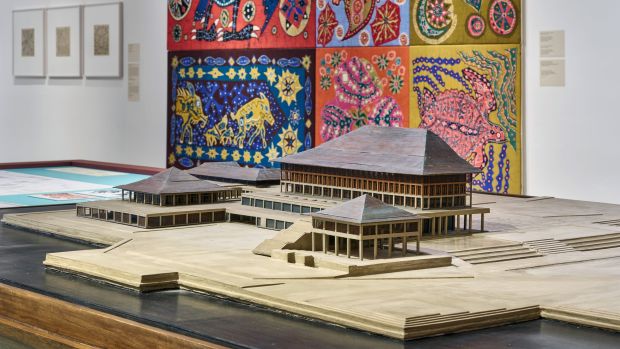
COLOMBO – The Vitra Design Museum, Germany, in partnership with the Geoffrey Bawa Trust, recently opened a major retrospective of the acclaimed Sri Lankan architect’s work.
Titled ‘Geoffrey Bawa: Architecture for the Senses’, the retrospective brings together over 250 exhibits, including drawings, models, furniture, historic footage, artworks, and photographs by Bawa as well as newly commissioned works by photographer Iwan Baan that capture the lived-in quality of some of Bawa’s most iconic buildings.
With a scenography designed by architect Lina Ghotmeh, the exhibition will transform the Vitra Design Museum into an immersive environment that evokes the sensual power of Bawa’s practice.
The exhibition officially opened on September 25 with a talk attracting an audience of over 450, and an opening day turnout of more than 500 people.
With a career spanning five decades and over 200 projects, Geoffrey Bawa (1919–2003) was one of the most influential twentieth-century architects in Asia.
His architecture blends the principles of modernism with the rich architectural history of Sri Lanka, forming a distinctive oeuvre that includes private houses, schools, hotels, and factories, as well as the National Parliament.
“Geoffrey Bawa’s work occupies a unique position in the history of modern architecture. Rooted in Sri Lanka’s multiple architectural traditions, Bawa’s work offers a compelling alternative to the western narratives that have long shaped the architectural canon. Bawa’s relevance is just being rediscovered, and the exhibition will bring him to a wider attention,” said Mateo Kries, Director of the Vitra Design Museum.
Johan Deurell, co-curator of the exhibition added that Bawa’s sensitive response to the cultural, political, and geographical conditions in which he worked, his deep understanding of how architecture engages the senses, his close collaborations with local artisans and social enterprises, and his vision of building with nature rather than against it make him an enduring inspiration for architects and designers today.
Bawa has been labelled a pioneer of Tropical Modernism, but the exhibition presents a more multi- layered perspective on Bawa’s work than this categorization might suggest.
By highlighting Bawa’s engagement with collaboration, ecology, and the cultural context of architecture, the exhibition foregrounds him as an innovator of socially responsible and sustainable building practice, whose approaches are more relevant today than ever.
The exhibition includes a large selection of objects, models, and documents from the Geoffrey Bawa Trust, alongside artworks by Ena de Silva, Laki Senanayake, and Barbara Sansoni, archival images by Sebastian Posingis and Dominic Sansoni, and newly commissioned photographs by Iwan Baan as well as films by Kavindu Sivaraj and Ruvin de Silva. Together, these works provide a contemporary perspective on the intensity of Bawa’s buildings and their powerful natural environments.
A co-production of the Vitra Design Museum, M+, and the Wüstenrot Foundation, in collaboration with the Geoffrey Bawa Trust, ‘Geoffrey Bawa: Architecture for the Senses’ will be at the Vitra Design Museum in Germany until February 28, 2027, before travelling to M+ in Hong Kong, where it will be shown from June 2027.
The Vitra Design Museum numbers among the world’s leading museums of design and is dedicated to the research and presentation of design, past and present, and examines design’s relationship to architecture, art and everyday culture. M+ is Asia’s global museum of contemporary visual culture. Located in Hong Kong, it is dedicated to collecting, exhibiting, and interpreting visual art, design and architecture, moving image, and Hong Kong visual culture of the twentieth and twenty-first centuries. The Wüstenrot Foundation is dedicated to the preservation and development of both tangible and intangible cultural heritage. The foundation’s goal is to generate momentum for new ways of thinking and acting by developing and disseminating practice-oriented models.
–EN

Comments are closed, but trackbacks and pingbacks are open.