

Kodikara Memorial Oration highlights need for more plural global order

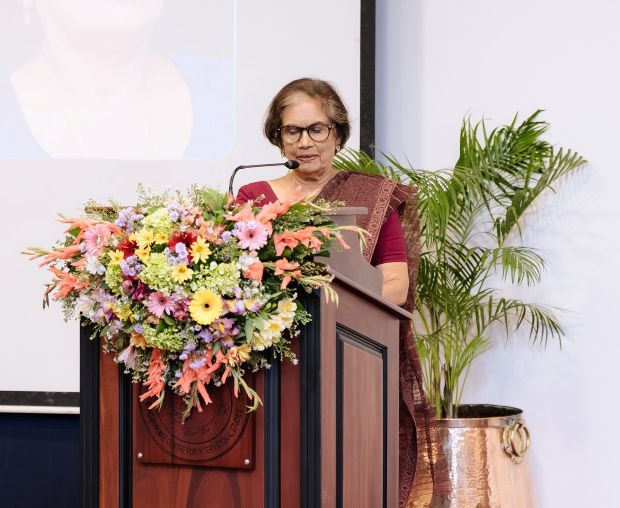
COLOMBO – Sri Lanka must adapt its foreign policy to a rapidly changing international order by embracing strategic hedging and multi-alignment while protecting the interests of smaller states, former President Chandrika Bandaranaike Kumaratunga said at the Professor Shelton U. Kodikara Memorial Oration held in Colombo.
Kumaratunga, who is Chairperson of the Bandaranaike Memorial National Foundation and the Bandaranaike Centre for International Studies (BCIS) Council of Management, was speaking as chief guest at the memorial oration organized by the Regional Centre for Strategic Studies (RCSS) in collaboration with the BCIS at the BCIS auditorium on August 8.
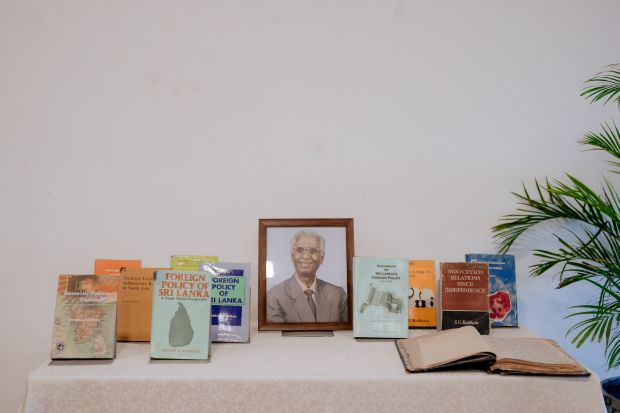
The event commemorated the late Professor Shelton U. Kodikara, regarded as a pioneer of international relations scholarship in Sri Lanka and the founder of the RCSS.
Kumaratunga said Kodikara was not merely an academic but a leader who helped shape Sri Lanka’s national intellectual identity.
She observed that during much of Sri Lanka’s post-independence history, foreign policy had been pursued largely without the benefit of a strong academic foundation, with diplomatic practice often taking precedence over scholarship.
“Prof. Kodikara changed that,” she said, stressing the continuing relevance of his work as Sri Lanka and other countries in the Global South confront an increasingly complex international environment.
She also highlighted the significance of the Fifth Summit of the Non-Aligned Movement, held in Colombo in 1976 under the chairmanship of then Prime Minister Sirimavo Bandaranaike. The 50th anniversary of the summit is to be commemorated on August 16 this year.
Kumaratunga said the established international order had been “made to stand on its head”, compelling countries of the Global South to reinterpret the traditional principle of non-alignment through contemporary strategies of strategic hedging and multi-alignment.
She said such approaches had become increasingly important as smaller and developing states sought to safeguard their national interests amid growing geopolitical and economic uncertainty.
Delivering the memorial oration, Professor Amitav Acharya, Distinguished Professor of International Relations at American University in Washington, DC, and UNESCO Chair in Transnational Challenges and Governance, paid tribute to Kodikara’s contribution to international relations scholarship in South Asia and his role as an institutional builder.
Acharya, who has long advocated broadening the study of international relations beyond its traditional Eurocentric and American-centric perspectives, drew on arguments from his latest book, ‘The Once and Future World Order: Why Global Civilization Will Survive the Decline of the West’.
Addressing the theme ‘What Comes after US Hegemony’, Acharya argued that world order should not be viewed as the product of any single nation, civilization or region, but as a shared creation shaped by the interactions and experiences of societies over thousands of years.
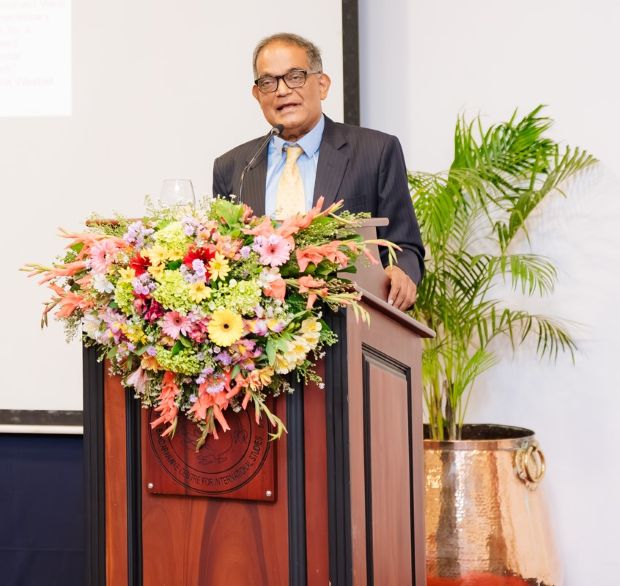
He cautioned against interpreting current global changes simply as a transition from Western to non-Western dominance.
Instead, he said the decline of Western primacy could create an opportunity for a more plural distribution of global power.
Moving beyond the conventional concept of multipolarity, Acharya described what he termed a “Global Multiplex” – a more decentralized, polycentric and pluralistic international order in which influence is distributed among major powers, middle and regional powers, international organizations and non-state actors.
In his welcome remarks, BCIS Executive Director Priyanthi Fernando described Kodikara as a “legend” and recalled his dedication to teaching and scholarship.
She said Kodikara, while serving as a lecturer at the BCIS, would travel from Kandy to Colombo specifically to conduct classes.
Fernando said that at a time when education was increasingly being delivered through hybrid and online platforms, and when acquiring certificates and diplomas could sometimes take precedence over acquiring knowledge, Kodikara’s commitment to international relations scholarship remained an example worth remembering and emulating.
Introducing the orator, RCSS Executive Director Ambassador (Retd.) Ravinatha Aryasinha highlighted Acharya’s contribution to the development of Global International Relations scholarship.
He said Acharya’s research had reshaped understanding of world order, international norms and the Global South, while continuously reinterpreting the changing dynamics of the international system.
Aryasinha also reaffirmed the RCSS’s commitment to research, dialogue and policy advocacy.
He said the participation of diplomats, public officials, academics, policymakers, students and others, including RCSS alumni and participants attending the International Studies Association South Asia conference in Sri Lanka, represented a fitting tribute to Kodikara’s enduring legacy.
The programme began with a floral tribute to Kodikara by his son, Dilip Kodikara, a founding member of the RCSS Board of Directors, followed by the screening of a commemorative video highlighting the late professor’s life and contribution to international relations scholarship.
-ENCL

Comments are closed, but trackbacks and pingbacks are open.