

Sri Lanka’s prisons are burning again, and so is our collective conscience

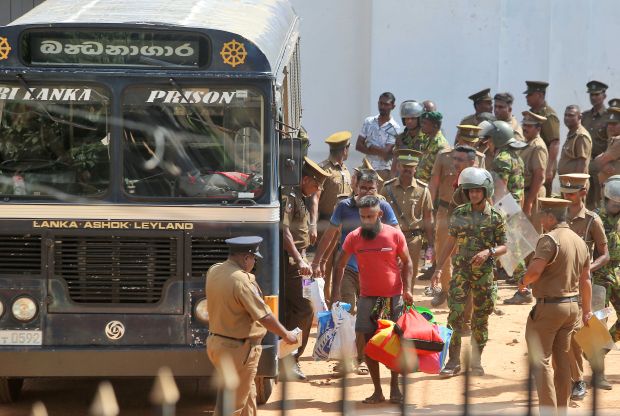
The images out of Negombo Prison this week are, by now, grimly familiar to anyone who has followed Sri Lanka’s penal history: rooftop protests, relatives massed at the gates pleading for information, Special Task Force personnel taking up positions with rifles slung, and a death toll that climbed hour by hour until it settled, officially, at 26 – seven prison officers and 19 inmates, with more than a hundred others wounded. Justice Minister Harshana Nanayakkara has visited the site, expressed shock, accepted “responsibility”, and announced a cabinet-appointed committee under retired Supreme Court Justice Priyantha Fernando. Roughly 700 inmates have been dispersed to prisons around the country. The Colombo Crime Division and the CID are investigating. All of this is necessary. None of it is sufficient.
What happened over Sunday (5) and Monday (6) was not a single riot but an escalation. Sunday afternoon’s clash between remand prisoners and convicted inmates, reportedly triggered by a dispute over the exposure of a drug trafficking network operating inside the prison, left two dead and dozens injured. By Sunday night, it had metastasized into something far larger: rival groups fighting for control, cells forced open, a prison dispensary raided for painkillers, female inmates staging a rooftop protest, and by Monday morning, guards being killed as they tried to intervene. Officials say CCTV systems and a body scanner were destroyed in the process, evidence, if any were needed, that this was not a spontaneous brawl but a systemic collapse of control inside a facility holding thousands of people the state is legally and morally obliged to keep safe.
None of this is new. Sri Lanka’s prisons have periodically erupted into lethal violence for more than four decades, and each episode carries the DNA of the one before it. In 1983, at the height of Black July, Sinhalese inmates at Welikada Prison, reportedly with the complicity or indifference of guards, massacred 53 Tamil detainees over two days, an atrocity that deepened ethnic alienation and helped accelerate the slide into civil war.
In 2012, another Welikada riot during a Special Task Force search for weapons and contraband left 27 prisoners dead after inmates seized arms from the prison armoury; convictions took a decade and applied to only a fraction of the victims.
In 2020, at Mahara Prison, fear of COVID-19 and rumours about the treatment of infected inmates sparked protests that guards suppressed with gunfire, killing 11.
Each time, the pattern repeats: a public inquiry is announced, a handful of officials are reprimanded years later, and the underlying conditions are left untouched until the next explosion.
Those underlying conditions are not a mystery. Sri Lanka’s prisons hold somewhere in the region of 40,000 inmates in a system built for roughly a quarter of that number, with occupancy rates exceeding 300% of designed capacity. A large share of that population is on remand, often for months or years, because of chronic judicial backlogs, restrictive bail practices, and the routine imprisonment of people who simply cannot pay fines.
Overcrowding of this scale is not merely uncomfortable; it is combustible. It concentrates rival gangs and drug networks in close quarters, overwhelms an understaffed and under-resourced prison service, and turns ordinary disputes into the kind of organized, weapons-grade violence we saw at Negombo.
This is where government culpability becomes unavoidable. Every administration since 1983, across party lines, across the war and the peace that followed it, has known these numbers and known this history, and none has treated prison reform as a governance priority rather than a crisis-management exercise.
A minister accepting “responsibility” after the fact, without a credible account of why security and monitoring systems failed so completely that inmates could dismantle CCTV networks and storm an armoury-adjacent dispensary, is not accountability; it is a press statement. Real accountability requires answering uncomfortable questions: why was intelligence on an active drug-trafficking dispute inside the prison not acted on before it turned lethal? Why, after 2012 and 2020, were the same structural vulnerabilities… inadequate staffing, porous security, unresolved contraband networks… still in place in 2026?
There is also a harder conversation that Sri Lankan society tends to avoid: the excessive and sometimes lethal use of force by security personnel inside prisons, and the rights of prisoners more broadly. Human rights groups have documented, after previous riots, allegations of beatings and disproportionate force used to restore order rather than to protect life.
Remand prisoners, in particular, many of them unconvicted, some held for minor or fine-defaultable offences, are entitled to due process, humane conditions, and protection from violence, whether from other inmates or from the state’s own officers. A society that only thinks about its prisoners’ rights when they are dying in a riot has already failed them. Prisons exist, in principle, to rehabilitate and to hold people safely while justice is done, not simply to warehouse and forget. When we treat incarceration purely as containment, we should not be surprised when containment fails.
What is needed now goes well beyond another commission of inquiry, however credible its chair. It requires an honest accounting of why remand populations remain so large; urgent investment in staffing, infrastructure, and rehabilitation programming rather than reactive transfers between overcrowded facilities; independent oversight of the use of force inside prisons; and a judiciary empowered to move cases faster so that “temporary” pretrial detention stops functioning as a de facto sentence.
Above all, it requires political will that survives past the news cycle. Because Negombo will not be the last riot if the only lesson we take from it is how to manage the next one.
-ENCL

Comments are closed, but trackbacks and pingbacks are open.