

Vasudeva urges Sallay to end hunger strike, pursue legal remedies

By K. Sivalingamoorthy
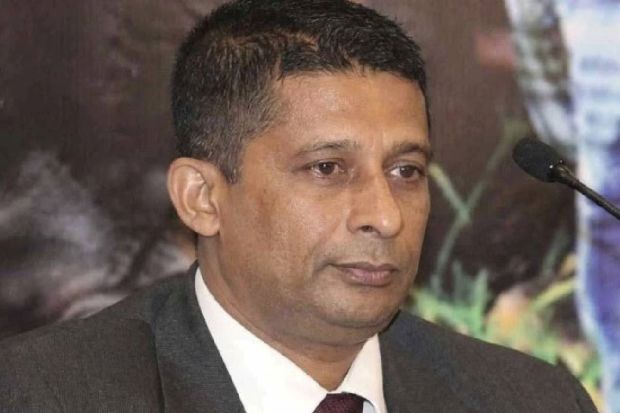
COLOMBO – Veteran politician and former Member of Parliament Vasudeva Nanayakkara on Monday (15) urged retired Major General Suresh Sallay to immediately end his hunger strike, emphasizing that the former intelligence chief must prioritize his survival to pursue legal recourse against alleged injustices suffered in custody.
Speaking at a press briefing in Colombo, Nanayakkara stated that while legal avenues exist to address claims of mistreatment, they can only be pursued if Sallay remains alive and medically stable. Sallay’s family recently reported that his health has severely deteriorated, requiring hospitalization during his detention.
“There are legal remedies available to take action against officials found to have subjected him to alleged degrading or abusive treatment while in custody,” Nanayakkara said. “But to pursue those remedies, he must first survive. That is why I urge Sallay to end his hunger strike, obtain medical treatment, recover physically, and then move his grievances through the courts.”
Nanayakkara criticized the ongoing political confrontation surrounding Sallay’s arrest and subsequent investigations into the 2019 Easter Sunday attacks, arguing that the case has been heavily politicized by rival political factions and mainstream media, leading to nationwide confusion.
According to Nanayakkara, the public is being subjected to two conflicting political narratives with one camp alleging that the Easter Sunday attacks were orchestrated under Sallay’s guidance to facilitate former President Gotabaya Rajapaksa’s rise to power, and the opposing camp contending that Sallay’s arrest was a calculated move designed to falsely implicate Rajapaksa.
“Because these rival political camps are at odds, an avoidable state of confusion has developed nationwide,” Nanayakkara noted, adding that the matter should have been processed as a routine criminal inquiry. “Sallay should have been produced before a court, and based on his testimony and the evidence, the court could then decide the next steps,” he said,
Noting that numerous senior military officers have faced investigation, detention, and punishment in the past without triggering such immense political controversy, he cautioned that generating outside political turmoil undermines the judiciary and drags independent legal processes into the political arena.
Nanayakkara also defended the current administration’s right to appoint key law enforcement officials, addressing opposition criticism regarding the appointments of figures such as Ravi Seneviratne and Shani Abeysekera to high-profile investigative positions.
“No government appoints people it does not trust to high office,” he said, stating that complaints over these assignments are counterproductive.
Addressing reports that investigators have demanded the password to Sallay’s personal computer, Nanayakkara suggested a conditional approach to the request, noting that if Sallay is unable or unwilling to provide the password due to the sensitive nature of his past intelligence work, he should formally state his reasons to the authorities.
“He might fear that, if he provides the password, officials could seize and misuse those materials for political ends,” Nanayakkara observed. “If so, he should state that and specify secure, lawful procedures by which relevant data can be examined without risking misuse.”
Nanayakkara reiterated that while custodial harassment and rights violations have historically occurred and can never be condoned, the appropriate venue for accountability remains the judiciary, rather than public political standoffs.
-ENCL

Comments are closed, but trackbacks and pingbacks are open.