

When the story is the struggle

Journalism and storytelling in a time of genocide
By Hana Ibrahim
In a humanitarian crisis, journalism is never just information. It is an argument – about whose lives are visible, whose suffering counts, and who gets to tell the story. Nowhere in recent memory has this been more starkly illustrated than in Gaza and Palestine, where the act of reporting has become inseparable from the act of survival, resistance, and historical reckoning.
Journalism’s oldest and most essential function is to document what power would prefer to leave invisible. In conflict zones and humanitarian emergencies, this means bearing witness not only to the scale of destruction but to its human texture – the names, the faces, the testimonies that refuse to let mass suffering be reduced to a statistic.
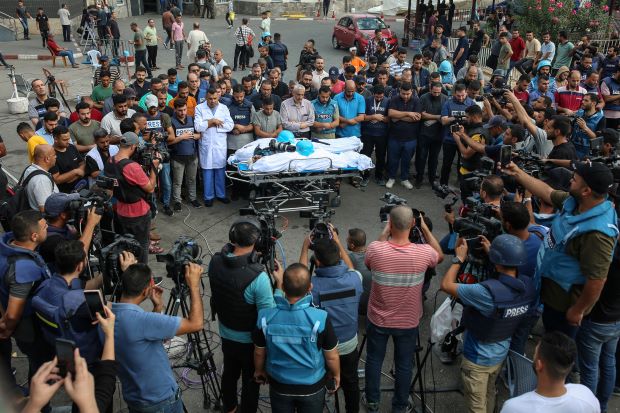
In Gaza, local journalists have continued to report under bombardment, working with disrupted communications, destroyed equipment, and the constant threat to their own lives. Their work is not only professional, but it is also, in the most literal sense, an act of resistance against erasure. When a journalist photographs a family pulling children from rubble, or records a doctor describing what it means to perform surgery by torchlight, they are making a moral argument: that these lives matter, that this moment must be recorded, that the world has no excuse for ignorance.
The act of naming victims, gathering testimonies, and putting faces to numbers is not a minor editorial choice. It is a direct counter to the abstraction that war relies upon – the language of ‘collateral damage’, ‘target acquisition’, and ‘conflict zones’ that strips human beings of their particularity and, in doing so, their claim on our conscience.
The Human Cost
Gaza has become one of the deadliest conflicts for journalists in modern recorded history. The number of reporters killed in a compressed period of time is, by most accounts, historically unprecedented. That fact alone demands reflection – not only as a press freedom issue, but as a question about what it means when the witnesses themselves become casualties.
Many of those killed were not foreign correspondents embedded with military units. They were local journalists reporting from within their own communities, their own families, their own streets. The line between witness and victim dissolved. A journalist covering the destruction of a neighbourhood was, in many cases, also watching his own neighbourhood being destroyed.
This proximity is not incidental. It shapes the nature of the journalism produced, more immediate, more personal, more unguarded than the distanced reporting that Western audiences are typically accustomed to. But it also means that the death of a journalist in Gaza is not only the loss of a professional. It is the silencing of a community’s voice and the creation of an irreplaceable gap in the historical record.
The destruction of physical media infrastructure, offices, internet cables, and electricity operates as a parallel form of silencing. When the tools of documentation are systematically destroyed alongside the people who use them, it becomes difficult to avoid the conclusion that the erasure of the record is itself part of the strategy.
Storytelling
Personal stories are not soft journalism. In a crisis, they are often the most politically potent form of truth-telling available.
Stories of families separated and reunited, of doctors performing miracles under impossible conditions, of teachers holding classes in shelters, of poets writing on scraps of paper in the dark, these narratives resist the dehumanising vocabulary that war manufactures. They restore individuality to people who have been classified, counted, and dismissed. They make it harder to look away.
Palestinian journalists and civilians have used social media platforms to bypass the traditional gatekeepers of international media, editors, wire services, and foreign correspondents flown in from distant cities. This direct-to-audience model of reporting has introduced millions of people to voices and perspectives that would otherwise never reach them, and in doing so has fundamentally challenged the framing that dominant Western media institutions have long applied to the Palestinian story.
The results have been significant. Mainstream outlets, confronted with the gap between their own coverage and the raw testimony circulating online, have been forced to reckon with their own editorial blind spots. Diaspora communities – Palestinian, Arab, and beyond – have acted as translators, validators, and amplifiers of on-the-ground reporting, bridging local truth and global audiences in ways that traditional journalism rarely manages.
The Politics
Words are not neutral. In journalism, every editorial choice, what to name, how to describe, whose perspective to centre, constitutes an implicit argument about reality.
In coverage of Gaza, these choices have been under sustained and legitimate scrutiny. The difference between writing that someone was ‘killed’ and that they ‘died’ is not grammatical; it is a question of agency and responsibility. The choice between ‘terrorist’ and ‘militant’, between ‘conflict’ and ‘siege’, between ‘attack’ and ‘retaliation’ does not merely describe events; it assigns moral weight to them. And the way that weight has been assigned, critics have argued, has not been consistent across conflicts or across the identities of the people involved.
Western media have faced sustained criticism for what has been called asymmetric empathy: the application of different emotional registers, different linguistic norms, and different standards of documentation depending on whether victims are Western or not, white or not, proximate to Western political interests or not. This is not a new critique; it has been levelled for decades. But the visibility and speed of social media have made the inconsistencies harder to ignore and easier to demonstrate in real time.
Journalism ethics have always demanded even-handedness. Humanitarian crises are where that demand is tested most severely, and where the cost of failure is highest.
Access and Censorship
Restrictions on foreign press entering Gaza have placed a disproportionate burden on local Palestinian journalists, who have become the primary, and in some periods the only, source of on-the-ground reporting. This is not a neutral arrangement. It means that the international community’s understanding of events has depended almost entirely on the journalists most at risk, working under the most constrained conditions, with the least institutional support.
The physical destruction of media infrastructure, buildings that housed news organizations, internet connections, and power supplies, has compounded this problem. Journalism requires tools; when those tools are destroyed, so is the capacity to document.
Social media platforms have introduced a further layer of complexity. Multiple investigations and firsthand accounts have alleged that Palestinian content – video testimony, news reporting, personal documentation – has been subject to algorithmic suppression, with posts being removed, accounts restricted, and content downranked without clear explanation. The question of who controls the information ecosystem, and how that control is exercised during a crisis, is not a secondary concern. It is central to the question of what the public is able to know.
Journalism in a humanitarian crisis does more than inform the present. It builds the evidentiary foundation on which future accountability depends.
The documentation work of journalists and human rights organizations in Gaza, including photographs, video footage, testimony, and geolocation data, constitutes the raw material of legal proceedings. Cases brought before the International Court of Justice, investigations by UN bodies, and future war crimes tribunals all rely on the kind of meticulous, courageous documentation that reporters produce under fire. Without it, accountability becomes impossible. With it, it becomes at least conceivable.
There is also the question of historical memory. What is recorded now shapes what future generations will understand to have happened. Events that are photographed, filmed, and written about in detail are harder to deny, harder to minimize, and harder to revise. The archive is not a passive thing; it is an argument that reaches forward in time, insisting on the reality of what occurred.
Objectivity and Emotional Truth
The question of objectivity in crisis journalism is genuinely difficult, and it deserves honest engagement rather than simple resolution.
The traditional model of journalistic neutrality, presenting ‘both sides’, maintaining emotional distance, avoiding the appearance of advocacy, was developed largely in contexts of relative political symmetry. When one party to a conflict holds vastly more military power, economic resources, and international political support than the other, the mechanical application of ‘both sides’ framing can itself become a form of distortion, implying an equivalence that does not exist.
This does not mean that accuracy and fairness are dispensable. They are not. But it does mean that the question of what ‘objectivity’ requires in conditions of extreme asymmetry is worth asking seriously, rather than treating it as already settled.
Emotional truth is not the enemy of accuracy. Reporting that centres grief, love, fear, and ordinary human life alongside the facts of destruction and displacement is not biased; it is more complete. Trauma-informed journalism recognizes that the experience of covering atrocity takes a psychological toll on reporters and affects what they are able to see and say, and that this must be accounted for in how we understand and evaluate their work.
Power of the Individual Story
Individual stories travel further than aggregate data. This is not a weakness of human attention; it is a feature of how human empathy works. A statistic describing thousands of deaths is almost impossible to hold in the mind. A single story, of a child, a doctor, a grandmother, a poet, is not.
The reporting from Gaza has galvanized protest movements on university campuses and city streets across the world, generated sustained policy debates in parliaments and international institutions, and produced a shift in public opinion in many countries that political analysts are still trying to fully account for. This is journalism doing exactly what it is supposed to do: making distant suffering impossible to ignore.
The diaspora has been an integral part of this process. Palestinian communities living outside Gaza and the West Bank have brought linguistic fluency, contextual knowledge, and personal connection to the work of translating and amplifying local testimony for international audiences. They have also provided a check on the tendency of international media to parachute into a crisis without the background necessary to report it accurately.
None of this is purely a matter for journalists. Audiences bear responsibility too.
Media literacy, the capacity to identify who funds a news organisation, to notice what a story leaves out as well as what it includes, to understand how framing shapes meaning, is not an optional extra in the contemporary information environment. It is a civic necessity. To consume journalism passively, without asking how it was produced and in whose interest, is to abdicate a form of democratic responsibility.
This is especially true in a humanitarian crisis, where the stakes of misunderstanding are highest, and the incentives for manipulation are greatest. Sharing journalism critically, asking questions about it, contextualising it, seeking out sources from multiple perspectives and especially from those closest to the events, is itself a form of participation in the humanitarian record.
Whose Story Is This?
The journalism produced from Gaza and Palestine over recent years has been, in the most demanding circumstances imaginable, some of the most significant and morally urgent reporting of our time. It has been produced at enormous personal cost by local journalists who have refused to stop bearing witness even as the conditions for doing so have been systematically destroyed.
It has also exposed, with uncomfortable clarity, the ways in which the international media ecosystem, its editorial norms, its political alignments, its ownership structures, and its algorithmic platforms shape what the world is able to know and care about. That exposure is itself a contribution to the ongoing project of improving journalism and holding it to its own stated standards.
The core tension does not resolve neatly. Journalism in a humanitarian crisis is never simply a technical matter of accurate reporting. It is a struggle over representation, over memory, over the question of whose lives are deemed worth mourning. The best journalism acknowledges this struggle and enters it honestly, not as an advocate for a predetermined conclusion, but as a committed witness to the full complexity of what is happening to human beings.
That commitment, to see clearly, to record faithfully, and to insist that the record matters, is what distinguishes journalism, at its best, from the noise that surrounds it.
-ENCL

Comments are closed, but trackbacks and pingbacks are open.