

Sri Lanka backs housing scheme for parents of Buddhist clergy

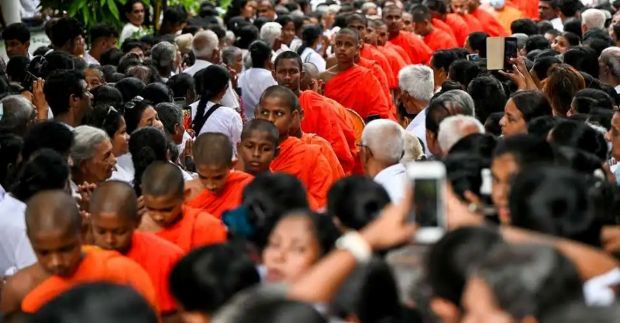
Cabinet approves 1,000-home project, citing state duty to safeguard and foster Buddhism
COLOMBO – The Sri Lankan government has approved a national housing scheme to provide permanent homes for parents who have offered their children to the Buddhist priesthood, recognizing their sacrifices and supporting their dignity and well-being.
Foreign Minister Vijitha Herath confirmed on Tuesday (17) that the cabinet approved the implementation of the ‘Yathiwara Mapiya Niwahana National Program’, a housing initiative to support economically disadvantaged parents who lack permanent dwellings and have dedicated their children to the Buddhist order.
The government said the project is expected to provide permanent homes to low-income parents currently living in cadjan houses (woven-mat abodes made from coconut palm leaves), offering them greater security.
Herath told the media that the government is committed to supporting families who help preserve Buddhism through their children’s dedication.
The decision underscores the privileged constitutional status of Buddhism in Sri Lanka and reflects the government’s broader effort to support families that sustain the country’s majority religion.
While Sri Lanka is multi-religious, the Constitution grants Buddhism the ‘foremost place’ and requires the state to protect and promote it while ensuring the rights of all faiths.
In the initial phase, 1,000 houses will be built across all districts. Each house will be constructed with financial assistance of 1.5 million Sri Lankan rupees (US$4,833), Herath said.
Of Sri Lanka’s 21 million people, about 70% are Buddhists, 13% Hindu, 10% Muslim and 7% Christian.
The cabinet approved a joint resolution submitted by the minister of Buddhasasana, Religious and Cultural Affairs and the minister of Housing, Construction and Water Supply to implement the project.
Several years ago, two brothers, Ven. Kadawatha Saddhamathi Thera and Ven. Kadawatha Samudra Thera, who were studying at a pirivena, or Buddhist monastic college, spent their evenings making bricks to build a house for their abandoned mother. Media coverage later drew public support, enabling the construction of a new home.
Nimal Charith, a member of an interreligious group in the capital Colombo, said the group has previously built three houses for Catholic priests and nuns before ordination, with the help of Caritas, the Catholic Church’s social service arm, and parishioners.
“Some parish priests were helped by carpenters, masons and workers, as well as through donations of construction materials, to build new houses,” said Charith, who is also a member of the Legion of Mary.
He welcomed the government’s initiative and said he hoped followers of other religions would extend similar assistance to those in need.
A senior Catholic priest from the Archdiocese of Colombo, who requested anonymity, said parents sometimes offer their only son to the Catholic or Buddhist priesthood, and in such cases, their poor families often require financial or material assistance.
“It is the responsibility of all people to safeguard their religious leaders,” the priest told UCA News.
Nipuni Saroja, a Buddhist mother of a monk from Kurunegala, the capital of the Northwestern Province, said allowing a son to become a priest is difficult today, as he is often the family’s prospective breadwinner and protector.
“Families used to have four or five children, but now they have only one or two, and that makes it very difficult for parents to offer a child to the clergy,” she said.
-UCAN

Comments are closed, but trackbacks and pingbacks are open.