

Trump rescinds Canada’s invitation to join his ‘Board of Peace’

By Chris Cameron and Matina Stevis Gridneff
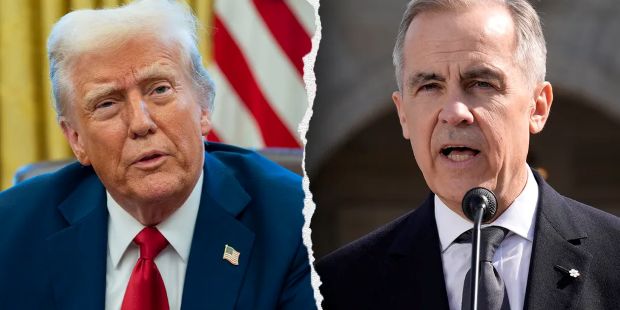
WASHNGTON – President Donald Trump rescinded on Thursday (22) his invitation for Prime Minister Mark Carney of Canada to join his ‘Board of Peace’, an organization that he had founded to oversee a peace deal between Israel and Hamas in the Gaza Strip but that he has now tried to broaden into an institution to rival the United Nations.
In a high-profile speech at the World Economic Forum on Tuesday (20), Carney had urged leaders of smaller nations to band together to resist Trump’s America First doctrine and his efforts to dismantle the post-World War II international order. On Thursday, hours before Trump’s announcement, Carney went further, denouncing “authoritarianism and exclusion” in a speech that appeared to be referencing the president.
Though Trump did not explain why he was rescinding the invitation, Trump, who often lashes out against leaders who publicly defy him, appeared to be reacting to Carney’s candid remarks. In a similar episode months earlier, Trump sought to punish Canada with additional tariffs because of a Canadian television ad that quoted former President Ronald Reagan denouncing tariffs.
“Please let this Letter serve to represent that the Board of Peace is withdrawing its invitation to you regarding Canada’s joining, what will be, the most prestigious Board of Leaders ever assembled, at any time,” Trump wrote in a social media post framed as a letter to Carney.
The Canadian leader had received an invitation to the Board of Peace last week, and his staff had said he was planning to accept. But he quickly distanced himself from the offer after it emerged that Trump would charge members more than $1 billion in exchange for a permanent seat in the organization, and that other Western leaders such as France’s Emmanuel Macron, had declined to join.
Trump’s public snub of Carney was the latest blow to relations between the United States and Canada, which had long been close — though there were serious challenges during Trump’s first term. In the year since Trump’s return to power, he has taken a particularly aggressive stance against the northern neighbour, which has rankled Canada’s government and enraged its citizens.
The president has at times waged a trade war, threatened to annex Canada as the 51st state and lobbed harsh language at Carney and other Canadian officials amid negotiations over tariffs and other issues. Economic ties have also been significantly harmed: Canadians, who have historically formed a large share of international tourists in the United States, are boycotting American travel destinations and imported American products.
The diplomatic downward spiral bodes ill for the renegotiation of the USMCA, the free-trade agreement among Canada, the United States and Mexico that underpins trade and supply chains across the continent. The fate of that agreement, reached during the first Trump administration, is very much up in the air.
Trump rescinding the invitation to Carney was also the latest sign that the Board of Peace would be anything but a typical international organization, where disagreement and open discourse among member states is tolerated or even encouraged. Its charter grants Trump, the chair of the organization, outsized power, including the authority to veto decisions, approve the agenda, invite and remove members, dissolve the board entirely and designate his successor.
The founding of the board comes as Trump advances an imperialist vision of American foreign policy, where the United States could overthrow governments, seize foreign territory and resources and dominate neighbouring countries “whether they like it or not.” The Trump administration has also largely shunned coalition-building and the consensus of nations typically sought among international organizations such as the United Nations and NATO.
Carney and Trump had in the past enjoyed a cordial relationship. But Carney’s speech in Davos appears to have marked a turning point: he did not once mention Trump or the United States, and described in stark, dark terms what he called a “rupture” from the US-led global order. Carney called on middle powers — nations like Canada that are not strong enough to rival the United States or China on their own — to unite, lest they be at the mercy of greater powers, warning that “if we’re not at the table, we’re on the menu.”
Trump, speaking a day later, briefly referenced Carney’s speech. “I watched your prime minister yesterday. He wasn’t so grateful, but they should be grateful to us. Canada lives because of the United States,” the president said in Davos.
“Remember that, Mark, the next time you make your statements,” he added.
Carney pushed back Thursday in a national address. “Canada and the United States have built a remarkable partnership. In the economy, in security and in rich cultural exchange. But Canada doesn’t live because of the United States,” he said.
Carney added, “Canada thrives because we are Canadian.”
-New York Times

Comments are closed, but trackbacks and pingbacks are open.