

Ditwah redefined disaster; Sri Lanka must redefine preparedness

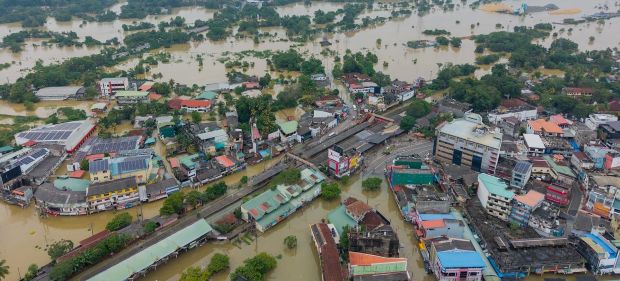
Cyclone Ditwah has left behind an immense trail of death and destruction across Sri Lanka – deadly landslides, entire families buried under collapsing earth, hundreds dead and hundreds more still missing, roads washed away, homes inundated, and communities stranded for days without food, clean water, or medical assistance. Even as rains subside and floodwaters gradually recede, new dangers continue to emerge. Water levels in the Kelani River remain critically high, posing a severe and immediate threat to the Colombo District, where overflowing banks could unleash yet another wave of displacement and destruction in the country’s most densely populated region.
This is not an isolated regional disaster. From the Central Hills to the South, from the Western Province to the North-Western and Eastern regions, Ditwah’s fury cut across the entire island, marking one of the most widespread and devastating natural calamities in recent memory.
What remains now are the painful realities of a nation in shock, mourning, and searching for answers. More than a natural disaster, Ditwah has exposed deep, long-standing structural vulnerabilities, governance failures, and societal complacency that transformed a severe weather system into a national tragedy.
In moments like these, grief and anger are both expected and justified. But Sri Lanka cannot afford to sink into the quicksand of finger-pointing, political opportunism, and short-term outrage. This is a moment that demands sober reflection, collective responsibility, and above all, a unified national effort to rebuild and prepare for the climate shocks that are certain to intensify in the coming years.
Cyclone Ditwah struck with a ferocity that tested every layer of Sri Lanka’s disaster-response system. Entire neighbourhoods were submerged within hours. Landslides swept away homes in the central hills. Major roads became impassable, leaving emergency teams struggling to reach those most in need. Power outages paralyzed communication networks, while thousands sought refuge in makeshift shelters with no clarity on when, or whether, they would be able to return home.
But beyond the chaos, Ditwah illuminated several systemic shortcomings that cannot be ignored. Sri Lanka’s disaster preparedness, though improved over the years, remains reactive rather than preventive. Early warnings were issued, but many communities lacked evacuation support. Critical infrastructure, roads, drainage systems, and housing proved inadequate. Urban planning failures, decades in the making, magnified the destruction.
Disaster science tells us that climate change is increasing the intensity of cyclonic storms globally. Sri Lanka now sits on the frontlines of a climate era marked by unpredictability and extremity. This is not the last such storm we will face. It may not even be the strongest. The question, therefore, is not only what went wrong this time, but how we can prevent the next disaster from becoming another national catastrophe.
Every government bears the ultimate responsibility of safeguarding its citizens, especially when the threat is known, predictable, and preventable. To its credit, the state machinery mobilized quickly in several areas, deploying disaster response teams, coordinating international support, and initiating evacuations. India’s rapid deployment of helicopters, naval assets, and NDRF teams under Operation Sagar Bandhu offered critical relief and saved countless lives.
Yet, these efforts, though commendable, were not enough to fully compensate for the deeper structural failures that preceded the storm.
One of the most glaring weaknesses has been disaster preparedness and risk mapping. Sri Lanka’s landslide-prone areas have been documented for years, yet families continue to live on unstable slopes without relocation options or financial support. Flood-prone districts suffer repeated devastation each monsoon season, with drainage, riverbank protection, and water-flow management remaining woefully inadequate.
Local government systems, those that stand closest to the people, also revealed significant gaps. Several communities reported receiving warnings but no assistance to evacuate. Relief supplies arrived late in many districts. Coordination between central, provincial, and local bodies broke down in key moments.
And then there is the long-standing issue of poorly planned development. The filling of marshlands for housing, the narrowing of canals, illegal construction along waterways, and the commercialization of natural flood retention areas all contributed to the scale of destruction. These are man-made vulnerabilities, and their consequences are measured in lost lives.
To move forward, the government must acknowledge these shortcomings openly, not defensively, and commit to systemic reform.
Governance is crucial, but disasters also reveal our collective attitudes. A significant portion of Sri Lanka’s vulnerability stems from how we, as a society, treat land, water, and safety.
Many people continue to build homes in high-risk zones, often against expert advice. Some resist relocation efforts due to emotional ties to land, mistrust of authorities, or economic necessity. Illegal land filling continues, often with political clout, public silence and passive acceptance. Waste disposal practices choke drains and waterways, worsening floods each year. Even after repeated tragedies, many still underestimate the gravity of disaster warnings.
This is not to blame the victims. People make decisions within the constraints of systemic failure, poverty, and lack of alternatives. But as a nation, we must recognize that disaster resilience is not only the job of the state. Communities, civil society, environmental groups, and individuals all share responsibility for preparedness, awareness, and sustainable practices.
Perhaps the most harmful and predictable development after Cyclone Ditwah has been the swift descent into political spectacle. Sections of the opposition have launched blistering attacks on the government, accusing it of incompetence, inaction, and negligence. Meanwhile, government spokespeople have responded defensively, blaming previous administrations, budget constraints, or the “unexpected” strength of the cyclone.
This cycle of accusation and denial is familiar and deeply damaging. Natural disasters should never become platforms for political point-scoring. In times of national crisis, leaders must set aside partisanship and prioritize the welfare of the people.
Both government and opposition owe the country something greater than rhetoric. The opposition’s role is vital, but it must offer constructive criticism and alternative solutions, not merely weaponize a tragedy. Similarly, the government must accept scrutiny, acknowledge failures, and demonstrate transparency.
The victims of Cyclone Ditwah deserve leadership, not theatrics.
Sri Lanka now stands at a critical juncture. The coming weeks will determine not only how well the nation recovers from this disaster, but how well it prepares for the next one.
While immediate priorities are clear – rescuing the stranded, restoring access, providing medical care, and ensuring the safety of vulnerable communities – the far more difficult and essential work lies in what comes next.
Sri Lanka needs a comprehensive national disaster-preparedness master plan that moves beyond ad-hoc responses. Cyclone Ditwah made that one truth abundantly clear. This includes strengthening early warning systems, building community alert networks and evacuation systems, enforcing environmental regulations to prevent illegal landfilling and deforestation, better drainage systems and relocating families from high-risk zones through humane, well-compensated, and consultative processes. Local government disaster units must be equipped and empowered, and climate adaptation must be integrated into every layer of national development planning.
Sri Lanka cannot afford to wait for the next storm to expose the same vulnerabilities and failures all over again
Cyclone Ditwah has tested Sri Lanka’s resilience, but it has also shown our capacity for compassion and solidarity, from volunteers who continue to wade through floodwaters to deliver food, to neighbours who opened their homes, to international partners who stepped in without hesitation.
This spirit, more than any policy document or political speech, is what will rebuild the nation.
In the end, Sri Lanka does not need a blame game. It needs a plan. It needs leadership. And most importantly, it needs unity. The waters of Ditwah will eventually recede. But the lessons it has taught us must not.
This is our chance to rebuild smarter, safer, and stronger, not as divided camps, but as one nation facing a shared future.
–ENCL

Comments are closed, but trackbacks and pingbacks are open.