

Bangladesh votes in landmark polls after deadly uprising

By Sheikh Sabiha Alam with Rasheek Mujib, Eyamin Sajid and Mohammad Mazed
DHAKA – Bangladesh voted Thursday (12) in its first election since a deadly 2024 uprising, as parties crushed under Sheikh Hasina’s rule return to the fray with a powerful political heir facing an Islamist-led coalition.
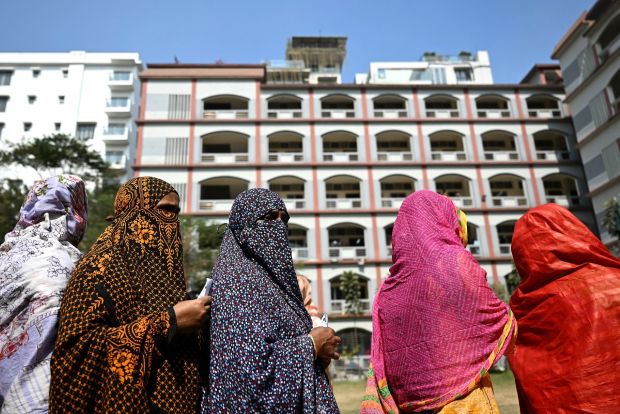
Voters lined up outside polling stations in the capital, Dhaka, in the hugely anticipated election, while key party leaders have raised fears of threats or “conspiracies” to derail the vote.
More than 300,000 soldiers and police are deployed countrywide, with UN experts warning ahead of voting of “growing intolerance, threats and attacks”, and a “tsunami of disinformation”, especially targeting millions of young first-time voters.
“This was my first vote,” said Shithi Goswami, 21, a student at Dhaka City College. “I hope after everything we went through the last few years, now is the time for something positive.”
Leading prime ministerial hopeful Tarique Rahman, 60, said he was “confident” his Bangladesh Nationalist Party (BNP) could regain power in the South Asian nation of 170 million people.
But he faces a stiff challenge from a coalition led by the Muslim-majority country’s largest Islamist party, Jamaat-e-Islami.
“If people in Bangladesh come out to cast their votes, conspiracies will not succeed,” the BNP’s Rahman said after voting.
Jamaat chief Shafiqur Rahman, 67, has mounted a disciplined grassroots campaign, and if victorious, the former political prisoner could form the first Islamist-led government in constitutionally secular Bangladesh.
Jamaat, who have campaigned on a platform of justice and ending corruption, sense their biggest opportunity in decades, with party leader Rahman saying it “will do whatever is required” to ensure a fair result.
Opinion polls vary widely, though most give the BNP the lead — with some suggesting a knife-edge race.
During campaigning, political clashes killed five people and injured more than 600, police records show.
Election Commissioner AMM Nasir Uddin said the vote was going “smoothly in a free and fair manner”, with “a few minor disruptions” – noting the main threat was a flood of disinformation on social media.
Interim leader Muhammad Yunus, who will step down once the new government takes power, has said the vote “will determine the future direction of the country”.
The 85-year-old Nobel Peace Prize winner has led the South Asian nation since Hasina’s 15-year rule ended with her ouster in August 2024.
His administration has barred her Awami League party from contesting the polls.
Hasina, 78, was sentenced to death in absentia for crimes against humanity for the bloody crackdown on protesters during her final months in power and remains in hiding in India.
Yunus, speaking after voting, said that the country had “ended the nightmare and begun a new dream.”
He has championed a sweeping democratic reform charter to overhaul what he called a “completely broken” system of government and to prevent a return to one‑party rule.
The 127 million voters are also voting in a referendum on whether to endorse proposals for prime ministerial term limits, a new upper house of parliament, stronger presidential powers and greater judicial independence.
Yeasin Arafat Emon, 25, said he had backed the charter as it “reflects the spirit of the uprising”.
Voters will elect 300 lawmakers directly, with a further 50 women chosen from party lists.
Counting by hand begins after polls close at 4:30 p.m. (1030 GMT), with first significant results expected potentially overnight.
The next government will inherit a battered economy in the world’s second-largest garment exporter, as well as delicate relations with India.
The BNP’s Rahman – whose late parents both led the country – told AFP ahead of the vote that his first priority, if elected, would be restoring security and stability.
But he warned the challenges ahead were immense, and that “the economy has been destroyed”.
– Agence France-Presse

Comments are closed, but trackbacks and pingbacks are open.