
US tanker seizures begin to draw international and domestic scrutiny

By Genevieve Glatsky
BOGOTÁ, Colombia — As the US Coast Guard continued to pursue an oil tanker in the Atlantic Ocean on Monday (22), the Trump administration made clear that its targeting of ships carrying Venezuelan oil was intended to push Nicolás Maduro, the country’s president, from power.
“We’re not just interdicting these ships, but we’re also sending a message around the world that the illegal activity that Maduro is participating in cannot stand,” Homeland Security Secretary Kristi Noem said in an interview on Fox News on Monday. “He needs to be gone.”
The campaign to interdict oil tankers is reverberating beyond the Caribbean, drawing criticism from foreign governments, warnings about threats to global energy markets and pushback inside the United States over the risk of escalation.
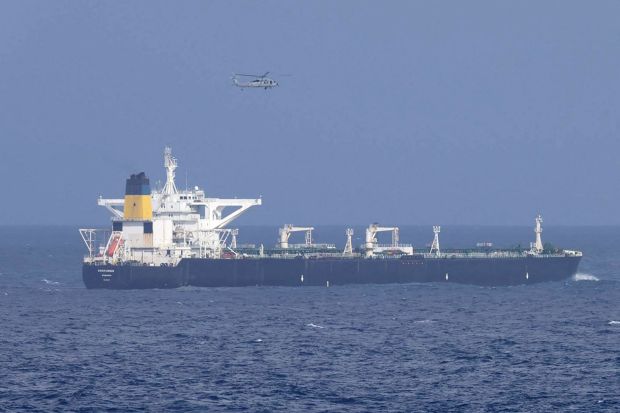
US officials say the Coast Guard on Saturday (20) attempted to intercept a tanker, Bella 1, in the Caribbean after determining that it was not flying a valid national flag, making it subject to boarding under international law. The ship did not comply, however, and continued sailing. Officials said they had obtained a seizure warrant based on the vessel’s previous involvement in the Iranian oil trade.
The Coast Guard has repeatedly tried to hail the Bella 1 and direct it to stop, but the vessel has ignored those calls, according to a US official briefed on the operation who requested anonymity to discuss the situation.
In a separate episode also on Saturday, the Coast Guard boarded the Centuries, a Panamanian-flagged tanker that had recently loaded Venezuelan crude oil, reportedly for a Chinese trader. US officials said they did not have a seizure warrant and were checking the ship’s registration, leaving unclear how long it might be detained. The United States seized a third tanker on Dec. 10, which is now at a port in Texas.
Panama’s foreign minister told a local news outlet Monday that the Centuries had violated Panama’s maritime rules by disconnecting its transponder.
Videos released by the Trump administration show US military helicopters deploying boarding teams onto tankers using ‘fast ropes’, a tactic that allows forces to land quickly with little warning, regardless of sea conditions, while helicopters and nearby aircraft provide security.
The Navy and Coast Guard have used such operations before, including in the Persian Gulf in the 1990s under a UN-authorized effort to enforce sanctions on Iraq.
China, which is the biggest importer of Venezuelan oil, condemned the continued seizure of ships in the Caribbean, calling it a serious violation of international law.
A Chinese Foreign Ministry spokesperson said Monday that Beijing opposes any actions that “infringe on the sovereignty and security of other countries, or constitute acts of unilateral bullying.”
While Venezuelan crude oil accounts for only a small share of China’s overall official oil imports, analysts say the volume is likely understated, and the seizures could still carry political weight.
With President Donald Trump focused on keeping a planned April summit with President Xi Jinping on track, any indication that China is dissatisfied with US actions could complicate deliberations inside the White House over how far to push the strategy.
President Luiz Inácio Lula da Silva of Brazil also warned against escalation, saying at a summit Saturday that an “armed intervention in Venezuela would be a humanitarian catastrophe”.
The Trump administration has accused Maduro, without providing any evidence, of sending enormous quantities of drugs to the United States and of stealing US oil assets.
Trump told reporters Monday that the United States intended to keep the 1.9 million barrels of oil that were on the first tanker that was seized. “We’re keeping it,” Trump said. “We’re keeping the ships also.”
María Corina Machado, Venezuela’s de facto opposition leader and winner of this year’s Nobel Peace Prize, told CBS News in an interview this month that she supports the seizures and has been “asking for this for years”.
Maduro, in a letter to the United Nations on Monday, said the “blockade and acts of piracy” would harm global energy supply, market stability and individual economies. The UN Security Council has scheduled an emergency meeting for Tuesday (23) to discuss Venezuela.
“Energy cannot be turned into a weapon of war or an instrument of political coercion,” he wrote in the letter, read out loud by his foreign minister.
Venezuelan Vice President Delcy Rodríguez wrote on Telegram that a ship from US energy giant Chevron had departed for the United States on Sunday carrying Venezuelan crude oil.
The shipment was made “in strict compliance with regulations and in fulfilment of the commitments assumed by our oil industry,” Rodríguez added. “Venezuela has always been, and will continue to be, respectful of national and international law.”
The seizures have also drawn criticism at home.
Sen. Rand Paul, R-Ky., said Sunday (21) on ABC that he viewed the tanker operations as “a provocation and a prelude to war.”
“Look, at any point in time, there are 20, 30 governments around the world that we don’t like,” Paul said. “But it isn’t the job of the American soldier to be the policeman of the world.”
Paul, a libertarian who routinely opposes US military intervention overseas, was one of two Republicans who joined Democrats last month in voting to block a potential attack on Venezuela.
-New York Times

Comments are closed, but trackbacks and pingbacks are open.