

The screwdriver salesperson behind Trump’s airstrikes in Nigeria

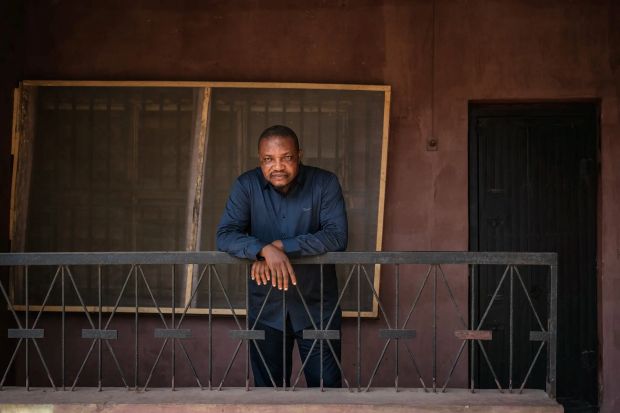
By Ruth Maclean
ONITSHA, Nigeria — In a market in southeastern Nigeria, a short man wearing one earbud recently made his way to the tool section, dodging wheelbarrows of sugar cane and porters carrying stacks of hard hats.
The man, Emeka Umeagbalasi, owns a tiny shop selling screwdrivers and wrenches in this market in Onitsha, the commercial hub of southeast Nigeria.
But this screwdriver salesperson is also an unlikely source of research that US Republican lawmakers have used to promote the misleading idea that Christians are being singled out for slaughter in Africa’s most populous nation. Sen. Ted Cruz of Texas, Rep. Riley Moore of Virginia and Rep. Chris Smith of New Jersey have all cited his work.
Armed with his ideas, President Donald Trump launched airstrikes on the other side of Umeagbalasi’s country on Christmas Day.
To Umeagbalasi, the fact that the American president had taken up a cause he had promoted was “miraculous”.
“If nothing is done,” he said in an interview from his home, “Nigeria will explode”.
Umeagbalasi says he has documented 125,000 Christian deaths in Nigeria since 2009, but told The New York Times that he often does not verify his data. He acknowledged that his research was mainly based on “secondary sources”, including Christian interest groups, Nigerian news reports and Google searches.
Cruz, Moore and Smith did not respond to requests for comment. A White House spokesperson did not address questions about Umeagbalasi’s data and methods, but said in a statement that “the massacre of Christians by radical, terrorist scum will not be tolerated”.
It is notoriously difficult to collect data on the killings, kidnappings and attacks that have wrought havoc on Nigerians for years.
The Nigerian government does not release comprehensive data on the number of people killed in violent attacks or their religions. Many attacks in Nigeria go unrecorded because they happen in remote areas and are only heard of long afterwards.
While some research shows that Christians are being killed in large numbers in Nigeria, researchers say a lack of security and widespread impunity in the most affected parts of the country endanger both Christian and Muslim Nigerians.
Umeagbalasi, who is Catholic, founded the International Society for Civil Liberties and the Rule of Law, or Intersociety, in 2008. He runs the organization out of his home. His wife, Blessing, an evangelical Christian, is a board member.
He said he has degrees in security studies and peace and conflict resolution from the National Open University of Nigeria and described himself as a very “powerful” and “knowledgeable” investigator, comparing himself with veteran CNN journalist Christiane Amanpour.
But when questioned about the accuracy of his data, establishing the religion of victims and determining the intent of perpetrators, he admitted that he rarely travels to the regions where attacks have occurred and usually assumes the victim’s religion.
Umeagbalasi has said that more than 7,000 Christians were killed in Nigeria in the first seven months of 2025. But an independent conflict-monitoring group, Armed Conflict Location and Event Data, estimates that around 6,700 people, including Islamist insurgents and military personnel, were killed in the same period. Only 3,000 of them were recorded as civilians, but that data is not disaggregated for religion.
Umeagbalasi explained that he determines the religious identity of victims based on where each attack occurs. If a mass abduction or killing happens in an area where he thinks many Christians live, he assumes the victims are Christians.
“For instance, if killings take place in Borno today, when I look at it, I will just look at the zone where the killings take place,” he said, referring to the majority-Muslim state at the heart of Boko Haram’s deadly insurgency in Nigeria. “Once they take place in southern Borno, there is a likelihood of the victims being Christians or many of them or most of them being Christians.”
Many of Boko Haram’s victims are Muslim.
He also gave the example of 25 schoolgirls recently kidnapped in the state of Kebbi. The girls were all Muslim, according to the school principal and local officials. But Umeagbalasi claimed that they were mostly Christian.
“The girls — a majority of them are Christians, but you know what the Nigerian government did?” he said. “They went and Islamized them. Gave them Islamic names just to confuse people.”
Alkasim Abdulkadir, a spokesperson for Nigeria’s foreign minister, denied that the government had misrepresented the girls’ religion. “There’s a lot of fallacy to his research, a lot of confirmation bias,” he said of Umeagbalasi. “He’s very performative.”
Umeagbalasi said he almost never travels to Nigeria’s Middle Belt, the region where violence against Christians is most intense. Instead, he said, he relies on “secondary sources” like news reports and Open Doors, a Christian advocacy group whose data has been cited by Trump.
One of his main secondary sources is Truth Nigeria, a project founded by a filmmaker and evangelist from Iowa, Judd Saul.
Like Intersociety and other Christian advocacy groups in Nigeria and the United States, Truth Nigeria frequently identifies the perpetrators of attacks on Christians in the country as “Fulani ethnic militias”. The Fulani are an ethnic group with tens of millions of mostly Muslim members, some of whom are herders whose ancestors have roamed across West Africa for centuries.
Umeagbalasi called the Fulani “animals” and said all Fulanis should be confined to one Nigerian state, a move that would be tantamount to ethnic cleansing.
Researchers, journalists and prominent Christians regularly dispute Umeagbalasi’s figures.
Nnamdi Obasi, the Nigerian adviser for the International Crisis Group, described Intersociety’s methodology as “a total blank” and said that the figures in Intersociety’s reports did not add up correctly.
“The basic addition is very, very faulty,” he said.
Bishop Matthew Hassan Kukah, the Catholic bishop of Sokoto, the northwestern Nigerian state that the United States bombed in December, said in an interview that focusing too much on the data about Christians obscured a more important issue. “Focus on the fact that this state is weak and doesn’t have the capacity to protect its people,” he said.
Umeagbalasi remains undeterred by criticism.
He flipped open his laptop, where he had almost completed work on his next report, titled, ‘The Situation of Christians in Nigeria Fuelled by Jihadist Terrorism Inches a Point of No Return’.
“This is our heavenly marathon,” he said.
He sat in his living room, its walls painted green and black. A bookshelf was crammed with old papers and plaques. One read, ‘For excellent service to humanity’.
He said close to 20,000 churches were destroyed in the past 16 years, and, he said, 100,000 churches existed in Nigeria.
There is no government data on the number of churches in Nigeria. So where did he get the 100,000 figure?
“Googled it,” he said.
-New York Times

Comments are closed, but trackbacks and pingbacks are open.