

Allies unite behind Saudi Arabia as more Iranian flights restricted

By Hatem Maher and Eman Abouhassira
CAIRO/DUBAI – Saudi, Turkish and Pakistani military chiefs are to discuss help for Saudi Arabia as it faces attacks by Yemen’s Houthis, while Iraq further curtailed Iranian flights on Friday (25), in line with US pressure, and an Iranian official threatened retaliation.
The Houthis have launched strikes on the Saudi-backed government in Yemen and repeatedly fired into Saudi Arabia, disrupting oil flows from the world’s largest energy exporter, as part of a wider Middle East war that began with US and Israeli strikes on Iran on February 28.
The military escalation continued this week despite a push during the UN General Assembly in New York to revive diplomacy to end the conflict, which quickly spread to Lebanon and the Gulf in March before escalating in Yemen in recent weeks.
With talks stalled and during a lull in direct fire by the US and Iran, Washington had shifted tactics to extend financial sanctions by targeting companies from third countries that do business with Iranian firms through “secondary sanctions”.
Iranian airlines were barred from neighbouring countries including the United Arab Emirates and Oman on Thursday (24) in response to new US sanctions, the first big impact of the shift.
On Friday, the three other Iraqi airports that operate flights to and from Iran joined Baghdad airport in suspending them, sources and state media said.
A flight ban, if sustained, could deepen Iran’s isolation and worsen an economic crisis in the country, which is already facing a US blockade of its seaports.
Mohammad Mokhber, an adviser to Iran’s supreme leader, accused regional countries of “alignment with America” for blocking flights.
“If Iran does not have the possibility to fly and receive airport services, then no country in the region will have this possibility either”, he said in a social media post.
Oil Exports Squeezed
The war, which US President Donald Trump launched alongside Israel, has killed thousands of people and disrupted global trade and energy supplies, adding to inflationary pressures.
While the fighting between the US and Iran has been stop-start, Iranian allies have mobilised, with Hezbollah attacks triggering an Israeli invasion of Lebanon and the Houthi advance in Yemen prompting a new humanitarian crisis.
Iran and its allies have significantly squeezed oil exports from Saudi Arabia, a US ally. The Houthis have disrupted ship traffic at the mouth of the Red Sea, while Iran has limited tanker traffic at the Strait of Hormuz, the conduit for 20% of the world’s oil exports before the war.
On Thursday, the Houthis said they had fired dozens of missiles and drones at Saudi targets, while Saudi authorities said they had intercepted six ballistic missiles fired by Houthi fighters.
Later, Saudi Arabia’s Grand Mufti, the kingdom’s top religious authority, called on soldiers to be ready to lay down their lives to fight the Houthis until the group was ousted from power.
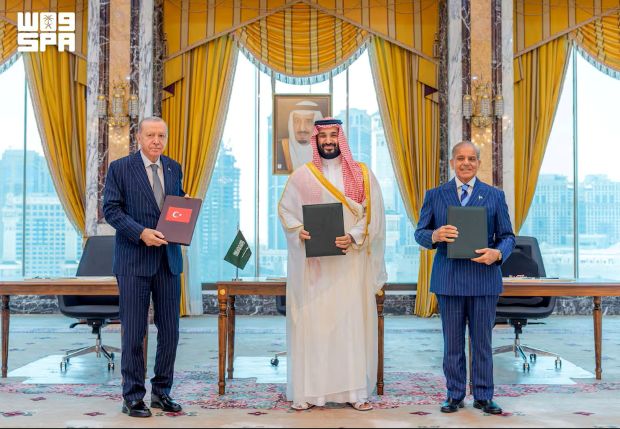
Amid the fighting, the Saudi, Pakistani and Turkish foreign ministers met on Thursday for discussions under a defence pact signed in August.
They condemned attacks targeting the holy Saudi city of Mecca and other civilian sites, while affirming Saudi Arabia’s right to defend itself and planning a meeting between chiefs of staff on ways to assist the kingdom.
Turkey’s defence ministry said Chief of General Staff General Selcuk Bayraktaroglu was travelling to Saudi Arabia on Friday to meet his Saudi and Pakistani counterparts.
Turkish President Tayyip Erdogan said the defence pact, which stipulates that an attack against one country be considered an attack against all, could lead to intelligence, logistical or ammunition support.
“More advanced military support could also be considered depending on the scale of the threat,” Erdogan said in written responses to Newsweek.
The speaker of Turkey’s parliament, which has yet to ratify the pact, said it could be expanded into a broader alliance “for the Muslim world”, including Iran.
Shuttle Diplomacy in New York
In New York, Iran’s Foreign Minister Abbas Araqchi told reporters on Thursday that Tehran had conveyed a proposal to the US via intermediaries under which the Strait of Hormuz would be reopened if Tehran’s conditions were met.
Under Iran’s proposal, hostilities would end on all fronts, including Lebanon, within seven days. The US would lift its blockade on Iranian ports, release Iran’s frozen funds and waive its oil sanctions, he said.
“The Strait of Hormuz will be reopened on the last day,” Araqchi said, adding that talks with the US on other issues, including Iran’s nuclear issue, would then start.
A senior Iranian official told Reuters on Wednesday that Tehran was reviewing Washington’s response to its peace proposals.
Oil prices fell on Friday as markets weighed the possibility of a truce, despite the number of ships recorded transiting the Strait of Hormuz dropping to nine on Thursday, half the 10-day average.
-Reuters

Comments are closed, but trackbacks and pingbacks are open.