

Trump says ‘complete disarmament’ of Hamas agreed in Gaza; Israel yet to accept

By Julian Borger
WASHINGTON – Donald Trump has declared a breakthrough in negotiations over the disarmament of Hamas in Gaza and the withdrawal of Israeli forces, issues that have so far stalled implementation of last October’s ceasefire, but Israel has yet to respond officially to the plan and government officials have voiced scepticism over the deal.
Announcing the agreement in a social media post on Thursday (30) night, Trump said it involved the “complete disarmament” of Hamas and other armed groups in Gaza and was “a monumental step toward ending the fighting”.
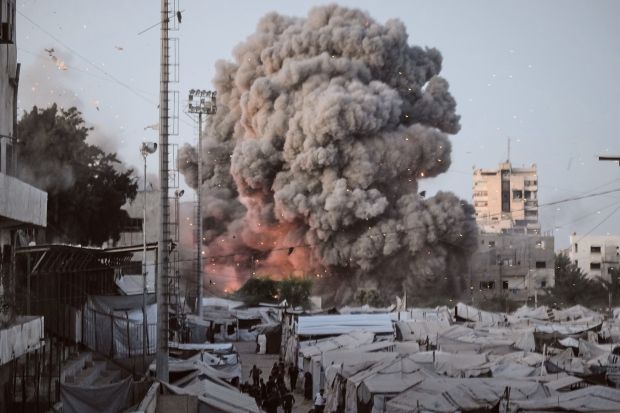
Israel has pointed to Hamas’s failure to disarm as justification for its continued strikes and refusal to allow any reconstruction in Gaza, and for Israeli forces’ steady edging forward from the demarcation line agreed in October.
After months of negotiations in Cairo, the Board of Peace (BoP) set up by Trump last year managed to secure Hamas’s agreement to a “roadmap” for phased disarmament, in parallel to Israeli withdrawal, along with a transfer of power in Gaza from Hamas to a Palestinian interim administration of technocrats, supported by specially trained Palestinian police and an international stabilisation force (ISF).
Nickolay Mladenov, a Bulgarian diplomat appointed as the BoP’s high representative for Gaza, said: “Today, agreement has been reached on the decommissioning of weapons and civilian transition in Gaza. It took months of very difficult negotiations to get here. There were several points when I did not believe we would make it.
“What the agreement says matters. What happens next matters even more. Implementation and verification have to be real. Withdrawal must move in lockstep with decommissioning.”
There was no confirmation from the Israeli government on Friday (31) morning that it accepted the agreement. The far-right national security minister, Itamar Ben-Gvir, said: “The only solution in Gaza to which Israel is willing to be a partner is encouraging emigration and destroying Hamas – no other resolution.”
Israel’s Channel 13 quoted officials as saying the agreement had “no chance” and was no more than a “desperate attempt” by Hamas to play for time.
An Israeli official told Reuters: “Israel demands the complete disarmament of Hamas, including the removal of weapons from Gaza and the complete demilitarisation of the strip as a precondition for any process.” They said the plan under discussion did not “provide a satisfactory response to these demands and Israel conveyed its objections”.
Hamas said it agreed to the roadmap on condition that disarmament was carried out at the same time as Israeli withdrawal. “We will not take any action regarding disarmament prior to Israel’s withdrawal from the strip,” Ghazi Hamad, a member of the Hamas negotiating team, told Al Jazeera.
Hamad told Agence France-Presse in a separate interview: “The agreement contains a clear provision stating that Israel must commit to and implement its obligations. If Israel does not implement the agreement, neither will we.”
By agreeing to Mladenov’s roadmap, Hamas has increased the pressure on Israel to fulfil the commitments it made in the October ceasefire. A US official briefing the press on Thursday night acknowledged that Israel was “very sceptical that Hamas will disarm” but added that Trump would be “very, very disappointed” if Israel did not meet its obligations under the agreement.
It is unclear how long the agreement would take to implement. Hamas is supposed to hand over its weapons to the Palestinian interim body, the National Committee for the Administration of Gaza (NCAG), which would be backed by a Palestinian police force and the ISF. However, the 13 members of the NCAG have so far been barred by Israel from entering Gaza, the special training of Palestinian police has yet to start, and troops from the countries volunteering to support the ISF, such as Morocco and Kosovo, have yet to arrive.
A BoP official said the agreement would usher in an initial 14-day period in which “military activity ceases” and an international verification committee (IVC) would be set up to oversee compliance by both sides with the agreement.
“The whole point of this is the sequencing, the verification and the reciprocity, less [about] timetables,” the official told the Guardian. “If something isn’t adhered to, the next step isn’t compelled. If something requires more time, the IVC allots more time. There is a recognition that this won’t be easy. There will be challenges, and things may take more or less time.”
-theguardian.com

Comments are closed, but trackbacks and pingbacks are open.