

India will stand with Sri Lanka through recovery and rebuilding, says High Commissioner Santosh Jha

By Robert Antony
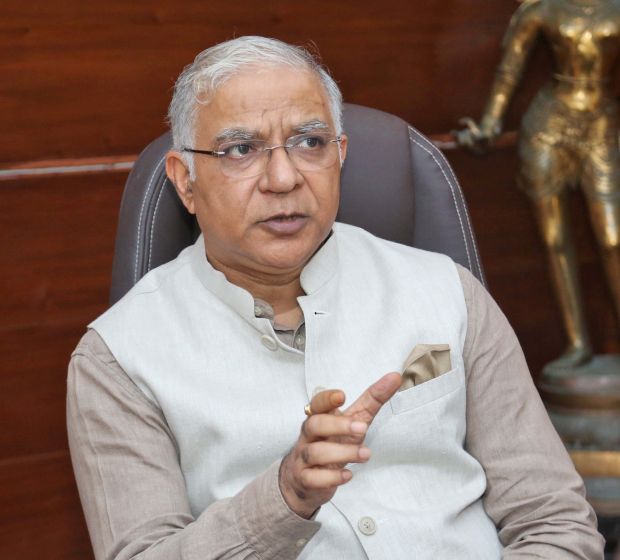
COLOMBO – As Sri Lanka grapples with the aftermath of Cyclone Ditwah, India has emerged as the country’s most consistent and immediate partner in rescue, relief, and recovery efforts. In an exclusive interview with Virakesari, Indian High Commissioner to Sri Lanka Santosh Jha outlines the scale and phases of India’s humanitarian assistance, addresses geopolitical perceptions, and speaks candidly about future reconstruction, disaster preparedness, and the evolving Sri Lanka-India relationship. Reaffirming India’s ‘Neighbourhood First’ policy, Jha stresses that New Delhi’s commitment goes beyond emergency response, underscoring the country’s readiness to stand with Sri Lanka through long-term rehabilitation and rebuilding.
Excerpts from the interview:
Question: Can you briefly outline the phases of India’s immediate assistance operations?
Answer: Since the cyclone was expected on the evening of the 27th, we were already prepared. I was in consultations in Delhi. On the morning of the 28th, I received instructions to start work. So, we first offloaded materials using the aircraft carrier INS Vikrant and the ship Udaygiri, which were already here. This is because these ships always carry humanitarian aid and disaster relief packages. So, we immediately took out about 9.5 tonnes of food and shelter-related materials.
At the request of the Sri Lankan government, we were able to dispatch two helicopters from the Vikrant for immediate rescue efforts. At the same time, we started the effort to send rapid relief from Delhi to Sri Lanka. The first C-130 aircraft took off carrying materials. They arrived in Sri Lanka in the early morning. Subsequently, two more aircraft landed in Sri Lanka.
The relief materials, such as food, water, and shelter materials, included medicines. In one of these aircraft, we sent the National Disaster Response Force (NDRF). So, an 80-member relief team arrived here on the 29th, and they were then dispatched to different locations for rescue and relief work. We provided two Bheeshmak medical blocks. These are modular units the size of a cupboard that can be converted into a surgical theatre, with basic monitoring capabilities, X-ray machines, and so on. They can serve two hundred patients a day, and they are operating in two locations in Sri Lanka. Indian experts came with these units and trained Sri Lankan doctors, who are now handling them. We initially deployed two MI-17 helicopters for relief, evacuation, rescue, and so on. They have gone back, but we have rotated another MI-17, because every helicopter that comes has a specific time allotted to perform duties. Once that period is over, it has to return for maintenance.
We have brought four C-17 aircraft so far, which have brought four packages of Bailey bridges (temporary iron bridges). These are 110 feet long. The Sri Lankan government has decided to use them in one location north of Puttalam and another near Kilinochchi. Work is underway to install the bridges. We also brought a Field Hospital with 78 medical personnel, which is operating in Mahiyangana. Over the last four days, they have been treating around one thousand to twelve hundred patients almost every day. The health minister told me that this hospital is larger than any other hospital that came to Sri Lanka from other friendly nations.
One thousand tonnes of materials were sent from Tamil Nadu in four naval ships. They are mostly food items. Clothing and similar materials are also included. There was another ship (Sukanya) that arrived in Trincomalee with 12 tonnes of relief materials.
If there is an intention to send more relief materials, we will continue to work with the Tamil Nadu government. India was not only the first responder but has also been the most consistent nation in meeting the needs of the Sri Lankan government for the entire period since the cyclone.
Q: India has been very active in supporting Sri Lanka during this crisis. How do you view India’s interest in Sri Lanka, and is it influenced by regional strategic considerations?
A: This is a way of looking at things with a very narrow perspective. India has a stated policy of ‘Neighbourhood First’. It is natural for India to respond when a humanitarian crisis occurs in a neighbouring country.
We view any problem or crisis in a neighbouring country as a crisis for our own country. We came in 2004 during the tsunami, in 2016 during landslides and floods, and in 2022 during the economic crisis. Today, 22 out of 25 districts are affected. Sri Lanka will naturally turn to India for help. But the truth is, we did it even without Sri Lanka asking.
Q: Is there any plan to help rebuild Sri Lanka after this crisis? What about the reconstruction process?
A: I don’t believe in announcing things prematurely. So, we will allow things to evolve and grow. We are discussing with the Sri Lankan government about what the short-term and medium-term needs are in terms of reconstruction.
Q: This question comes from members of the public who have noted your visible presence in several affected areas. What motivated you to personally visit multiple locations during the crisis to assess the situation on the ground?
A: I returned from Delhi on November 30. And I wanted to see how our teams were working in different locations. It’s not just me. I went to the Sedawatta flood area to see how the relief team was working. I went to Negombo to distribute relief materials. I visited a Buddhist temple where there were visually impaired people. Our representative at the Assistant High Commissioner’s office in Kandy visited the hospital to see how things were happening there. My Consul General in Jaffna was at the site where the bridge is being built in Kilinochchi. So, this is part of a continuous effort. We are trying to motivate our own people working in these locations. We also need to see if things are moving at the pace we desire. There is really nothing special about this.
Q: How do you view the future of Sri Lanka-India relations, considering the close cooperation witnessed during this crisis?
A: I see more continuity. Relations change from time to time. But if you look at the big picture of the large projects we are doing, they continue for many years. If you look at the power grid connectivity we are trying to establish, I handled it as a consultant between 2007 and 2010. We are trying to build a power plant in Sampur. That is also a project I handled. I have been involved in the Free Trade Agreement upgrade activities. We are doing housing projects in every district of Sri Lanka. We are constructing ten thousand houses among the estate communities in the upcountry. So, I would say that relations are better than before. The areas where we cooperate are expanding. There is greater trust and certainty in the bilateral relationship.
Q: What were the challenges faced by your rescue team during the rescue operations?
A: The rescue team that was deployed came prepared to deal with challenges. The National Disaster Response Force is a dedicated force in India. And they are experts in handling such situations. So, they know how to handle situations where there are shortages, communication problems, and road connectivity issues. We brought communication equipment. We brought Bailey bridges to connect parts of Sri Lanka. The Sri Lankan government also provided us with great support and cooperation. And we have worked in complete coordination and under the guidance of the Sri Lankan authorities.
Q: You visited all the areas and witnessed the cyclone situation firsthand, and you mentioned the National Disaster Response Force. Will India support Sri Lanka if it initiates a similar work program on its own in this matter?
A: There is a need for cooperation in establishing systems that can respond better to these situations. This also includes having disaster-resilient construction mechanisms. I don’t know if Sri Lanka wants to set up a National Disaster Response Force like the one we have. If they are interested in it, we will be very supportive and will do everything we can to help build it.
Q: In 2019 – 2020 and again in 2024, Odisha experienced severe flooding and frequent cyclones. How did the state manage these disasters, and what lessons can be drawn from its response?
A: There are many incidents. Since my childhood, Odisha has been more vulnerable to cyclones than other states in India. The people of that state had very bad experiences in the past. Now they have a system where they have zero casualties, not only for humans but also for livestock. This is very surprising. This is not entirely government-led. Action is taken in anticipation of a disaster coming. Sometimes the cyclone may not be very intense. But if the intensity is high, at least you save lives and property as much as possible.
Q: Are you ready to share all the Odisha experiences?
A: Of course, we are ready. Both Odisha and Andhra Pradesh have an early warning system. In fact, there is a nationwide warning system developed by the Telecom Development Centre in India. And we offered this to Sri Lanka some time ago. And if Sri Lanka wants it, we can start working on it.
Q: There were allegations that India delayed or obstructed a Pakistani aircraft carrying relief supplies from transiting Indian airspace. Could you clarify what actually transpired?
A: What actually happened was that Pakistan came here and delivered its relief by plane. This shows that Pakistan has been lying for so long. They asked for flight permission. Flight permission was granted within four hours. It takes a much longer time for our planes coming to Sri Lanka to get flight permission. Pakistani airspace is closed to Indian aircraft. They do not allow any relief flights over their territory. Our airspace is also closed to Pakistan. Despite that, we granted permission within four hours. Pakistan was not so keen on helping Sri Lanka. It was more interested in continuing its propaganda and showing that India is not so committed to Sri Lanka. But Pakistan unexpectedly received the approval. We received a request from the Sri Lankan government regarding this. But it was found that Pakistan was not ready to provide assistance immediately.
So, they started making excuses that India was delaying. But if all this was true, how did the plane come and land in Sri Lanka? And it landed 48 hours after the approval was granted. So, it means that the approval was valid for a very long time. Flight permission for the return was also granted. So, I think this is the nature of Pakistan.
What they export to the world is terrorism. They are not accustomed to sending relief materials in such situations. I also don’t know if these relief materials were of the quality that the people of Sri Lanka expected to receive. I would never use a humanitarian situation for political gain. Our response was immediate. Our focus was on the people of Sri Lanka. As I said before, our friendship is with the people of Sri Lanka. Governments come and go. That friendship has existed for centuries.
Q: Sri Lankans were also surprised when India granted permission to Pakistan. We saw them expressing their surprise on social media. What is the message in this for the people of Sri Lanka?
A: The message is humanity. We care about Sri Lanka. We do not want to stand in the way of Sri Lanka receiving help from any country. It is very clear that we have provided help. The scale of our assistance is very large. But if other countries provide assistance, and if it helps Sri Lanka, why should India stand in the way as a friendly nation? Understand that our approach to Pakistan is different. Our relationship with Sri Lanka is different.
Q: Concerns have been raised about Sri Lanka’s meteorological systems being outdated. Is India considering ways to support Sri Lanka in upgrading its forecasting and early-warning technology?
A: Naturally, when facing a crisis like this, people will ask questions and have expectations. But for now, we are mostly focused on the relief and rescue part, and trying to enter the rehabilitation and reconstruction phase. This is the next phase. And we need to work in each of these areas that you mentioned.
If there is a need and desire on the part of the Sri Lankan government, we will be happy to do so. We are very ready for that. We are always ready for that.
Q: Each year, Sri Lanka experiences a seasonal rise in air pollution, with some attributing it to cross-border factors linked to India. How does India view these concerns, and are there any measures being taken to address them?
A: I cannot imagine that this can be linked to another country. Climate change is a global issue. I heard the President say that we are not responsible for climate change because we are not an emitter. We believe the same. We are not responsible. We, as a developing nation and part of the Global South, are not responsible for these climate change events. But we are badly affected by it. And we need to cooperate on these matters. That is why I said that the Coalition for Disaster Resilient Infrastructure is important.
But if someone points out that this is happening because India is doing something, I think that is very narrow-minded. And actually not scientific.
Q: If you had to give a message to the Sri Lankan public about India’s long-term commitment, what would that be?
A: That is, India’s commitment to Sri Lanka is not just a long-term commitment, but an eternal commitment to Sri Lanka. We are neighbours. We have to live together. We have lived together through all these centuries. I am very optimistic because both Sri Lanka and India are led by enlightened leaders.
Q: Did the Indian rescue team share any memorable memories with you?
A: I met them once, but after that, I couldn’t meet them; I was involved in other activities. We are looking at the next phase of reconstruction. We are the first responders in a crisis. We will be the first responders in reconstruction as well.
Q: So, is India ready to help Sri Lanka in the future?
A: Without a doubt, India is certainly ready to help Sri Lanka. You can be assured of that.
Q: Social media has circulated claims that India issued a warning to Sri Lanka about the cyclone. Can you clarify whether there is any truth to this?
A: The information was not officially shared. Neither the High Commission nor I shared anything like that. I don’t know if anyone else shared it.
–Robert Antony, a multiple award-winning journalist, currently serves as Assistant Editor at Virakesari

Comments are closed, but trackbacks and pingbacks are open.