

Declassified documents detail Israel’s role at the start of Sri Lanka’s civil war

Not only did Israel ignore the severity of the human rights situation, it also knew from the outset that its military assistance had limited prospects of success
By Eitay Mack
In 1970, Sri Lanka severed diplomatic relations with Israel under pressure from Arab states. Yet about a year after the outbreak of Sri Lanka’s brutal civil war, an Israeli Interests Section was opened in 1984 at the US Embassy in Colombo.
Files from Israel’s Foreign Ministry from the mid-1980s concerning relations with Sri Lanka – recently partially opened to the public in the Israel State Archives – confirm information that had surfaced in the press over the years and reveal new details.
According to a review prepared on December 11, 1987, by Israel’s Foreign Ministry, Sri Lanka initially agreed to the establishment of the Interests Section in 1984 because it wanted Israel to “assist in solving the Tamil terrorism problem”. By 1988, Israel had sold the country military equipment worth $30 million.
In a cable sent on December 8, 1985, the director of the Foreign Ministry’s Asia Department wrote that Israel had sold Sri Lanka six Dvora-class fast patrol boats for $10 million. In another cable dated June 20, 1986, the head of the Israeli Interests Section in Colombo, Haim Divon, noted that Israel had also sold Mini-Uzi submachine guns “for considerable sums”. In a cable dated June 15, 1987, Divon reported that Israel had also sold Sri Lanka electronic fences, communications equipment, machine guns, and ammunition.
Israel trained the personal bodyguards of President Junius Richard Jayewardene. In a cable sent on Aug. 18, 1986, Divon wrote: “Last week we conducted a shooting course for about 30 members of the president’s security un”. He added that the training lasted four days and received praise.
How Israel trained Sri Lankan military forces
Israel also trained Sri Lankan military forces. In a cable dated Jan. 23, 1987, Divon reported that Israeli military instructors had been publicly presented as “agricultural advisers”. In another cable sent the same day, he wrote that “the Tamils control the Jaffna enclave without challenge”, and that according to the commander of the Israeli training team, local forces believed the training would prepare them to “capture Jaffna in a swift offensive”, with trainees’ questions during exercises focusing on problems likely to arise during such an assault.
In a cable sent on February 15, 1987, Aryeh Mekel, the political adviser to Prime Minister Yitzhak Shamir, suggested that Shamir inform US Secretary of State George Shultz that Israel had responded positively to “Sri Lanka’s urgent request for assistance in security preparations against Tamil underground activity”. He said the assistance included “training officers as well as the urgent shipment of weapons and ammunition worth $3 million”.
On March 18, 1987, Divon reported meeting Sri Lanka’s finance minister. Divon told him that “just five Israeli instructors had been enough to turn the tide in the fighting in the north”, while acknowledging in the cable that he had exaggerated. The minister replied that he would be happy to receive help “from anyone – even the devil”. Divon responded that he hoped “we are not the devil”, to which the minister “simply smiled”/
After the presence of Israeli military instructors leaked to the Sri Lankan media, diplomat Ilan Peleg from the Israeli Interests Section joked in a cable on Dec. 7, 1987, that “we are left to explain to members of the anti-government JVP insurgency that the training was actually for their benefit”.
The comment suggests that Israeli officials were aware the training was not solely intended to assist in the fight against the Tamil insurgency.
Israel also assisted in training personnel of a special police unit notorious for its violent methods.
In a cable dated March 18, 1987, Divon reported that the US deputy ambassador in Colombo had approved Israel maintaining ties with the local military but warned that assistance to the Special Task Force (STF) was “a dubious investment in the short term and a grave mistake in the long term” given “the horrific massacres it has carried out”. He added that if the president and his son were to leave the political scene in the future, “the force would be dismantled, and anyone associated with it would be in a very delicate position”.
Despite the American warning, a cable sent on August 19, 1987, by diplomat Ilan Peleg from the Israeli Interests Section reported that following an assassination attempt on the president, the government decided “to immediately establish an entirely new VIP protection unit drawn from the STF”, and Israel agreed to send “a three-person Israeli team for four weeks to train the unit”. In separate cables, Divon explained that the STF was an “elite unit” in which “the person who sets the tone is the president’s son” and reported that he had met with the commander of the STF.
Although Divon was fully aware of Israel’s actual activities in Sri Lanka, he remained concerned about how the section was perceived. In a cable sent on September 10, 1987, he wrote that Israel’s goal was to achieve full normalization of relations with Sri Lanka and that public diplomacy was needed to create the right atmosphere among the local population. However, he noted a reputational problem: the Interests Section was widely seen as “a mission established to assist the government in the war against Tamil terrorism”. He added that “this was, unfortunately, also one of the official explanations used to justify the establishment of the section”.
In a cable dated November 11, 1987, Divon reported that together with a representative of the Mossad, he met President Jayewardene, who asked to personally meet the Israeli military instructors. Divon wrote that the president “clearly appears inclined toward excessive optimism about the situation and detached from reality – possibly as a result of overly rosy assessments provided by advisers who assume this is what he wishes to hear.”
In a cable sent the following day, Divon wrote that two Mossad officers operated in Sri Lanka on a permanent basis. In another cable he noted that their presence was known and that “we occasionally receive admiring remarks about the Mossad men who, in addition to their other qualities, also know how to grow fruits and vegetables” – a reference to the common cover of Israeli security personnel as agricultural experts.
Amid pressure from Arab states and the Sri Lankan opposition to close the Israeli section in Colombo, cables from August 6 and August 14, 1987, reported that the president asked a Mossad representative during their meeting for assistance in financing his election campaign, requesting $1 million. Divon wrote that “the message regarding the elections is clear – after all, we have an interest in his victory, and therefore we should assist it. He assumes we know that if the opposition comes to power, we are out”. The opposition, which had severed relations with Israel in 1970, promised that if it won the election and returned to power it would expel the Israelis within 24 hours.
The cables released to the public contain no documentation that Israel actually provided Jayewardene with campaign financing. As described, however, Israel did fulfil his security requests. The importance of Israeli military assistance is evident in a cable Divon sent on May 21, 1987, reporting a meeting with the president’s secretary, who “expressed disappointment with Western countries that neither support them morally nor practically and reject requests for assistance – mainly military. He emphasized that only we, the Israelis, have come to their aid.” In a cable sent on January 4, 1988, Divon attached a letter from the president thanking Israel “for the assistance provided in the fields of security and intelligence”.
In a cable dated March 25, 1988, Divon reported meeting the president and telling him that “the assistance we have provided so far is certainly exceptional,” noting that even Prime Minister Shamir had released two of his own bodyguards to train the president’s security detail. Divon again wrote that he could not understand the president’s optimistic mood and wondered whether it was “the result of a detachment from reality or perhaps that he understands his people better”.
Military assistance provided despite repeated reports about severity of human rights situation
This significant military assistance was provided despite repeated reports by Israeli representatives in Sri Lanka about the severity of the country’s human rights situation during the civil war.
These reports included allegations that the STF was responsible for “the disappearance of many young men in the south suspected of belonging to the Tamil underground”; that the army and air force had indiscriminately bombed Tamil civilians, hospitals and markets; fears of a large-scale crackdown similar to that of 1971, when “between 10,000 and 20,000 members of the insurgency were killed in violent clashes with the army”; that government ministers were establishing private militias and purchasing weapons, communications and surveillance equipment; reports of torture of Tamils; the closure of universities; and the suspension of Tamil employees from positions in the civil service.
The secretary-general of the Tamil Teachers’ Union even demanded in a meeting with Israeli representatives that Israel refrain from helping the authorities exterminate the Tamils. In a cable dated January 12, 1988, Divon wrote that “every day we hear of cases of assassination, murder and massacre”, particularly those carried out by the Sri Lankan army.
Israel’s consulate in Chicago reported that “the Committee to Stop the Genocide of the Tamil Minority in Sri Lanka,” operating in the United States, claimed Israel had “sent weapons and advisers to train the government’s army and police”. In response, the consulate denied the allegations, stating that “once again certain parties are attempting to fabricate accusations against us”. As described above, however, the Foreign Ministry documents in the State Archives confirm the committee’s claims.
Not only did Israel ignore the severity of the human rights situation, it also knew from the outset that its military assistance had limited prospects of success. As early as November 1984, during a meeting between Foreign Ministry Deputy Director-General Avi Primor and the US Deputy Assistant Secretary of State for South Asian Affairs, the American official told Primor that Washington believed the Sri Lankan authorities were expanding their army and paramilitary forces but were “deluding themselves into thinking they could achieve a military solution”. As noted, the head of the Israeli Interests Section in Colombo repeatedly wrote that President Jayewardene was detached from reality.
Since military aid had been the main reason the Sri Lankan government renewed diplomatic ties – and despite awareness of human rights abuses and the clear assessment that the government could not resolve the conflict militarily – Israel concluded that continuing its assistance was preferable.
-Eitay Mack is an Israeli human rights lawyer and activist who exposes Israel’s role in the Sri Lankan civil war and has pursued legal action in Israel. This article was originally featured on thewire.in
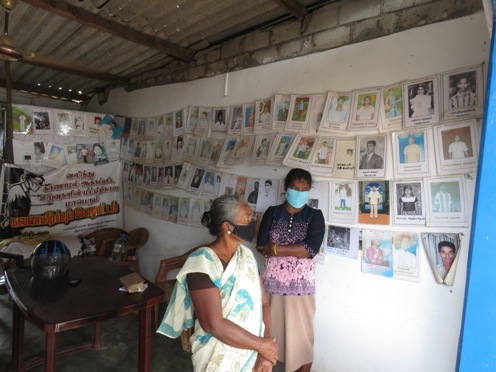
The Sri Lankan government has acknowledged that there could be as many as 65,000 people missing following three decades of civil war -Amantha Perera/IPS

Comments are closed, but trackbacks and pingbacks are open.