

Former SAARC SG Esala Weerakoon calls for ‘South Asian Climate Compact’

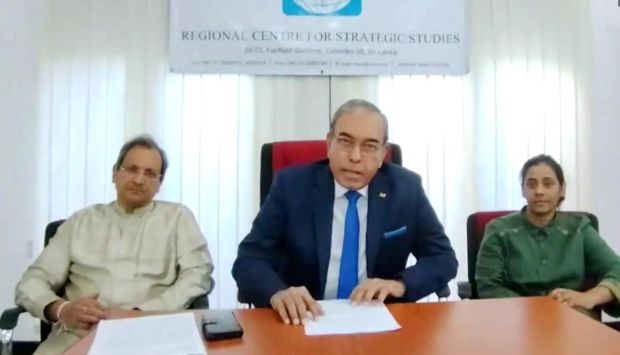
COLOMBO – Ambassador (Retd.) Esala Weerakoon, former Secretary-General of the South Asian Association for Regional Cooperation (SAARC) and former Foreign Secretary of Sri Lanka, has called for the creation of a ‘South Asian Climate Compact’, urging governments in the region to adopt a renewed collective commitment to environmental protection, climate justice, and regional solidarity.
He made these remarks, delivering the Valedictory Address at the conclusion of The Southasia Lectures (SAL) series, a nine-day virtual program hosted by the Regional Centre for Strategic Studies (RCSS) in Colombo. The series, held via Zoom, explored ‘Climate Policy and Climate Justice’, featuring experts who presented country-level assessments of climate mitigation and adaptation. The final session on Monday (8), coinciding with SAARC Charter Day and the 40th anniversary of SAARC’s founding, provided an overview of South Asia’s regional climate challenges.
The series was curated by Dr Swarna Rajagopalan of Chaitanya and RCSS, with Himal Southasian and Sansristi serving as outreach partners.
Ambassador Weerakoon noted that while SAARC Charter Day symbolizes pride, it also offers a moment for introspection. He emphasized the region’s shared vulnerabilities and the urgent need for collective action, stating that climate change is “not merely an environmental issue, it is a human issue, a justice issue, and ultimately a regional peace and security issue.”
He underscored the continuing relevance of SAARC, arguing that the future of South Asia “depends on our ability to act together, to imagine boldly, and to uphold the principles of solidarity that define our region”. SAARC, he stressed, must strengthen its institutions and ensure that its initiatives translate into tangible benefits for the people.
Dr Rajagopalan said the SAL series aimed to create a platform for South Asians to learn from one another and strengthen regional connectivity, an objective aligned with RCSS’s broader alumni network.
Speakers throughout the series highlighted: the intersectional impacts of climate change on gender, livelihoods, governance, ecology, and politics; the transboundary nature of disasters and resource depletion; growing water and food insecurity; and escalating public health impacts linked to climate disruptions.
Participants also underscored the importance of knowledge-sharing, “borderless conversations,” and presenting a united regional position at global climate forums, including COP negotiations.
Series Coordinator Chamika Wijesuriya stressed the need to empower communities at the nexus of climate mitigation, adaptation, and disaster risk reduction. She emphasized that equipping communities with knowledge, skills and technology is essential to strengthening local resilience.
She also advocated for just and equitable climate solutions, robust policy interventions, and regional alliances enabling technology transfer, elements she described as “the need of the hour”.
In his closing remarks, RCSS Executive Director Ambassador (Retd.) Ravinatha Aryasinha reflected on the urgency of regional collaboration, referencing recent catastrophic climate-related disasters in Sri Lanka and across South Asia. He acknowledged the regional support extended to Sri Lanka, underscoring the importance of cooperation within the Global South, especially as multilateral institutions struggle to deliver adequate solutions.
Speaking on SAARC’s legacy, Aryasinha argued that its effectiveness should be assessed over the “longue durée” – the long span of its existence – rather than through short-term snapshots. While SAARC may not have fully functioned as an economic “engine”, he said, it has succeeded as a “catalyst”, fostering closer ties among the people of South Asia.
He called for strengthened Track 1.5 diplomacy to help break the current regional impasse, noting that RCSS has championed such dialogue since its establishment in 1992.
-ENCL
The series of lectures could be accessed at:

Comments are closed, but trackbacks and pingbacks are open.