

TNC delegation calls for Tamil Nadu consensus on Sri Lanka issue

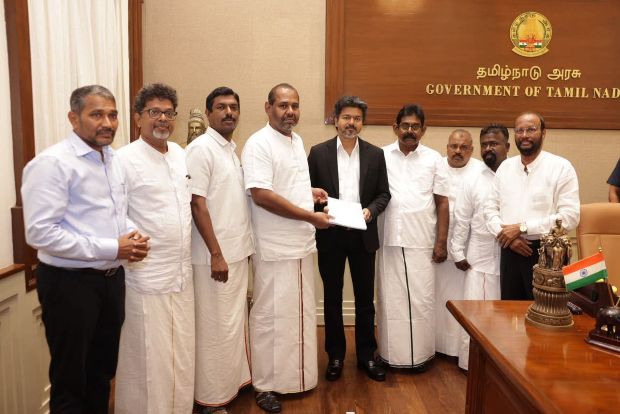
COLOMBO ‒ A delegation representing Sri Lanka’s Tamil National Council (TNC) has urged Tamil Nadu Chief Minister C. Joseph Vijay. to initiate an all-party conference aimed at building a unified political stance on the Tamil question in Sri Lanka, including opposition to the 13th Amendment as a framework for resolving the ethnic issue.
The appeal was made during a meeting held at the Tamil Nadu Secretariat in Chennai on Thursday (2) between Chief Minister Vijay and a seven-member delegation led by Jaffna District MP and Tamil National People’s Front (TNPF) leader Gajendrakumar Ponnambalam. Members of the delegation included former TNPF MP Selvarasa Gajendran, Tamil National Green Movement leader Ponnuthurai Aingaranesan, Democratic Tamil National Party leader K.V. Thavarasa, TNPF National Organizer Dharumalingam Suresh, official spokesperson Kanagaratnam Sukash, and policy secretary Nadarajah Kandeephan.
The TNC delegation also submitted a written memorandum outlining what it described as the “political aspirations” of Tamils in Sri Lanka’s north and east, and calling for stronger engagement from Tamil Nadu political leaders and the Indian central government on the issue.
In its submission, the group said successive Tamil Nadu political leaders had historically maintained engagement with Sri Lankan Tamil representatives, particularly during periods of armed conflict and political negotiations.
It argued that earlier efforts to secure political rights for Tamils in Sri Lanka had been ignored by successive governments in Colombo, leading to prolonged armed conflict, and cited past contacts between Tamil political actors and the Liberation Tigers of Tamil Eelam (LTTE) and Tamil Nadu leaders.
The memorandum also referred to a previous meeting held in December 2025 with then Chief Minister M. K. Stalin, during which concerns were reportedly raised over proposed constitutional reforms in Sri Lanka and their implications for Tamil political rights, self-determination, and sovereignty.
It further noted that follow-up correspondence from the Tamil Nadu leadership to India’s central government in January 2026 had highlighted concerns over what it described as a proposed “unitary” constitutional framework in Sri Lanka, urging consideration of alternative models based on federal principles and earlier political negotiations, including the Thimpu Principles discussed in the mid-1980s.
The delegation contrasted unitary and federal governance systems, arguing that a unitary constitution centralizes sovereignty in the national parliament, while a federal structure distributes power between central and regional authorities.
It also reiterated long-standing Tamil nationalist positions rejecting the 13th Amendment and the Provincial Council system, arguing that these arrangements have not addressed core political demands since their introduction under the Indo-Sri Lanka Accord.
The group further claimed that proposed constitutional reforms in Sri Lanka, including references to a “unitary state” framework, fall short of expectations articulated by Tamil political actors and communities.
Calling for coordinated political action in Tamil Nadu, the delegation urged Chief Minister Vijay to facilitate an all-party conference to develop a unified position that could be conveyed to both the Indian central government and Sri Lanka.
–ENCL

Comments are closed, but trackbacks and pingbacks are open.