

Matale mass grave and the case against Gotabaya Rajapaksa

By Minoli de Soysa
There are thousands of bodies lying in mass graves across Sri Lanka, a legacy of its brutal and bloody past, which could reveal the fate of some of the thousands of missing people from the 26 year civil war and two Janatha Vimukthi Peramuna (JVP) uprisings.
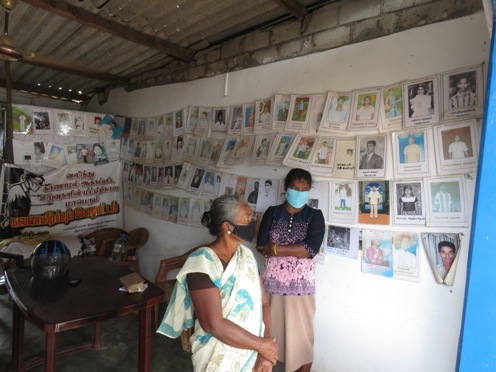
Over the last 30 years around 32 mass graves have been identified and 20 have been partially exhumed but hardly any family has had the remains of their loved ones identified and returned. The graves are unmarked and unprotected and, in some cases, new structures have been built over or around them.
Ongoing forensic investigations have shown that the people in the graves were victims of the civil war from 1983 to 2009 or the JVP insurgencies in 1971 and 1988 to 89. According to government figures, the JVP killed 6,517 people between late 1987 and March 1990. By April 1990, the total number of people killed by the JVP and the security forces was over 40,000, leading to the conclusion that over 33,000 people were killed by the security forces.
One of the contested grave sites is located in the Matale Base Hospital and is back in the spotlight after the Families of the Disappeared (FOD) last month petitioned the Magistrate’s Court to reopen investigations into the case where construction workers uncovered the remains in 2012. By February 2013, when the mass grave was closed under a court order, 154 human skeletons had been dug up. The hospital was close to where the Vijaya College army camp was located from 1989 to 1990.
Forensic archaeologist Dr Raj Somadeva, who investigated the site, concluded that the remains dated from 1986 to 1990. He also concluded that the individuals buried there did not die of natural causes and that there was evidence of torture and extrajudicial execution. In his report Dr Somadeva identified artefacts recovered from the mass grave, the style and origin of which he traced to the late 1980s period. He also recovered a noose made out of metal wire attached to a leg bone and several nails, some of which had pieces of bone attached.
President Mahinda Rajapaksa appointed a Commission of Inquiry into the mass grave site. Material alleged to be remains from the gravesite was sent to the US for carbon dating and, based on the finding, the commission concluded that the remains dated from before 1950, although it agreed that the remains showed evidence of torture and murder. Suspicious that the evidence was tampered with, the forensic medical officer in charge, Dr Ajith Jayasena, alleged that the chain of custody was broken and that skeletal remains sent to the US laboratory were not actually from the Matale mass grave.
As the campaign intensified for the 2015 elections, President Rajapaksa’s government shelved the commission’s report and its findings and recommendations were ignored. The names of alleged perpetrators were placed under a government secrecy order until 2030. When the United National Party (UNP) – led United National Front for Good Governance (UNFGG) came into power in 2015, it had no interest in pursuing the case because the murders had been carried out when it was in government.
“It is clear that if the 154 bodies were established to be from the JVP-era and if genuine efforts were made to identify them, evidence may emerge regarding those responsible for their arrest, torture and killing in custody,” an extensive report by the International Truth and Justice Project (ITJP), titled ‘Gotabaya Rajapaksa: The Sri Lankan President’s Role In 1989 Mass Atrocities’, published in May 2022 said.
Asked why he disagreed with the findings of the US laboratory, Chairman of FOD, Brito Fernando, said, “The local Judicial Medical Officer (JMO) and the archaeologist were of the opinion that they belonged to the 1989 period. The JMO who packed the bones did not travel with them, so we are not sure whether the same bones, which were sealed by the JMO, reached the US lab. When Gotabaya Rajapaksa was the Defence Secretary, the bones were sent for testing. It is also alleged that he ordered the destruction of all police and other reports during that period.”
Fernando also dismissed the possibility of the people in the grave having died in an epidemic. “The general cemetery was near the hospital. If the people died in an epidemic, the bodies should have been buried in a respectful way. Also, there was evidence of torture,” he pointed out.
Fernando said FOD was pressing for a fair inquiry and trials for the perpetrators. “We need to have a list of DNA of the skeletons saved so they can be checked with the families in the future,” he pointed out. “There are some witnesses who were held at nearby torture camps and they have horrific stories about people who were with them and how they were made to disappear. They will come forward if the government makes them feel their lives are safe and they can talk freely.”
Asked what he thought the JVP’s responsibility was to pursue the case, Fernando said, “Unfortunately today, as the strongest party in the government, the JVP is still not saying anything about this case. The JVP has more responsibility in reopening it and demanding the safeguarding of the DNA of every skeleton that was excavated to check with the family members to reveal the truth.
“The government has to publish the list of suspected perpetrators from Matale area, which is due to be published in 2030, or to start inquiries of those findings. All the commissions’ reports on disappearances should be made public as these commissions were supported by public money. Under President Chandrika Kumaratunga, a sealed list of suspected 600 perpetrators was handed over by the commissions, which has also not been published,” he pointed out.
The ITJP report documented a strong case against former president Gotabaya Rajapaksa, who spent almost two decades in the army and served as the District Military Coordinating Officer of the Matale District, an area seen as a JVP stronghold, between May 1989 and January 1990. This period was investigated by four presidential commissions mandated to investigate incidents of disappearances from January 1, 1988 onwards, which listed the names of at least 700 people who disappeared during the period Rajapaksa was in charge of Matale.
As District Coordinator in charge of the administration, including the police and army, Rajapaksa would have known about the scale of violence in Matale, home to about 350,000 people at the time. Survivors recalled Rajapaksa’s presence in Matale at the various schools and guest houses documented as torture sites at the time, including the Vijaya College army camp. Relatives of those abducted and detained visited the camp where Rajapaksa was based to seek information about their family members. Rajapaksa knew, or should have known, that soldiers under his command were responsible for these widespread and systematic human rights violations. He chose not to act, the report said.
The ITJP report said that Rajapaksa, who was Secretary of Defence at time the mass grave was discovered, had allegedly ordered that all police registers and records older than five years at the police stations in the Central Province, including the Matale District, be destroyed. He reportedly also instructed the Inspector General of Police that all reports linked to the court action regarding the Matale mass graves be forwarded to him.
The abductions, unlawful detentions, torture and killings were well documented by the Commissions of Inquiry. A team of civil servants recorded testimony from complainants and witnesses, drew up detailed lists of alleged perpetrators, analyzed patterns and trends and recommended charges be filed against police and army officers. Rajapaksa’s name is one of the names on the list as an alleged perpetrator. Although judicial action was recommended against security officials and politicians, no action was taken due to lack of political will and the need to deal with war against the Liberation Tigers of Tamil Eelam (LTTE), the report pointed out.
Several of the police and army officers named by the commissions rose to the top of their institutions. Gotabaya Rajapaksa became president while Shavendra Silva, Rajapaksa’s deputy, became the Army Commander and Kamal Gunaratne became Secretary of Defence. They have all been implicated in crushing the JVP during that period. The list of perpetrators also included a number of politicians, the report said.
-This article was originally featured on groundviews.org

Comments are closed, but trackbacks and pingbacks are open.