

Sri Lanka swelters, but El Niño not the likely reason for heat

By Kamanthi Wickramasinghe
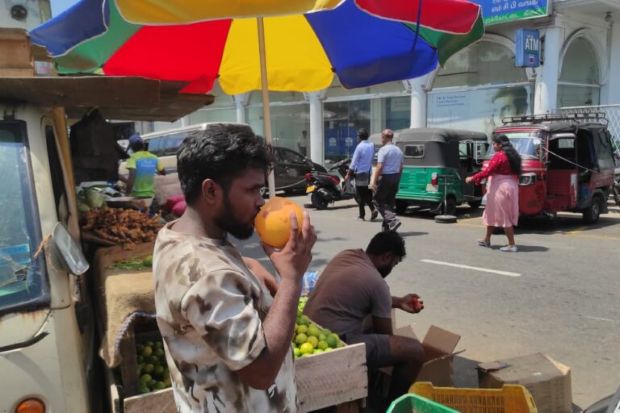
COLOMBO — Amid the hustle and bustle of Pettah, one of the busiest marketplaces in the Colombo district, Sri Lanka’s commercial region, Sandya Jayasekara was busy cutting king coconuts for her customers. Despite the heat, Sandya must engage in her business outdoors to earn a living and to fund her medical treatment.
“I have been selling king coconuts [Cocos nucifera var. aurantiaca] from a very young age,” Sandya tells Mongabay. “But sales are exceptionally low now because the price of a king coconut varies,” from 200-220 rupees ($ 0.63-$0.70). The heat is unbearable and sometimes my skin turns red, but I can’t afford to stay at home,” she adds.
Sri Lanka has been experiencing warmer temperatures for a couple of weeks now, and the dry heat is making people avoid outdoors as much as they can.
The latest heat advisory issued by the Meteorology Department shows an amber alert for several provinces, including the Western Province. On Saturday, March 28, the highest temperature of 39° Celsius (102° Fahrenheit) was recorded from Anuradhapura in the North Central Province and Colombo from the Western Province.
Sweltering Heat
Meril Mendis, Director Weather Forecasting and Disaster Management, Department of Meteorology, says the amber warning is meant for people to be prepared, explaining “We use three colours: yellow is for people to be aware, amber to be prepared or the caution level and red to take action. But usually, warm weather prevails during this time of the year”.
Mendis says the temperature felt by the body, thermoception, is measured through the heat index and is usually 2-3° degrees higher than the temperature in the environment. “The caution level is above 39°C, but the environment’s temperature has not reached this point yet,” he adds.
According to Mendis, the prevailing atmospheric conditions are expected to continue until mid-May, and the prevailing heat is likely to impact human productivity.
Meanwhile, medical experts advise people to stay hydrated and to take breaks in between work to avoid any complications due to extreme heat.
Despite heat advisories, individuals like Marimuththu Maheshwaran, a fruit vendor at the Pettah market, have no option but to continue to work outdoors. “The authorities will ask us to stay indoors, but we have to do our business as well,” Maheshwaran tells Mongabay. “Due to this heat, we do not have many customers. We need sales to cover the costs. Otherwise, we will not get paid. The New Year season (mid-April) is around the corner, but this heat is likely to severely impact my sales,” he notes.
Sun Directly Over Island
“March and April are the hottest months of the year,” Ranjith Punyawardena, climatologist and former chairman of the National Steering Committee on Climate Change Adaptation, tells Mongabay.
The sun is directly over Sri Lanka twice a year, known as the zenith position. “This happens in early April and in early September. The movement of the sun during April coincides with the first inter-monsoon rains in Sri Lanka. During this time, the Earth’s surface will receive a significant amount of solar radiation due to perpendicular rays of the sun. It heats up the land and the atmosphere becomes heated,” he explains.
Simultaneously, there will be high humidity due to lighter winds, he adds, noting, “With no winds, the water vapour concentrates around us. This means, even when people sweat, sweat does not easily evaporate and make people uncomfortable”.
Punyawardena further says that according to leading global meteorological organizations, Sri Lanka is heading toward a Super El Niño. “This is similar to what occurred in 2016. When El Niños develop in the central-eastern Pacific Ocean, simultaneously there’s a high likelihood of developing an anti-cyclone or high-pressure cell area in the northwestern part of the Pacific Ocean, closer to Japan and the Philippines. The same high-pressure area extends to the Indian subcontinent as well.”
Not in El Niño Phase Yet
El Niño/La Niña events are defined by the sea surface temperature or SST, along the tropical Pacific Ocean – the relative Niño 3.4 index,” says Charitha Pattiaratchi, a professor of coastal oceanography at the University of Western Australia. “According to the index, we are exiting a weak La Niña over the past few months and are currently in the neutral phase. Global model predictions indicate we are on track to go into an El Niño by May that would be well established by July-August. However, we are currently not in an El Niño phase.”
Pattiaratchi tells Mongabay that in previous El Niño events, in Sri Lanka, the southwest monsoon rains were lower while the inter-monsoonal rains in October and November were higher. “There are different configurations for the El Niño events and we can’t say definitively what the rainfall patterns will look like in the coming months.”
Pattiaratchi also adds that the predictions indicate higher temperatures by around 1°C (1.8°F), noting that Sri Lanka is currently experiencing a combination of elevated temperatures and humidity but that it is unlikely due to El Niño.
Punyawardena says, “The heat aggravates in places where there is high population density as well as concrete density due to the urban heat island effect, where the city experiences warmer temperatures than rural areas. Even in a city, if there’s good green cover, the situation will not be so bad. But we mostly have concrete forests”.
-This article was originally featured on news.mongabay.com

Comments are closed, but trackbacks and pingbacks are open.