

EU, UNDP announce initiative to strengthen Sri Lanka’s disaster preparedness

COLOMBO ‒ The Government of Sri Lanka, the European Union (EU) and the United Nations Development Program (UNDP) on Wednesday (11) announced a new 24-month initiative, Strengthening Sri Lanka’s Disaster Risk Management Framework, to strengthen the country’s disaster risk management systems, with an emphasis on proactive preparedness, improved coordination and early action.
Funded by the EU through its Directorate-General for European Civil Protection and Humanitarian Aid Operations (DG ECHO), the project will be implemented by UNDP in partnership with the Disaster Management Division of the Ministry of Defence, the Disaster Management Centre (DMC) and Save the Children International,
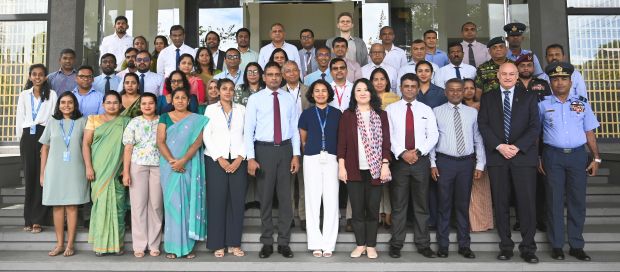
The initiative was announced at an inception workshop attended by representatives of government institutions, the EU, UNDP, development partners and other national stakeholders to discuss its objectives, activities and implementation arrangements.
Sri Lanka remains vulnerable to recurring climate-related hazards, including floods, landslides, cyclones, extreme rainfall, droughts and coastal hazards. Recent disasters have underscored the need for stronger institutional coordination, improved preparedness and mechanisms to translate early warnings into timely action.
The project will adopt a two-pronged approach, strengthening the policy, institutional and operational foundations of disaster risk management at the national level while developing and piloting a government-led preparedness and anticipatory action model in selected districts.
At the national level, UNDP will work with the Disaster Management Division, the DMC, the National Disaster Relief Services Centre and other relevant institutions to review existing legal, institutional and coordination arrangements, strengthen standard operating procedures and improve mechanisms linking early warnings to timely action.
Director General-Planning of the Disaster Management Division, Mahinda Gunaratne, said the initiative would help shift the emphasis beyond emergency response and relief towards anticipating risks and preparing communities in advance.
While emergency response and relief remained essential, he said, effective disaster risk management also required clear institutional responsibilities, strong coordination mechanisms, operational procedures and active community participation.
DMC Director of Training and Awareness Pradeep Kodippili said the project offered an opportunity to strengthen preparedness capacities at national and local levels through technical assistance, improved coordination and practical interventions in selected communities.
He said the initiative would also help identify lessons and good practices that could inform wider disaster preparedness efforts across the country.
At the sub-national level, the project will develop and pilot a consolidated, government-led disaster risk management model in the Badulla and Matara districts, working with local authorities, schools and communities.
Activities will include strengthening local preparedness plans, improving early-warning dissemination, enhancing coordination mechanisms, conducting simulation exercises and promoting early action. The pilot program is expected to generate lessons for extending the model to other parts of the country.
Save the Children International will lead implementation of the sub-national component, working with district and divisional authorities, schools, communities and other local stakeholders to develop, test and institutionalize the model.
The project is expected to directly benefit approximately 3,260 community members in the two pilot locations and engage around 3,200 government officials and technical personnel nationwide.
Particular emphasis will be placed on gender-responsive, age-sensitive and disability-inclusive disaster preparedness, including accessible risk communication and more inclusive planning processes.
EU Program Manager of the Cooperation Section in Sri Lanka, Seuwandi Yapa, said disaster preparedness was a critical investment in protecting lives, livelihoods and development gains.
Through DG ECHO, the EU supported efforts to strengthen preparedness, improve risk-informed planning and promote anticipatory approaches that enabled authorities and communities to act before a crisis escalated, she said.
UNDP Deputy Resident Representative in Sri Lanka Marina Ten said recovery from Cyclone Ditwah presented an opportunity not only to rebuild but also to strengthen the systems needed to protect communities from future disasters.
With EU support, UNDP was working alongside government partners and Save the Children International to translate lessons from recovery into practical reforms, including clarifying institutional responsibilities, strengthening coordination and improving local preparedness and early-warning systems, she said.
The initiative will link national policy and institutional reforms with practical experience from the two pilot districts, ensuring that lessons from local implementation inform national processes while policy improvements are translated into action at community level.
It will work through existing government structures rather than establish parallel systems, with the overall aim of building a more proactive, inclusive and resilient disaster risk management framework capable of helping Sri Lanka anticipate future shocks, reduce risks and protect vulnerable communities
-ENCL

Comments are closed, but trackbacks and pingbacks are open.