


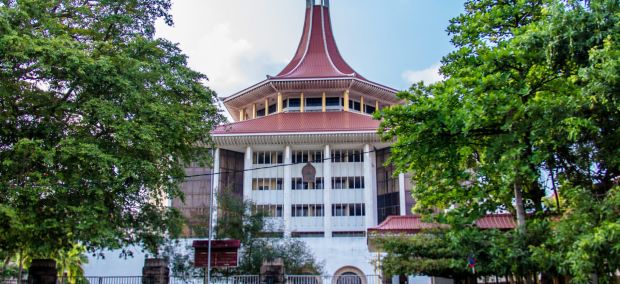
COLOMBO – The Supreme Court has ruled that judicial officers are liable to pay income tax on their remuneration and that Advance Personal Income Tax (APIT) may lawfully be deducted from their salaries, while stressing that the State must ensure adequate remuneration to safeguard judicial independence.
The five-member bench, comprising Chief Justice P. Padman Surasena and Justices A.L. Shiran Gooneratne, Janak De Silva, Mahinda Samayawardhana and Arjuna Obeyesekere, delivered the judgment on Tuesday (15), dismissing three appeals filed by associations representing judicial officers.
The appeals challenged a November 2023 Court of Appeal judgment that dismissed applications seeking to prevent the imposition and deduction of APIT from the remuneration of judicial officers.
The appeals were filed by the High Court Judges’ Association, Judicial Service Association and Association of Judicial Officers of Labour Tribunals.
The judicial officers had argued that they were not employees of the State or any other person and that treating them as employees for tax purposes was inconsistent with the constitutional principle of judicial independence. They had sought orders preventing future APIT deductions and the recovery of amounts already deducted.
Delivering the principal judgment, Justice Janak De Silva held that the Inland Revenue Act did not create an employer-employee relationship between judicial officers and the relevant State authorities in the conventional sense.
Instead, he said, the legislation recognized the factual role of the authority responsible for paying judicial officers’ salaries for the limited purpose of identifying the party responsible for deducting APIT.
The Supreme Court held that applying the Inland Revenue Act to judicial officers did not violate the Constitution, as the tax was of general application and non-discriminatory and did not amount to a reduction of judicial remuneration in a manner that undermined judicial independence.
The Court consequently ruled that High Court judges, District Judges, Magistrates and other judicial officers covered by the appeals are liable to pay income tax on their remuneration and that the relevant authorities are entitled to deduct APIT.
However, the judgment also addressed concerns over the financial impact of taxation on judicial officers, stressing that the answer was not to exempt judges from a tax that applies generally.
Justice De Silva observed that judicial officers must instead be remunerated by the State in a manner commensurate with the responsibilities they bear, the independence expected of them and the demanding standards of personal and professional conduct required by judicial office.
The judgment emphasized that adequate judicial remuneration is closely linked to maintaining the independence, dignity and effectiveness of the judiciary.
The three appeals were dismissed without costs, with Chief Justice Surasena and Justices Samayawardhana and Obeyesekere agreeing with Justice De Silva’s judgment.
–ENCL

Comments are closed, but trackbacks and pingbacks are open.