

When a Movement Meets the State: President Dissanayake after two years

By Ramindu Perera
“[…] It is the mothers, fathers, brothers and sisters living in rural Sri Lanka that built this government. Though some individuals from higher classes had doubts about whether we would confiscate their property, businesses, or houses, people in rural areas, without any doubt, chose us, believing that this government offers the best for the country. This is our government.” President Anura Kumara Dissanayake, at the Farmers Rally in Polonnaruwa in September.
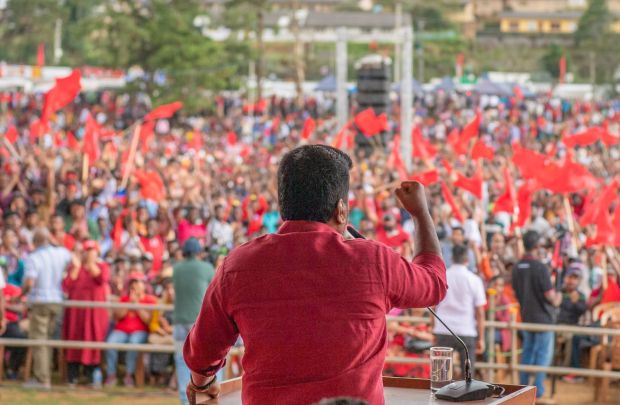
The National People’s Power (NPP) is conducting a series of mass rallies across the country to celebrate its two years of power. A close look at these rallies and the political rhetoric featuring speeches by President Anura Kumara Dissanayake offers interesting insights into what the NPP is after two years in power and where it intends to head.
When the NPP swept into power two years ago, this was a milestone in its political trajectory. The Janatha Vimukthi Peramuna (JVP), which is the main constituent force of the NPP, has been a party of dissent, protest and opposition throughout its 60 years of existence. A vote for the JVP was generally seen as a protest vote.
After entering parliamentary politics in the mid-1990s, the JVP evolved into a militant opposition party within the parliamentary opposition combining parliamentary politics with extra-parliamentary mass mobilization. Its intense work at the grassroots level, building a network comprising committed activists, working among diverse groups like workers, farmers and students and constant political education and awareness raising activities distinguished it from traditional parties, giving it the flavour of a social movement too.
The NPP, formed in 2019, was an extension of this practice in which a formal organizational link was established between the JVP and several other social activists and organizations working among the masses. Thus, entering government in 2024 marked a turning point in JVP/NPP’s political trajectory; it had to transform from a party of protest to a party of government.
During the campaign rhetoric before the 2024 elections, the alleged lack of experience of the NPP in government has been a main argument invoked by its rivals. Apart from a brief period in 2004, JVP/NPP members have never held any ministerial or administrative position. Its rivals alleged that, due to this lack of experience and the inability to maintain international relations in the context of the country facing a severe economic crisis, an NPP government would mean nothing but failure and disaster.
There was an obvious class connotation to the belief that the JVP/NPP is incapable of governing. The cohort of NPP parliamentarians is drawn from modest origins. Except for a few, the vast majority came from ordinary rural and semi-urban families, were educated through the free education system, mostly attended central colleges and converse in the vernacular. There was a subaltern flavour in this composition. Thus, the implicit question was whether the subaltern can actually govern?
In one way, the last two years of the NPP government can be described as a period that has greatly refuted this classist prejudice about politics and governance. The NPP’s main focus as a party was on transforming its members into administrators. The performance may vary across various departments and ministries but in an overall sense the catastrophe, the great standstill the right-wing opposition predicted, did not happen. The NPP, to a fair degree, has shown that it is not only a party of protest but also a party capable of governing.
But there is something more to this. There has been a renewed organizational drive on the part of the NPP in the background of the mass rallies now underway. The Kottasha Sabhas, which serve as the grassroots-level organizational units of the party, are being reorganized and activated. The party’s youth wing has launched its own mobilization drive. Conventions and meetings of NPP frontal organizations such as the National Intellectuals Organization and the Collective of Retired Army Veterans are held across the country.
What do these developments indicate? Speaking at a rally in Matara, President Dissanayake declared that he addressed the gathering not as the president but as the leader of the NPP. He said that, although the NPP holds the president’s office, the majority of Parliament and local councils, the real power rests with the people and that the NPP should be further strengthened and kept alive as a movement of the people.
These remarks indicate an important dynamic in the NPP’s thinking. The party has done a lot to master administration and become a party of governance. But it also seems to be conscious of the fact that administration should not substitute for political work among the masses. Constant mobilization and engagement with the masses to raise their political consciousness are attributes of the left wing political tradition and it appears that, after two years in power, the NPP is keen on retaining its movement-like character alongside its positioning as a party of government. It seems to be conscious of the risk of abandoning mass politics in favour of technocratic managerialism.
The way the NPP addresses and mobilizes the public shows that it continues its populist political strategy, which it pursued amid the 2022 economic crisis while in government as well. In the inaugural rally held in Kalutara, President Dissanayake invoked the imagery of a dark state enabled by the dark politics of the past. Drawing on information from recent investigations into various corrupt deeds during previous governments, President Dissanayake painted an alarming picture of a nexus connecting politicians, certain businessmen, state officials and the criminal underworld.
For instance, he explained how certain businessmen have been involved in illicit activities with impunity, transferring millions of dollars out of the country. Bureaucrats working at state institutions such as the Customs, Police and Immigration Departments have been maintaining links with underworld figures who, in turn, are connected to politicians at higher levels. Narcotics are dumped in the country, which has devastated the lives of younger generations. Not only does the criminal underworld pump money into political campaigns but it has also entered politics, assuming official positions.
The president framed what the NPP government is doing as a battle against this dark state that has eroded the authority of the formal state. He offered a sharp them versus us distinction, arguing that today’s politics is defined by the fight to liberate the state from the capture by dark elements. This rhetoric is very similar to the NPP’s pre-election popular vocabulary. At that time President Dissanayake described the NPP as the movement that represents the people against a corrupt elite network that has usurped political power from the people.
The NPP’s success in the aftermath of the 2022 economic crisis lay largely in the effectiveness of this populist discourse, which channelled the anger, antipathy and discontent among the masses against established political parties. Once the NPP entered into government, the question was how its populism would evolve. Invoking a populist discourse to appeal to a cross section of masses while in opposition, by talking to their anger is one thing. Once the party is in government, the people expect it to deliver and this requires concrete results.
On this matter, it is important to note the nuances of the NPP’s rise to power in the context of contemporary experiences in which progressive populist parties have assumed power. The experience of Syriza in Greece offers an interesting comparison. In both scenarios, an economic crisis led to a political crisis, a crisis of legitimacy of established political parties that created a vacuum for alternatives. In both Sri Lanka and Greece, left formations captured the moment of crisis by employing a populist strategy.
In Greece, however, economic demands – the demand to renegotiate the bailout program with the European establishment – featured at the forefront of Syriza’s platform. This inevitably led to a conflict with the European Union’s establishment after Prime Minister Alexis Tsipras assumed power. The balance of power was deeply unfavourable to Syriza, resulting in a bitter compromise that led to its fall.
The Sri Lankan experience differs due to the pre-eminence of demands of a political character. Political demands such as the removal of the Rajapaksa government, ending corruption and ensuring accountability defined the 2022 protests. Drawing on these sentiments, the NPP platform during the post-aragalaya phase capitalized on slogans to dismantle the corrupt elite network and change the political culture. This formulation calls for a confrontation with domestic forces, not necessarily external ones, as in the Greek case.
This has also allowed the NPP to continue its populist strategy effectively once in office and it is fair to say that the NPP has moved beyond rhetoric. The last two years have been characterized by a full frontal attack against the old political establishment. The government seems to have taken the matter of anti-corruption seriously as its legitimacy largely depends on whether it can deliver on its pledges to combat corruption and ensure accountability for past misdeeds.
The coherence of the process to investigate and prosecute those alleged to be involved in corruption is hard to dismiss. Sri Lanka has entered an unprecedented phase in its history, in which former presidents, individuals of powerful political families and their cronies are standing trial en masse. This stands in stark contrast to the 2015-2019 yahapalanaya period, which saw investigations compromised by political interference.
In Sri Lanka’s political practice so far, there has been an unspoken consensus between the two mainstream parties to keep corruption allegations against each other at the rhetorical level and never to move decisively against the other once they are in power. The NPP has definitely broken this elite consensus.
The battle against the former political establishment constitutes the central contradiction that defines Sri Lanka’s politics today. This has redefined political alliances, allegiances and sympathies. For instance, after the arrest of SLPP’s emerging leader Namal Rajapaksa over allegations of bribery earlier this month, UNP leader Ranil Wickremesinghe issued a special statement describing the arrest as a political witch hunt.
The opposition parties attempt to frame the ongoing prosecutions as an assault on democracy. There are allegations that the NPP is heading towards a one-party state. As leaders across political parties who have been part of the old political elite are caught in legal battles, it is understandable that commentators who may not necessarily share sympathies for the older establishment might raise suspicions of authoritarianism.
For example, when Wickremesinghe was arrested on charges of misappropriation of public funds last year, former Bar Association President Saliya Peiris, in a social media post that went viral, equated the scenario to Julius Caesar’s decision to defy Rome and cross the Rubicon. The implications are clear enough – Caesar’s move to repudiate the consensus with the Roman Senate ultimately led to the collapse of the republic.
Framing the question in these terms presents us with a genuine dilemma. Is the government supposed to overlook corruption charges against opposition politicians associated with former regimes in the name of preserving democratic plurality that contradicts the essence of the mandate the NPP received, as ending impunity was central to that mandate? If being true to the democratic mandate requires action against impunity and if that means leading figures across opposition parties are put on trial, it can actually have an impact on the pluralist nature of the political spectrum as it impedes the work of oppositional parties.
Does this mean that there is a trade-off between enforcing the 2024 democratic mandate and preserving a pluralist democratic polity? Responding to a question about whether the NPP rule would ultimately lead to a one-party state, during a recent television interview political scientist Jayadeva Uyangoda offered an illuminating analysis that might be of importance here. Professor Uyangoda observed that opposition parties have largely failed to recognize the significance of the political aspirations underlying the 2022 protests and the rise of the NPP. As he explained, the responsibility for preserving plurality lies largely with the conduct of the opposition parties rather than the government.
There has been little self-reflection on the part of the main opposition parties about the causes of their defeat in 2024. They tend to cling to the same leaders and adhere to the same political style, largely discredited during the 2022 protests. Political ruptures are not inherently detrimental to democratic plurality if political actors are willing to reflect and reform. For instance, the 1956 political change brought the importance of mass politics to the centre of political discourse, which had thus far been dominated by a highly elitist form of politics. In the aftermath of the defeat, the UNP learned its lesson and reformed by taking the concerns that underlie the 1956 political moment.
The 2022 aragalaya and the subsequent elections, which institutionalized that momentum, also mark a similar political rupture. Most opposition leaders seem to live in a pre-2022 universe and a clear distinction can be seen between their conduct and the governance style the NPP has employed. Alongside measures to curb corruption and end impunity, there have been other political changes at the higher level as well such as slashing lavish privileges accorded to public representatives and attempts to replace nepotistic and clientelist practices with a more rational, impersonal system of administration. Rather than a threat to democracy, the radical anti-corruption politics the NPP government pursues should be seen as a factor that can enhance the democratic quality of political and governance system.
Compared to the assertive, radical posture the NPP government has demonstrated in the field of politics and governance over the last two years, its interventions in economic policies appear modest, if not restrained. After the debt default in 2022, Sri Lanka entered into an Extended Fund Facility (EFF) program with the IMF. Subsequently it also entered into a debt restructuring deal with its external creditors, including bondholders. The IMF program, which imposed several conditionalities, seriously restricted the government’s fiscal and policy space. For instance, primary expenditure was subject to a ceiling of 13% of GDP, constraining the government’s room to spend on social services, welfare programs, subsidies and other public priorities.
The NPP, before the 2024 elections, adopted a cautious stance towards the IMF agreement. It refrained from contesting it in its entirety. It declared that it would seek to negotiate with the IMF to ease the burden of austerity on the masses while remaining within the broader parameters of the program. This reflected a compromised position. On the one hand, the NPP was eager to distance itself from the unconditional commitment the Ranil Wickremesinghe government showed towards pro-market economic reforms. Also, it avoided the position advocated by certain left critics – repudiating the agreement.
Once in office, the NPP government has largely followed what it has proclaimed before the elections. Defying the IMF arrangement would have put the government on a conflicting course with a range of external actors, including external creditors. The NPP seems to have resolved to avoid such a scenario. Avoiding a conflict has had its dividends. The sense of stability that appeared in day to day lives following the IMF agreement, despite the significant burden imposed on ordinary people, continued without disruption. This has also deprived the government’s right-wing opponents of a slogan they could have used to mobilize middle class sections of society against the government.
But on the downside, the government had to function within a limited policy and fiscal space. These restrictions are particularly concerning as poverty remains at higher levels in the aftermath of the economic crisis. However, attempts have been made to advance social and developmentalist ideas featured in the NPP election manifesto within the constraints of the IMF program. Three examples are worth recalling.
First, the government markedly departed from the previous administration’s unqualified approach to privatization. Reforms in the energy sector were partially reversed to retain state ownership. The government has also been successful in investing in modernizing the public transport system, notably by strengthening the state-owned Sri Lanka Transport Board (SLTB).
The previous government’s proposal to lease the farms of the National Livestock Development Board (NLDB) and Milco to India’s Amul cooperative was discontinued. A stronger role for the state in driving national development was a central theme of the NPP election manifesto and it appears that the government strives to defend state intervention.
Second, the two budgets during the NPP government saw increases in cash transfers to vulnerable segments in the country. These measures range from increases in the Aswesuma allowance and allowances granted to the disabled and elderly to the expansion of welfare schemes such as free school meals. New social programs have been introduced, such as the Artha program, which offers a monthly allowance for children under institutional care and a program to expand primary healthcare facilities in rural areas. Minimum wages in the private and estate sectors were raised.
Third, in the aftermath of the US invasion of Iran and the massive increases in oil prices in world markets, the government provided a broader 100 billion rupees relief package to mitigate the shock of price increases in the domestic market. This was a deviation from the IMF requirement of cost recovery energy pricing. It went on providing an electricity subsidy to the poorest households.
These social policy interventions were widely cited by the president in his recent public rallies, reiterating that the government is committed to look after the people. He also referred to the need to achieve economic sovereignty, stating that Sri Lanka had not yet reached genuine economic independence. Given the pervasive economic hardships faced by ordinary people, the government needs to consider additional avenues for expanding social policies.
The economic policy trajectory of the past two years can be described as an attempt to manage a neo liberal austerity regime with a social democratic-developmentalist sensibility. The IMF EFF program is set to end next year. To what extent the NPP government will have manoeuvring space and political will to implement the left developmentalist policy outlined in its election program in a less restrained environment will be a matter for future discussion.
– Ramindu Perera is an academic at the Department of Legal Studies, The Open University of Sri Lanka. He is currently pursuing his doctoral studies at the European University Institute in Florence. This article was originally featured on groundviews.org

Comments are closed, but trackbacks and pingbacks are open.