

Iran’s stranded sailors wait out the war in Sri Lanka amid US pressure

By Maria Siow
BEIJING -Just as Sri Lanka thought it had bought some time with a one-month visa for the Iranian sailors it rescued, another of Iran’s warships appeared offshore, deepening Colombo’s struggle to stay out of a war that keeps washing up on its doorstep.
The vessel was detected nine nautical miles (17km) off the coast on Tuesday (10), a week after a US submarine sank the Iranian frigate IRIS Dena and damaged the IRIS Bushehr off the southern port of Galle on March 4.
Sri Lanka now hosts hundreds of Iranian naval personnel it pulled from the sea, with no clear plan for sending them home.
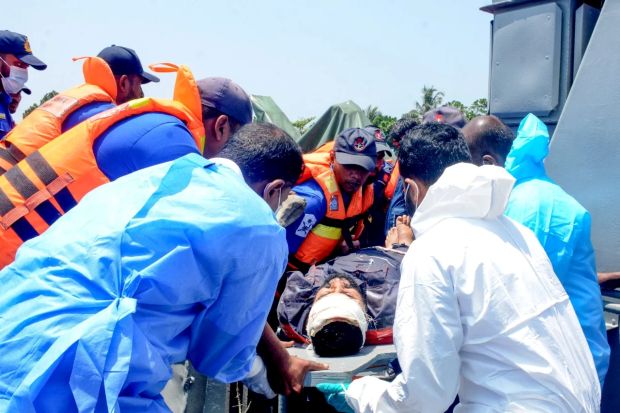
At least two of the Iranian vessels had earlier taken part in a naval exercise organized by India when the attack occurred. Sri Lanka’s navy moved quickly to rescue survivors and recover bodies from the sea.
On Sunday (8), Colombo announced it would issue one-month humanitarian visas to the sailors. Public Security Minister Ananda Wijepala said the decision strictly adhered to international maritime conventions and was in keeping with Sri Lanka’s non-aligned policy, allowing the government to meet its humanitarian obligations without appearing to take sides.
The measure may prove less of a solution than a delay, however. International conventions governing sailors from warships sunk in conflict set no fixed timetable for repatriation, meaning the crew could remain in Sri Lanka long after any visa expires and potentially until the war itself is over.
Repatriation is unlikely unless Iran exerts “significant pressure” to speed it up, according to Shakthi de Silva, an international relations lecturer at the University of Colombo.
“Once hostilities subside or end, they will most likely be repatriated in accordance with international law,” he said, adding that both sides in the conflict would “understand and respect” Sri Lanka’s position.
The United Nations Convention on the Law of the Sea provided a loose framework for repatriating sailors from sunken warships, said Frederic Grare, a senior research fellow at the Australian National University’s National Security College.
But there was “no specific clause” that dictated what must be done in this instance, he said, “and [it] certainly does not set any timeline” – leaving the question of when, or whether, Sri Lanka would act without a clear answer.
Sri Lanka has come under US pressure over the sailors’ repatriation amid the conflict in the Middle East.
A leaked State Department cable, reported by Reuters last week, showed that the US chargé d’affaires in Colombo, Jayne Howell, had urged Sri Lankan authorities not to repatriate survivors from either the IRIS Dena or a second Iranian vessel in their custody.
The cable warned Colombo to “minimize Iranian attempts to use the detainees for propaganda”. Other reports suggested Washington had gone further, raising the possibility of encouraging defections among the crew.
The State Department subsequently sought to soften its position, saying in a statement to the media that Washington “of course respects and recognises Sri Lanka’s sovereignty in the handling of this situation”.
Still, such reassurances will do little to resolve Colombo’s underlying bind, according to Neil DeVotta, a professor of politics and international affairs at Wake Forest University in the US.
“The last thing a bankrupt country wants is an impetuous US president lashing out at it,” he said.
Sri Lanka declared a sovereign debt default in May 2022, after its usable foreign reserves fell to just US$50 million. A US$3 billion International Monetary Fund bailout the following year steadied the economy, but the island’s recovery has been fragile, burdened by high debt, unfinished structural reforms and future repayment obligations.
President Anura Kumara Dissanayake has publicly reaffirmed his government’s neutrality and insisted Sri Lanka must not be drawn into the military conflict.
But like most countries on the periphery of the conflict, Sri Lanka would eventually absorb its economic consequences, Grare said – even if it had “no direct stake in it”.
“The government’s main concern is to keep itself and to keep, with others, the Indian Ocean out of the conflict,” he added.
Holding the line
Iran had requested permission for all three of its naval vessels to dock in Sri Lanka before the attack, but the government was still deliberating when the IRIS Dena was torpedoed.
DeVotta called the hesitation understandable – a government committed to neutrality could hardly be seen welcoming Iranian warships into port – but said the moment the frigate was struck, the obligation to act was unambiguous.
He credited the Sri Lanka Navy for responding decisively following the attack, noting the rescue operation had highlighted “how well the island’s navy acquitted itself and emphasised its neutrality.”
For DeVotta, the episode illustrates a dynamic playing out far beyond Sri Lanka’s waters. By grounding its response in international maritime law rather than strategic allegiance, Colombo was reaching for the only shield available to a nation too small and too exposed to take sides.
“It highlights how small countries wishing to be neutral are seeking refuge in international conventions when confronted with big powers showing no regard for the rule of law,” he said.
For now, Sri Lanka is holding the line and hosting the Iranian sailors. How long either position holds is, like so much in this conflict, anyone’s guess.
-scmp.com

Comments are closed, but trackbacks and pingbacks are open.