

Rethinking Shakespeare in Shanghai

By Andrew Higgins
SHANGHAI — Thomas Caron has performed as Hamlet, Macbeth and King Lear, but Othello, the fourth of William Shakespeare’s great tragic heroes, was out of reach for the American actor without resorting to blackface — until he got to China.
“There was no way I was ever going to play Othello in the United States,” Caron, 74, said. The actor is white and was unlikely, because of racial sensitivities, to play a character Shakespeare described as a ‘Moor’, early 17th-century English parlance for a dark-skinned foreigner.
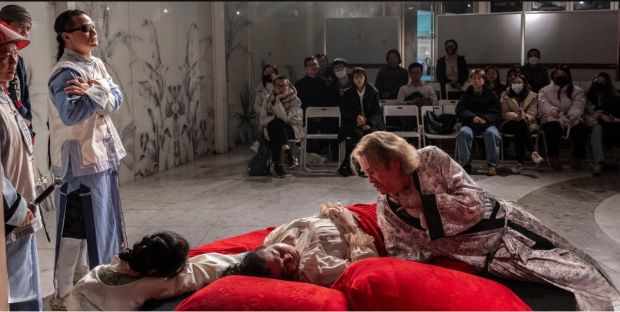
The bilingual version of the play in which Caron recently performed in Shanghai reimagines the story’s racial dynamics: Othello, played by Caron in English, is a clueless American mercenary despised and ruined by a Chinese Iago, a Machiavellian villain consumed by jealousy and a hatred of foreigners.
Instead of Venice and Cyprus, Shakespeare’s setting for ‘Othello’, the Shanghai version takes place on an island at the mouth of the Yangtze River, where an American has been hired to help fight the Taiping rebellion, a bloody revolt in the 19th century. Iago curses Othello not as a Moor but a “laowai”, a mildly pejorative but widely used Chinese term for Westerners.
“I retell you again and again, I hate that laowai,” Iago says in Chinese.
This recent low-budget production of ‘Othello’ — which was staged inside a shopping mall — shows that while China under President Xi Jinping has become increasingly authoritarian, the state’s reach isn’t absolute.
Between dreary slabs of cultural concrete laid by Communist Party commissars, small private flowers can still grow between the cracks, from clubs offering space for amateur stand-up comedians to hole-in-the-wall music venues and small theatres. So long as they steer clear of myriad red lines set by the party.
Rockbund Art Museum, a private Shanghai museum, regularly hosts exhibits and events that while not overtly dissident still test boundaries, including a Shakespeare-themed musical that invited the audience to “rethink their lives and find their own value”. The production, based on a South Korean reworking of Shakespeare, mixed the protagonists from Hamlet and Romeo and Juliet, who rebel against their scripted roles to choose their own paths.
Rockbund is hosting an exhibition of contemporary art called ‘The Great Camouflage’, which touches on sensitive issues like street protests, dissent and the despair of angry young people.
What will and will not be allowed by the party is hard to predict, Caron, the actor, said. He was surprised, for example, that he was permitted to stage ‘What Where’, a short play by Samuel Beckett that revolves around violent interrogations. “I thought this would never pass, but it did,” he recalled.
Shakespeare has generally been safe ground in China since the death of Mao Zedong in 1976. His plays, first performed in China in translation more than a century ago, were banned during the Cultural Revolution — a decade-long period of political frenzy unleashed by Mao in 1966 — but have been revived with gusto since the 1980s, despite their often subversive political probing.
Nan Z. Da, a Chinese-born English professor at Johns Hopkins, argues in her recent book ‘The Chinese Tragedy of King Lear’ that “the tragedy of Maoist and post-Maoist China and Shakespeare’s ‘King Lear’ are uncannily similar”.
In Da’s telling, the fate of Lear’s favourite daughter, Cordelia, who is cruelly punished for refusing to feed her father’s thirst for professions of love and obedience, mirrors that of Mao’s victims trapped in “a world of perverse love, gross flattery, silencing, schoolyard cruelty and desolate deaths”.
Nobody in China is openly discussing such a comparison.
Wang Meng, 30, a talented newcomer to the stage who is also a teacher in Shanghai, insisted she was uninterested in politics and simply found “great personal satisfaction” playing the role of Iago’s wife Emilia. (The character is initially complicit in her husband’s mendacious machinations against Othello but later dies for the truth.) Emilia, Wang said, shows that a “woman can stand on her own” and “does not always have to obey men”.
With questioning of the party snuffed out inside China, even highly educated theatregoers may not connect what Shakespeare has to say about tyranny to their lived reality — or at least they keep any such thoughts to themselves.
Ling Yanduo, 23, a chemistry student from the coastal province of Fujian who attended the Shanghai show, said she liked Shakespeare because “his stories never get dated.” But, when asked whether there were any parallels between these stories and China’s current situation, she said, “I see no connections”.
China’s safe space for Shakespeare has been kept open in part by the fact that Xi has declared himself a big fan. According to Prime Minister Keir Starmer of Britain, Xi spoke warmly during their meeting in Beijing last week about his love of Shakespeare.
The recent staging of Othello, put on by Shanghai Shakespeare, an amateur troupe formed by Caron and Chinese actors, avoided China’s elaborate state vetting procedures for all shows that charge admission by making the show free. None of the actors were paid and its performance space, a bare hall between a health club and clothing boutique, was donated free of charge by a high-end shopping mall. A teahouse donated a room for rehearsals.
However, it was not all smooth sailing for the troupe. It briefly had problems when it printed flyers for “Othello” that showed a Chinese Desdemona, Othello’s wife, leaning on the shoulder of her foreign husband. This prompted angry warnings from a Shanghai culture impresario that spotlighting romance between a foreign man and Chinese woman was offensive.
China’s internet regulator blocked the troupe’s website, which featured the flyer and a quotation from Xi that “Chinese art will further develop only when we make foreign things serve China”. The troupe deleted the picture showing interracial romance from its site but kept Xi’s words, and the show went ahead. “We are not pushing any cause,” Caron said, “just telling stories”.
Under rules issued by the China Association of Performing Arts, a government-affiliated body that both promotes and polices culture, artists are required to show “love for the party” and commit to serving “the people and socialism”.
The state-funded theatre scene therefore leans heavily toward propaganda, featuring shows like ‘Eternal Wave’, a recent drama by the Shanghai Song and Dance Troupe about an underground Communist telegraph worker in the 1940s, and the ‘Battle of Shanghai’, an acrobatic spectacular that tells the story of a battle over a power plant during the Communist revolution.
“The biggest problem with Chinese theatre is propaganda plays, but ordinary people will never go to these,” said Sun Huizhu, a professor at the Shanghai Theatre Academy who has worked on several productions of Shakespeare. “But,” he added, “there are some very good things happening in private theatres”.
Shakespeare, he said, is a perennial favourite, though the playwright is better known to many Chinese for his story lines, which have been borrowed by traditional Chinese opera, than for his actual plays, whose language, even in translation, is “too complicated and very far away”.
‘Birthday Celebration By Five Daughters’, an opera written in the 1980s and performed many times since, is set during the Ming dynasty and roughly follows the plot of ‘King Lear’, exploring greed and family intrigue around a needy patriarch.
Cao Jifeng, 43, an amateur actor who has a day job with a foreign pet products company and played Iago in Shanghai, said Shakespeare’s plays were not about politics but universal human failings like jealousy. “No matter whether you are Chinese, European or American you have a common human nature,” he said.
-New York Times

Comments are closed, but trackbacks and pingbacks are open.