


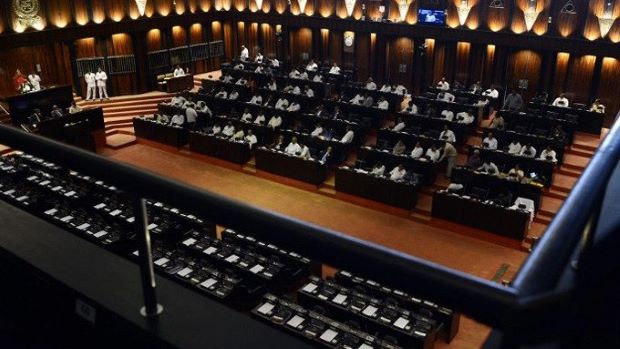
In what could only be described as a decisive step toward redefining political privilege, lawmakers on Tuesday (17) voted 154 to 2 to abolish pensions for all legislators and their widows, ending a 49-year legal framework that had long been viewed as an indefensible entitlement.
The repeal of the Parliamentary Pensions Act, enacted barely months after the government stripped former presidents of housing, vehicles, and security details, signals a rare willingness to curtail the perks of political office. Whether it marks the beginning of deeper reform or remains a symbolic gesture will depend on what follows.
The scale of parliamentary support was striking. In a legislature where the ruling party commands a two-thirds majority, cross-party backing suggested recognition that the status quo was politically untenable. Justice Minister Harsana Nanayakkara captured the public mood bluntly: “When people see the quality of debate and what members say in this House, they don’t think MPs deserve a pension.” His remarks, delivered on the floor of Parliament, were a tacit acknowledgement of the erosion of public trust in the institution.
For decades, parliamentary pensions have been a flashpoint in public discourse. Under the law now repealed, Members of Parliament became eligible for lifetime pensions after serving just five years in office, half the service requirement imposed on other public servants. In a country where millions in the informal sector retire without any pension at all, and where recent austerity measures placed heavy burdens on ordinary citizens, the preferential treatment of legislators had become morally indefensible.
The repeal is both comprehensive and immediate. There is no grandfathering of benefits. Existing pensioners, including widows of former MPs, will cease to receive payments from the date of enactment. This uncompromising approach is what distinguishes the reform from past attempts at piecemeal change. It is also what generated legal and ethical debate.
Constitutional challenges were anticipated. Petitioners invoked the principle of legitimate expectation, arguing that having entered Parliament under a framework that guaranteed pension benefits, the state could not unilaterally withdraw entitlements upon which they had relied. Others raised concerns under Article 12 of the Constitution, contending that retroactive cessation constituted unequal treatment compared to other public sector retirees whose pensions remained intact. Yet the Supreme Court dismissed these objections, ruling the repeal fully constitutional and permissible under a simple parliamentary majority. The Court’s decision affirmed that parliamentary pensions are statutory privileges, not constitutionally protected rights, and that extraordinary economic circumstances justify such measures.
With constitutional hurdles cleared, the parliamentary vote became inevitable. However, the overwhelming margin, with 154 in favour and only 2 against, still carries significance. It suggests that most lawmakers understood the political cost of opposing reform outweighed the personal financial loss.
Notably, Opposition Leader Sajith Premadasa raised a dissenting voice, not to defend entitlement but to warn of unintended consequences. He argued that without some form of social security, legislators could be tempted to amass wealth through corruption to secure their retirement. His concern is not without merit. If parliamentary service becomes economically precarious, particularly for those from modest backgrounds, it could narrow the social diversity of Parliament or incentivize self-enrichment during tenure.
This raises a critical question: what replaces the abolished pension? Many democracies provide legislators with contributory retirement schemes tied to years of service, recognizing that public office can disrupt professional careers and income streams. Eliminating pensions entirely, without establishing a transparent alternative, risks making parliamentary service accessible only to the wealthy or financially secure. Reform must not inadvertently reinforce inequality in political representation.
The government has yet to clarify whether a contributory system will be introduced or whether retirement planning will be left entirely to individual MPs. This ambiguity is a gap in an otherwise decisive reform. Transparency about what comes next is essential to ensure the abolition does not create new problems while solving old ones.
Beyond pensions, the repeal is part of a broader recalibration of political privilege. In September, the government introduced legislation to scrap perks for former presidents following Mahinda Rajapaksa’s refusal to vacate a government bungalow. Former presidents had been entitled to luxury vehicles with government-funded fuel, secretarial staff, and extensive personal security. These entitlements have now been drastically curtailed.
The examples are illustrative of a culture of entitlement that took root over decades. In 2021, while serving as prime minister, Rajapaksa reportedly spent 800 million rupees (about $2.5 million) of public funds refurbishing a state residence. His brother, Gotabaya Rajapaksa, who was forced to resign as president in 2022 amid allegations of economic mismanagement, vacated a state bungalow only after public pressure. Many of these residences were built during British colonial rule for senior civil servants, not as permanent estates for political families.
The significance of Tuesday’s vote lies not in the immediate fiscal savings, parliamentary pensions, while symbolically offensive, represent a relatively modest line item in the national budget, but in the signal it sends about political accountability. By subjecting themselves to the same economic conditions as the citizens they represent, lawmakers are attempting to rebuild credibility in an institution that has suffered profound reputational damage.
Trust in Parliament has eroded dramatically in recent years. Allegations of corruption, mismanagement, and detachment from public suffering have weakened faith in the legislature as a representative body. Pension reform alone will not restore that trust. But it may serve as a tangible demonstration that reform can move beyond rhetoric.
At its core, the abolition challenges a fundamental assumption: that elected office carries inherent entitlement beyond the term of service. It reinforces the principle that public representatives are temporary custodians of power, not beneficiaries of permanent privilege. In a political culture often criticized for self-enrichment, that message resonates.
Yet the real test lies ahead. Will the government follow through with structural reforms to prevent new forms of privilege from emerging? Will Parliament establish transparent, equitable systems for retirement planning that do not disadvantage those without independent wealth? And critically, will the abolition of pensions lead to a shift in legislative behaviour – towards greater accountability, more substantive debate, and renewed focus on public service?
The passage of the Parliamentary Pensions (Repeal) Act marks the end of a nearly five-decade-old legal framework. Whether it marks the beginning of a new era of political accountability depends on whether this moment of political will is sustained. Symbolic reform, however significant, is insufficient. The challenge now is to translate Tuesday’s vote into a broader culture of public service that prioritizes the welfare of citizens over the comfort of those in power.
-ENCL

Comments are closed, but trackbacks and pingbacks are open.