

The re-rise of Iran: Did US-Israeli aggression revive the Islamic Revolution?

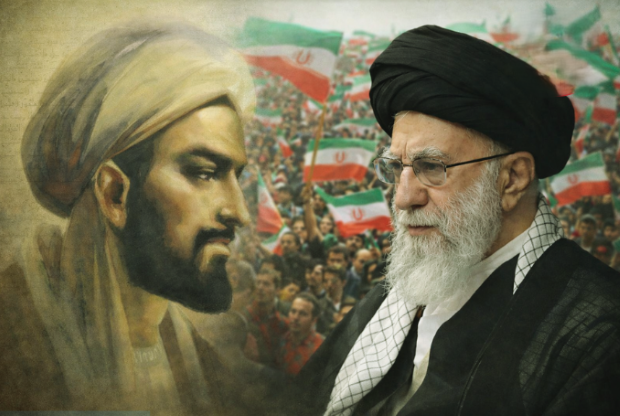
Ibn Khaldun’s theory of civilizational cycles offers a powerful lens to understand Iran’s resilience and the West’s decline
By Ramzy Baroud
Few thinkers have shaped our understanding of political power and historical change as profoundly as Ibn Khaldun (1332–1406). The Tunisian-born historian, philosopher and sociologist—widely regarded as the father of sociology—developed one of the earliest systematic theories explaining the rise and fall of civilizations.
Writing in the fourteenth century, Ibn Khaldun produced his most influential work, The Muqaddimah (1377), a sweeping introduction to history in which he explored how societies form, consolidate authority and eventually weaken.
At the heart of his theory lies the concept of ‘asabiyyah’—a form of social solidarity or group cohesion that binds communities together and enables them to overcome adversity.
As Ibn Khaldun wrote:
“Group feeling gives protection, makes possible mutual defence, and enables the undertaking of collective enterprises.”
For Ibn Khaldun, political authority cannot survive without this shared sense of collective purpose. Strong solidarity allows tribes, movements or nations to rise rapidly, challenge established powers and establish new political orders.
Yet success carries the seeds of decline.
Over time, ruling elites grow distant from the social forces that brought them to power. Luxury, complacency and internal division weaken solidarity. Generations raised in comfort lack the pioneering spirit of their predecessors. As ‘asabiyyah’ fades, the political system loses legitimacy, making decline inevitable.
These cycles—rise, consolidation, stagnation and collapse—have often been used to explain the trajectories of historical empires.
Today, they may also help explain the shifting balance of power in the modern Middle East.
Israel: Crisis of Legitimacy
From an Ibn Khaldunian perspective, Israel increasingly appears to be struggling with a profound crisis of legitimacy and cohesion.
For decades, Israel was supported by rooted ideological narratives. For many Jewish communities around the world—particularly in the United States—it was portrayed as a historical miracle: a refuge born from trauma and a symbol of national revival.
However, that narrative is rapidly eroding.
Younger Jewish communities in the United States and elsewhere are increasingly distancing themselves from Israel’s policies, particularly in the wake of the devastating war on Gaza and the wider regional escalation. The moral legitimacy that once sustained Israel’s international support has been deeply shaken.
Rather than attempting to restore that legitimacy through stability, justice or political compromise, Israel has increasingly relied on overwhelming military force.
The decision to escalate regional war—including the devastating assault on Iran—may ultimately prove to be a strategic miscalculation.
From the perspective of Ibn Khaldun’s theory, regimes facing internal legitimacy crises often resort to external confrontation as a means of restoring authority. Yet such strategies can accelerate decline if they further weaken the social cohesion necessary for long-term stability.
Israel’s reliance on war, combined with growing ideological fractures and declining international credibility, suggests a political system struggling to renew its founding solidarity.
Signs of Imperial Decline
The legitimacy crisis is not limited to Israel.
The United States and the broader Western order are experiencing their own forms of structural decline.
For much of the twentieth century, Western dominance rested on a combination of military power, economic influence and ideological appeal. Liberal democracy, technological progress and economic opportunity formed the pillars of a global order centred on Washington and its allies.
Today, many of those pillars are eroding.
Endless wars, deepening political polarization and widening economic inequality have weakened the credibility of Western leadership. At the international level, the emergence of alternative power centres—from China to regional alliances in Asia and the Middle East—has further diluted Western dominance.
In Ibn Khaldun’s terms, the social cohesion that once sustained imperial authority appears increasingly fragmented.
Empires often fail not simply because of external challenges but because they lose the internal unity and moral clarity that once justified their power.
Why Iran Was Expected to Collapse
Against this backdrop, the US and Israel appeared to believe that Iran was approaching its own moment of decline.
When the two allies launched their war on Iran on February 28, their calculations seemed straightforward. Iran had experienced years of economic pressure, sanctions and periodic domestic protests. Some observers argued that the revolutionary fervour that defined the early years after 1979 had faded.
If the leadership could be decapitated, the logic went, the entire political system might collapse.
Targeting senior figures—including the assassination of Supreme Leader Ayatollah Ali Khamenei and other prominent figures from the revolutionary generation—was meant to create political chaos and accelerate regime change.
The assumption was that Iranian society had already lost the cohesion that sustained the Islamic Republic.
But the opposite occurred.
The War That Renewed Iran’s Social Contract
Rather than collapsing, Iran experienced a powerful surge of social solidarity.
The assassinations and external attacks triggered widespread mobilization across the country. Political factions that had previously been divided found themselves confronting a common external threat.
In many ways, the war revived the revolutionary discourse that had defined the early years of the Islamic Republic.
Anti-imperialist and anti-Zionist slogans that once dominated Iran’s political culture resurfaced across public life. Mass mobilization, volunteerism and expressions of national unity began to resemble the atmosphere that followed the 1979 revolution.
In Ibn Khaldun’s framework, this represents the reawakening of ‘asabiyyah’—a renewed sense of collective identity forged under pressure.
Ironically, the strategy designed to destroy Iran’s political system may have restored its legitimacy.
By targeting figures associated with the original revolutionary leadership under Imam Ruhollah Khomeini, the war reconnected the population with the founding narrative of the Islamic Republic. What had appeared to be generational fatigue suddenly transformed into renewed solidarity.
External aggression often has this effect: it compresses political divisions and forces societies to rediscover their collective purpose.
Reversing the Expected Cycle
According to Ibn Khaldun, states typically enter periods of decline as the pioneering generation disappears and later generations lose the cohesion that once sustained the system.
By that logic, Iran—now well into its third revolutionary generation—might have been expected to weaken.
Instead, the war appears to have reset the cycle.
The renewed revolutionary discourse, popular mobilization and revived national solidarity suggest that Iran may be experiencing something closer to a political renewal than a terminal decline.
Meanwhile, the countries that initiated the war face their own deepening crises of legitimacy.
Israel struggles with growing international isolation and internal ideological fragmentation. The United States increasingly finds its global authority challenged while domestic polarization intensifies.
In this sense, the regional conflict has exposed a striking paradox.
The powers that assumed Iran was nearing collapse may themselves be confronting the structural conditions that Ibn Khaldun associated with imperial decline.
Ibn Khaldun’s Lesson for the Present
More than six centuries after he wrote the Muqaddimah, Ibn Khaldun’s insights remain remarkably prescient.
History rarely moves in straight lines. Nations rise, consolidate power, stagnate and fall—not merely because of military strength or economic performance, but because of the strength or weakness of the social bonds that hold them together.
What is unfolding in Iran today may illustrate exactly that dynamic.
At a moment when Iran was expected to enter a period of natural decline, external war appears to have revived the very social cohesion that sustains political systems.
If Ibn Khaldun were observing these events, he might recognize them as a classic example of historical cycles at work.
The war intended to end Iran’s revolutionary system may have instead reset the clock of its political life—while accelerating the decline of the very powers that sought its collapse.
– Dr. Ramzy Baroud is a journalist, author and the Editor of The Palestine Chronicle, where this article was originally featured

Comments are closed, but trackbacks and pingbacks are open.