


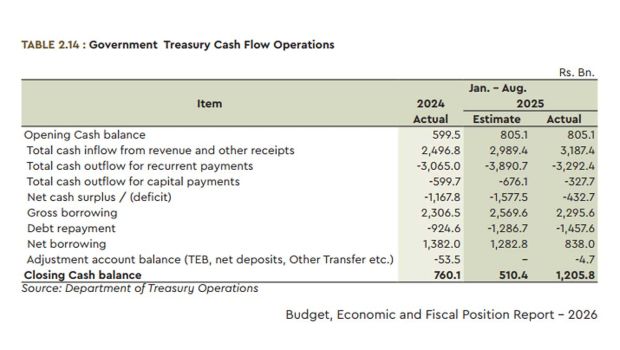
COLOMBO – The cost of maintaining a domestic cash buffer by overborrowing, which was said to have been around 1.2 trillion by November, costs about an extra 2% to maintain, the Parliament’s Committee on Public Finance was told.
“There is a margin of about 2% between the borrowing and the return we get,” Additional Director General, Treasury Operations, Damitha Rathnayake said.
“So we are downsizing it.”
It was not clear whether the 2% was an average cost or the marginal cost of over-issuing longer-term bonds and under-selling cheaper Treasuries.
In Sri Lanka, there is more money in the short term, due to interest rate volatility coming from currency crises discourages holding long-term bonds.
By the end of the year, the excess borrowings would be around a trillion rupees, she said.
President Anura Kumara Dissanayake told Parliament last week that by the end of November, the excess borrowings were around 1.2 trillion rupees.
About 500 billion rupees would be used in hurricane relief and recovery.
There were plans to keep around three months of debt service as excess borrowings, which is around 500 to 600 billion rupees.
The excess borrowings are deposited in state commercial banks.
Sri Lanka was keeping the excess borrowings as a buffer to replace money printing, Rathnayake told the COPF.
Analysts had warned that the domestic ‘reserves’ cannot be kept in domestic banks ‘for a rainy day’ as commercial banks tend to lend cash in the interbank market, give credit or buy short-term government securities in a circular scheme.
Any sudden withdrawals of state cash deposits in banks would lead to some dislocation or inter-bank credit and bank deposits or reduced subscriptions to new bills in the interim, analysts say.
Any ‘rainy day’ funds have to be kept outside the country, which is why countries build sovereign wealth funds externally.
Cash deposited in the central bank’s deposit window over a period however, would be deflationary and would lead to a rise in monetary forex reserves, which would be used up when the liquidity is withdrawn at a fixed exchange rate.
Treasury bills were invented to cover the short-term cash needs of the government. Treasury bills pass on the effect of government cash needs, market pricing interest rates in the short-term and crowding out private credit to stop any external crises or depreciation.
Government cash needs can go up, due to war or other crises, when sections of the population are already in trouble.
Any depreciation from interest manipulation, especially through inflationary open market operations, pushes up food and energy prices and gets them further into trouble, analysts say.
-economynext.com

Comments are closed, but trackbacks and pingbacks are open.