


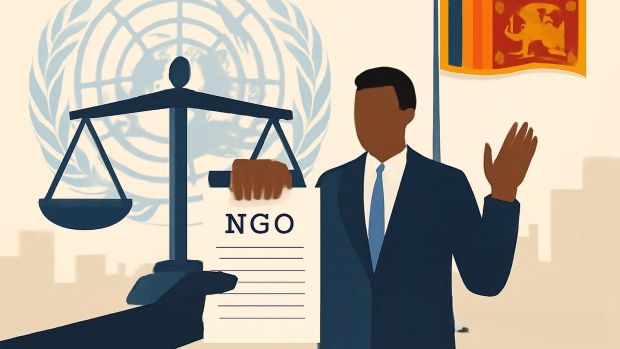
COLOMBO – Four United Nations Special Rapporteurs have formally raised concerns with the Sri Lankan government over the proposed Non-Governmental Organizations (Registration and Supervision) Bill 2026, warning that several of its provisions are inconsistent with international human rights law and global standards on countering terrorist financing.
In a communication dated September 28, 2026, the UN experts –Special Rapporteur on human rights while countering terrorism Ben Saul, Special Rapporteur on freedom of opinion and expression Leopoldo Maldonado Gutiérrez, Special Rapporteur on freedom of peaceful assembly and of association Gina Romero, and Special Rapporteur on the situation of human rights defenders Andrea Bolaños Vargas – said the Bill’s registration and penalty regime could restrict the right to freedom of association protected under Article 22 of the International Covenant on Civil and Political Rights (ICCPR).
The Bill was first published in 2024 without consultation with civil society or the Human Rights Commission of Sri Lanka, and has since undergone successive drafts, the latest in June 2026, adding provisions on monitoring NGOs for compliance with counter-terrorism financing and anti-money laundering standards. The legislation is reportedly linked to Sri Lanka’s preparations for a mutual evaluation by the Asia/Pacific Group on Money Laundering, a regional body affiliated with the Financial Action Task Force (FATF), scheduled for October 2026, and is intended to replace the Voluntary Social Services Organizations Act of 1980.
The Rapporteurs noted the Bill would require all NGOs to register with a Competent Authority, with failure to do so constituting an offence carrying criminal liability for directors and office bearers. Registration certificates would be valid for three years and require renewal, with no specified time limit within which the Competent Authority must decide an application – while organizations would be barred from commencing activities before registration is granted.
The communication raised particular concern over obligations imposed on registered organizations, including requirements to align with government policy, refrain from activity deemed to affect national sovereignty or territorial integrity, and avoid causing “public disorder”. The Rapporteurs said such broad and vague grounds were prone to misapplication, warning they could disproportionately affect organizations working on disappearances, land rights, transitional justice, and the rights of minority groups, including LGBTIQ+ communities.
The experts also flagged the Competent Authority’s powers under the Bill to enter NGO premises without a search warrant upon prior notice, access and copy records, attend organisational meetings with consent, and share NGO information, including on staffing and funding, with terrorist-financing and other regulatory authorities. The communication said the absence of judicial authorization for such measures raised concerns under the ICCPR, and that data-sharing provisions could contravene Sri Lanka’s Personal Data Protection Act, No. 9 of 2022.
The Rapporteurs noted the Bill allows for suspension or deregistration of NGOs on multiple grounds, including alleged financial irregularities or activities deemed “prejudicial” to national security, and permits deregistration by court order without specifying the grounds for such a decision. They said the Bill includes no process to appeal a registration refusal, and that the uniform application of its requirements to organizations of all sizes would disproportionately burden small and grassroots associations.
On terrorist financing, the communication said blanket regulation of all NGOs regardless of their individual risk level was inconsistent with the risk-based approach required under FATF’s revised Recommendation 8 and relevant UN Security Council resolutions. It noted that Sri Lanka’s own national risk assessment of the NGO sector, conducted in January 2026, found the sector’s inherent risk to be low to medium, with limited evidence of proven terrorist financing by NGOs.
The Rapporteurs placed the Bill within a wider pattern, citing previous communications to the Sri Lankan government concerning intimidation, surveillance, arbitrary arrests and house raids against human rights defenders. They also referenced a 2019 official visit to Sri Lanka by the Special Rapporteur on freedom of assembly and association, whose subsequent reports found that informal refusals of registration remained commonplace for groups working on politically sensitive issues, particularly in the north and east of the country.
The communication posed four questions to the Sri Lankan government: whether it will provide further comment on the Rapporteurs’ analysis; how the Bill is consistent with freedom of association and international counter-terrorism financing standards; whether the Bill will be withdrawn or substantially revised; and whether it will be gazetted to allow for transparent and inclusive public consultation. Under UN procedure, the communication and any government response will be made public via the UN communications reporting website after 48 hours, and subsequently included in a report to the Human Rights Council.
–ENCL

Comments are closed, but trackbacks and pingbacks are open.