


By Dr Subashini Pathmanathan
The Sammangodu Manikka Vinayagar Temple in Bambalapitiya, Colombo, stands as an important landmark of Sri Lanka’s Hindu religious and cultural heritage, with a history stretching back 150 years.
The temple is closely linked to the Sammangodu Kathirvelayutha Swamigal Temple on First Cross Street, Pettah, reflecting the deep historical and religious connections between the two shrines and the Indian mercantile communities that helped establish them.
The origins of these temples can be traced to the migration of prosperous South Indian merchants to Sri Lanka, particularly to Colombo, in search of commercial opportunities. Among them were members of the Chettiar community, who began arriving in Colombo by sea as early as the 18th century and established themselves in areas close to the Colombo Port.
The continued presence of Chettiar Street, near the port, is a reminder of that history.
As these communities settled in Colombo, they brought with them their religious traditions and devotion to Lord Murugan and Lord Vinayagar. Kathirvelayutha Swamigal temples were also established by Indian communities in several parts of Asia, serving as places of worship and centres of cultural identity for migrants living away from their homeland.
In Colombo, devotees travelling to and from religious centres traditionally stayed at ‘maddams’ or rest houses established along Galle Road. Among them were the old Kathiresan Maddam, the new Kathiresan Maddam and the Sammangodu Manikka Vinayagar Maddam in Bambalapitiya.
These establishments provided accommodation and facilities for travellers and devotees, particularly those making religious journeys. Over time, the movement of devotees and the traditions associated with these shrines contributed to the development of Kathirkamam celebrations in Colombo, allowing religious observances to continue even when devotees were unable to travel to distant pilgrimage sites.
Historical research indicates that the Sammangodu Manikka Vinayagar Temple was constructed in 1910. Major renovation work commenced in 1996 and was completed in 2001, followed by the temple’s first Kumbabhishekam that year. A second Kumbabhishekam was conducted in 2014.
Following another major program of renovation and restoration, the temple had its third Kumbabhishekam on September 17, an occasion eagerly anticipated by Hindu devotees in Colombo and across Sri Lanka.
Religious observances associated with the Kumbabhishekam commenced on September 11, with a special oil-anointing ceremony on September 14 and 15 from 7 a.m. to 11 p.m. The observances also coincided with Avani Chaturthi, which fell on September 14 this year.
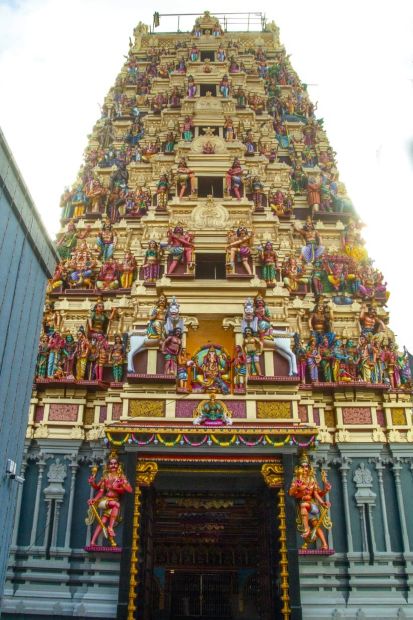
One of the most striking features of the temple is its magnificent seven-tiered Rajagopuram, which faces west and rises to a height of approximately 108 feet.
The imposing gopuram is adorned with intricately crafted and brightly painted sculptures depicting episodes from the Puranas and Hindu epics. Its distinctive architecture allows the tower to be seen from a considerable distance, making it one of the prominent religious landmarks along Galle Road.
The artistic richness continues throughout the temple. Elaborately carved pillars, ceilings and entrances feature representations of Lord Vinayagar and stories drawn from Hindu religious literature. Intricate sculptures and colourful paintings cover many sections of the temple, while lotus motifs on the ceilings symbolise spiritual growth and the blossoming of the soul.
The temple’s architecture reflects a rich tradition of South Indian temple craftsmanship, with every major section contributing to the overall religious and aesthetic character of the shrine.
Upon entering through the Rajagopuram, devotees are welcomed by the principal shrine of Lord Vinayagar, while the temple complex also contains shrines dedicated to Dwara Ganapathy, Dhandayuthapani and Idumban.
Further within the temple are the Vasantha Mandapam, Bhairava shrine and Meenakshi Amman shrine, while the western-facing Sivan shrine houses Sundaresa Peruman. The temple complex also includes separate shrines for the Navagrahas and Dakshinamurthy, as well as a shrine dedicated to Durga Amman, who faces north.
The arrangement of these shrines and the intricate architectural details provide devotees with an opportunity to worship a number of important deities within a single sacred complex.
The temple’s religious life extends well beyond its daily rituals. One of its most significant annual events is the Vel Festival, a major celebration that brings together the two Sammangodu temples in Pettah and Bambalapitiya.
The festival is centred on the Kavadi Chariot procession, which begins at the Sammangodu Kathirvelayutha Swamy Temple at No. 141, First Cross Street, Colombo 11, and proceeds towards the Sammangodu Manikka Vinayagar Temple in Bambalapitiya.
The chariot carries Lord Murugan, accompanied by Valli and Deivanai, as the deities are taken in procession to bless devotees along the route.
The two temples operate under the same administration, enabling the annual festival to be conducted as a coordinated religious celebration. The deities remain in procession in Bambalapitiya for four days, culminating on the full moon day of the Tamil month of Aadi with the traditional sea-water-cutting or Theertham ceremony.
The procession then returns to the Sammangodu Kathirvelayutha Swamy Temple in Pettah.
The Vel Festival is also notable for its vibrant cultural programme. During the four-day celebration, traditional South Indian Nadaswaram and Thavil performances accompany the religious ceremonies, while renowned South Indian musicians and artists participate in special performances.
Annadhanam, or the traditional provision of free meals, is also offered to devotees throughout the festival.
The Vel chariot has traditionally received a warm welcome from people of different communities. Hindus and Buddhists, as well as members of Colombo’s business and trading communities, participate in welcoming the procession with devotion and respect.
The chariot itself is traditionally decorated with yellow electric lights, fresh flower garlands, coconut-leaf decorations, ornamental arches, plantain bunches and banana trees, creating a striking spectacle as it moves through the streets of Colombo.
A distinctive feature of the procession is the prominent place given to Idumban, regarded as the guardian deity. Idumban is traditionally taken ahead of the Vel chariot during the procession, and the festival concludes with a final pooja dedicated to him.
For generations, the Sammangodu temples have therefore served purposes extending beyond worship. They have preserved religious traditions, cultural practices, music, architecture and community bonds associated with the South Indian heritage of Colombo’s Hindu community.
Their history also reflects the story of migration and commerce in Colombo, demonstrating how communities that arrived for economic reasons established institutions that eventually became enduring centres of faith and cultural identity.
Today, the Sammangodu Manikka Vinayagar Temple remains an important place of worship for Hindus in Sri Lanka. Its imposing Rajagopuram, richly decorated interiors, centuries-old religious traditions and close relationship with the Pettah shrine make it a significant part of Colombo’s multicultural heritage.
As the temple prepares for its third Kumbabhishekam following its latest restoration, devotees are looking forward not merely to another major religious ceremony, but to the renewal of a living tradition that has continued to connect generations of worshippers, communities and cultures in Colombo.
–ENCL

Comments are closed, but trackbacks and pingbacks are open.