


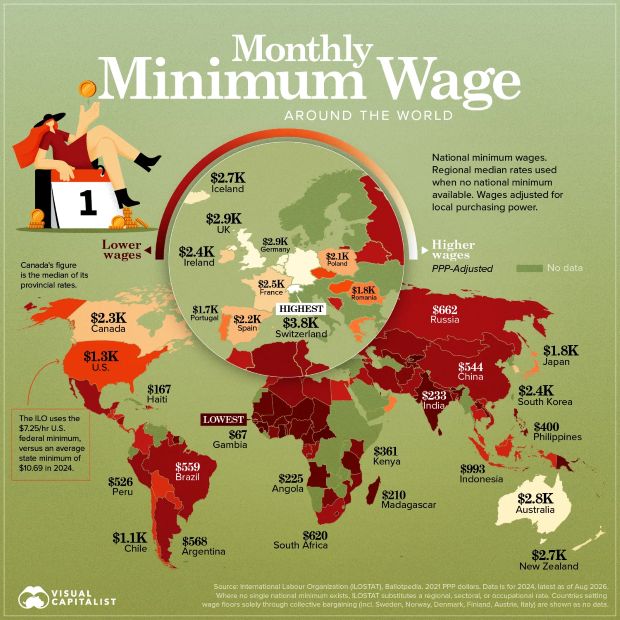
COLOMBO – Sri Lanka ranks 120th out of 130 countries in a global comparison of monthly minimum wages adjusted for purchasing power, with a monthly wage equivalent of just US$200, according to data compiled by Visual Capitalist from International Labour Organization (ILO) statistics.
The ranking places Sri Lanka near the bottom of the global table and last among the South Asian countries included in the comparison, highlighting the relatively weak purchasing power of the country’s statutory minimum wage.
Sri Lanka ranked below Pakistan, which was 68th with a PPP-adjusted monthly minimum wage of US$570, Nepal at 78th with US$490, Bangladesh at 89th with US$379 and India at 111th with US$233.
Only 10 countries ranked below Sri Lanka in the 130-country comparison: Niger, Bhutan, Haiti, Guinea, the Central African Republic, Sierra Leone, Ghana, Kyrgyzstan, Guinea-Bissau and Gambia.
The figures are based on 2024 ILO data and adjust minimum wages using purchasing power parity (PPP), a measure that takes differences in the cost of goods and services between countries into account.
This means the comparison goes beyond nominal wages in US dollars and attempts to show how much workers can actually purchase with the minimum wage in their respective economies.
At the top of the ranking was Switzerland, with a PPP-adjusted monthly minimum wage of US$3,804. However, the Swiss figure is based on a regional rather than a nationwide minimum wage.
Germany ranked second at US$2,928, followed by the United Kingdom at US$2,902 and the Netherlands at US$2,876. Australia, Belgium, Iceland, New Zealand, France and Ireland also featured among the countries with the highest minimum wages.
South Korea, with a PPP-adjusted monthly minimum wage of US$2,362, recorded the highest figure in Asia.
The United States ranked 25th at US$1,257 based on its federal minimum wage. The comparison uses the US federal rate of US$7.25 an hour rather than higher minimum wages applicable in many states and cities.
The ranking also highlights the limitations of making direct international comparisons of minimum wages, as wage-setting systems differ significantly between countries. In some countries, minimum wages are determined through collective bargaining rather than a single statutory national rate.
The ILO data therefore provide a standardized comparison rather than an indication of the actual wage floor faced by every worker in each country.
For Sri Lanka, the 120th-place ranking underscores the comparatively low purchasing power of the country’s minimum wage, particularly when measured against neighbouring South Asian economies.
–ENCL

Comments are closed, but trackbacks and pingbacks are open.