


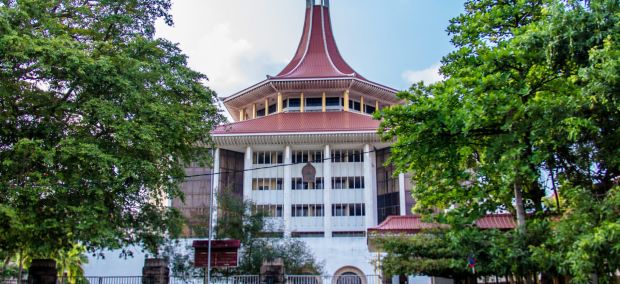
COLOMBO – Sri Lanka’s Supreme Court on Monday dismissed, without proceeding to a full hearing, a fundamental rights petition seeking to invalidate government circulars and legislation relating to legal gender recognition.
The petition was filed by Shantha Jayatilaka, a retired disabled Warrant Officer of the Sri Lanka Air Force, who challenged a series of administrative measures and legislation, including provisions permitting changes to legal gender following gender-affirming medical procedures.
Former Presidents Maithripala Sirisena and Ranil Wickremesinghe, as well as President Anura Kumara Dissanayake, were among the respondents named in the petition.
The matter was heard before a bench comprising Chief Justice Preethi Padman Surasena and Justice Arjuna Obeysekera.
The petitioner argued that a 2015 circular issued by the Director General of Health Services allows individuals to undergo gender-affirming surgery on the recommendation of a psychiatrist and subsequently obtain revised birth certificates and national identity cards reflecting their affirmed gender. He contended that the practice was inconsistent with the law and sought to have the relevant circulars and legislation declared invalid.
Appearing for the Attorney General, Deputy Solicitor General Nirmalan Wigneswaran raised a preliminary objection, arguing that the petition was filed outside the constitutional time limit for fundamental rights applications.
He told the court that the challenged measures had been introduced between 2015 and 2024, while the petition was only filed in 2026, well beyond the one-month period prescribed under the Constitution, rendering the application time-barred.
President’s Counsel Sanjeewa Jayawardena, appearing for several intervening petitioners including Dr Radhika Coomaraswamy, submitted that the petition also sought to invalidate the Women’s Empowerment Act, No. 37 of 2024, an Act duly enacted by Parliament, and argued that such a challenge was inconsistent with the constitutional framework governing the sovereignty of the people.
President’s Counsel Saliya Peiris, appearing for the Women’s Media Collective, further argued that the President had been improperly named as a respondent in his personal capacity. He submitted that under Article 35 of the Constitution, legal proceedings involving the President must be instituted through the Attorney General.
After considering the preliminary objections, the Supreme Court held that the petitioner had failed to establish how his own fundamental rights had been infringed.
The bench upheld the preliminary objections and dismissed the application without referring it for a full hearing.
-ENCL

Comments are closed, but trackbacks and pingbacks are open.