


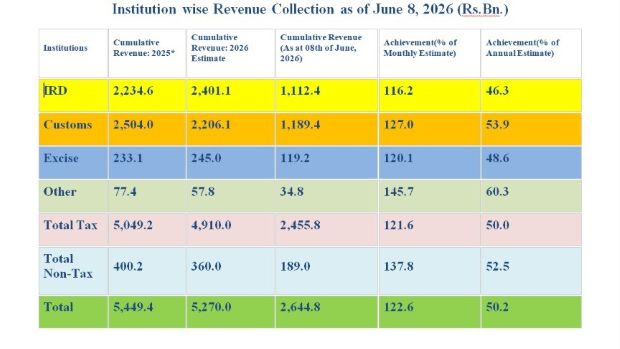
COLOMBO – Sri Lanka’s government revenue collection by all three major tax collecting agencies have outperformed up to June 8, 2026 and expanded more than 50% compared to the same period last year, Finance Ministry data showed.
The government has aimed at a 4,910-billion- rupee tax revenue target for this year, 2.8% lower than last year’s record revenue of 5,449.4 billion rupees.
Finance Ministry data showed the Inland Revenue Department has outperformed the target by 46.3% to 1,112.4 billion rupees as of June 8, 2026, while Customs has achieved revenue of 1,189.4 billion rupees with 53.9% growth from the same period last year.
“Usually, the revenue is higher in the second half compared to the first half,” Deputy Economic Minister Nishantha Jayaweera said on Wednesday (17) after a media briefing in Colombo.
The Excise Department has also exceeded the year-to-date revenue by 48.6%, compared to the last year, the data showed.
The country has already achieved 50% of this year’s target by June 8, the data showed.
The surge in Sri Lanka’s tax compliance and revenue collection is the direct result of an aggressive, enforcement-led modernization of the state’s fiscal apparatus.
Under severe pressure to meet rigid International Monetary Fund (IMF) structural benchmarks, the Inland Revenue Department (IRD) shifted from a passive auditing posture to a proactive enforcement regime.
A major catalyst has been the strict implementation of mandatory Taxpayer Identification Number (TIN) requirements, which are now legally required for essential daily transactions, including opening bank accounts, registering vehicles or land, and applying for credit cards.
This systematic net-widening was further bolstered by the passage of the Inland Revenue (Amendment), which expanded Withholding Tax (WHT) mandates to capture 29 new independent service professional categories.
To complement these rigid structural expansions, the government introduced powerful compliance measures alongside legislative steps, giving some relief incentives to boost tax compliance.
By pairing these targeted relief incentives with severe penalties for non-compliance and a significantly lowered Value Added Tax (VAT) registration threshold, the state is successfully in the process of curbing widespread tax evasion, driving the unprecedented revenue overperformance observed across the island’s three primary collection bodies.
-economynext.com

Comments are closed, but trackbacks and pingbacks are open.