


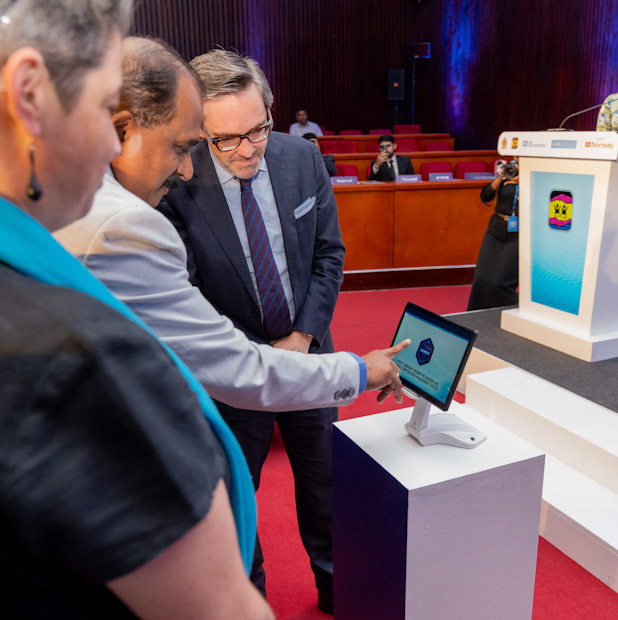
COLOMBO – Sri Lanka on Monday (18) launched a new digital Compensation Management System and Community Inquiry Mechanism aimed at improving the delivery of disaster relief and compensation services to communities affected by Cyclone Ditwah.
The systems were introduced by the National Disaster Relief Services Centre (NDRSC) under the Ministry of Defence at a ceremony held at the Bandaranaike Memorial International Conference Hall (BMICH) in the presence of Deputy Defence Minister Aruna Jayasekara.
The initiative is funded by the Government of Norway and supported by UNICEF Sri Lanka and United Nations Volunteers as part of efforts to modernize disaster response and improve access to assistance for affected families.
Officials said the new digital Compensation Management System would replace lengthy manual procedures with a streamlined online process, enabling disaster victims to submit compensation claims more efficiently through their local Grama Niladhari officers.
The system is expected to reduce delays, paperwork and repeated visits to government offices for families affected by Cyclone Ditwah, many of whom suffered loss of life, property and livelihoods.
Authorities also launched the Community Inquiry Mechanism, a platform designed to manage and respond to public inquiries relating to disaster relief, compensation, rehabilitation and resettlement services.
Affected individuals can submit inquiries directly to the NDRSC through a QR code system or by calling a dedicated hotline operating on weekdays in Sinhala, Tamil and English.
Each inquiry will be assigned a unique reference number, allowing users to track the status of their requests through the hotline or digital platform.
Senior Assistant Secretary of the NDRSC Namal Liyanage said the systems marked a significant step forward in strengthening Sri Lanka’s disaster response capabilities.
“In a crisis, immediate response is crucial. These digitised systems transform our ability to act quickly, providing us with the precise tools needed to meet the urgent needs of our people,” he said adding, “We are setting a new benchmark for transparency and efficiency in how we support every family hit by disaster”.
UNICEF Sri Lanka, which provided technical support and training for officials operating the systems, said the initiative was designed to ensure more people-centred and accountable disaster assistance.
“Access to timely support is not a privilege, it is a right for every affected family,” said Emma Brigham, UNICEF Representative in Sri Lanka, noting that the systems deliver dignity, speed and fairness, so children and their families can begin rebuilding with confidence.
Sharmalee Jayasinghe, Country Coordinator for UN Volunteers Sri Lanka, said 34 UN volunteers contributed to the initiative by supporting both the technical development of the platforms and community-level data collection efforts.
Officials said the digitalization effort aligns with Sri Lanka’s broader national digital transformation agenda and could be further strengthened through future collaboration between the NDRSC, the Welfare Benefits Board and the Election Commission.
Authorities said the initiative is expected to improve transparency, accountability and efficiency in disaster management while reducing the burden on affected communities seeking urgent state assistance.
-ENCL

Comments are closed, but trackbacks and pingbacks are open.