

Growing up through war, learning to bridge divides

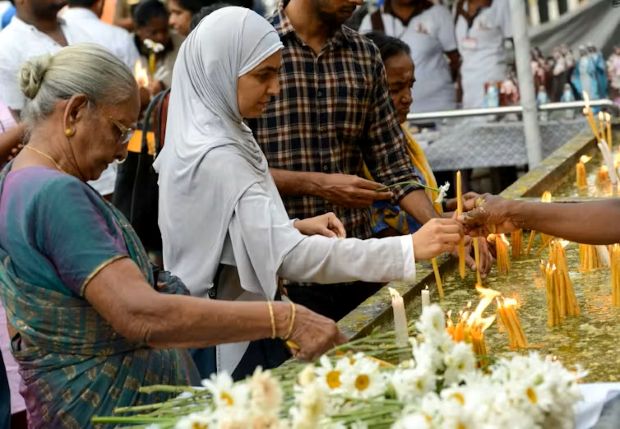
Eranda Jayawickreme reflects on how civil conflict shaped a belief in coexistence and empathy
I grew up in Sri Lanka. Much of my adolescence was spent in Kandy, a city built around a lake, set amid the lush tea plantations of the hill country. Its northern shore houses the Temple of the Tooth, one of Buddhism’s most sacred sites. Each year, it came alive with drummers, dancers and elephants parading through the streets in a ‘perahera’ or procession, honouring the Buddha’s relic.
But Buddhism was only one part of Kandy’s mosaic of religious life. I went to a high school where students from different religious and ethnic backgrounds got along easily. Within walking distance stood Buddhist temples, Christian churches, brightly coloured Hindu temples, or ‘kovils’, and Muslim mosques whose call to prayer echoed across the city multiple times a day. Religious observances filled the calendar; Sri Lanka has more holidays than almost any other country.
Our own home was a glimpse into the island’s diversity. I attended both churches and temples with ease. My mother regularly visited a Hindu kovil with a close friend – though she was Catholic and my father was Buddhist. Her family had emigrated from Kerala, the southwestern tip of India, at the turn of the 20th century. His was Sinhalese, Sri Lanka’s largest ethnic group.
But while Sri Lanka has a long history of religious and ethnic pluralism, it has also been fractured by mistrust, grievance and violence. Diversity did not prevent conflict. Rather, it exacerbated it.
I grew up during Sri Lanka’s civil war, which consumed the country from 1983 to 2009. The brutal conflict was fought between the Sinhalese-majority government and the Liberation Tigers of Tamil Eelam (LTTE), a separatist group fighting to create an independent state for the Tamil minority. An estimated 80,000-100,000 people lost their lives, and the war divided the country along religious and ethnic lines. Meanwhile, a separate insurrection led by the Janatha Vimukthi Peramuna (JVP), a Marxist political party, tore through the southern part of the country in the late 1980s, killing tens of thousands of people.
As a child, I did not possess the vocabulary to describe my own personal experience during this tumultuous time. All I knew was that some people withdrew into their own groups and vilified Sri Lankans who were different from them. Others worked hard to maintain relationships. Ordinary people in extraordinary circumstances could still choose connection over anger.
Those experiences sparked enduring interest in a question that animates my work as a personality psychologist. What allows people to live together across deep religious differences, without sliding into hostility or dehumanization? What helps them commit to pluralism?
Over time, I have come to believe that pluralism requires more than laws and institutions, although such structures are important. It is a moral commitment: a virtue that we each have a responsibility to cultivate.
What pluralism is
The phrase ‘pluralism’ is often used loosely. Sometimes it simply refers to diversity: people of many religions or ethnicities living in one society.
Properly understood, pluralism is something more demanding. It is the capacity and commitment to reach out to people across deep differences, cultivating mutual dignity and a shared civic life.
This can look quite ordinary: a Buddhist teacher attending a Christian colleague’s church wedding out of respect, or a Muslim shopkeeper and a Buddhist neighbour debating over tea, disagreeing sharply, but chatting again the following day. Many of the shopkeepers my family relied on every week were either Tamil or Muslim. One of my tutors – a Muslim man who had worked for the Sri Lankan foreign service in his youth – would sit with me over lessons and then linger to talk with me about politics, culture and the country.
Pluralism lives in these repeated, small acts: decisions to sustain relationships with people whose deepest convictions differ from your own. And it begins with tolerance.
True tolerance cannot exist without disapproval. If I fully agree with your beliefs, I do not need to tolerate them. Tolerance begins when you encounter a view or practice that you find mistaken, troubling or even morally wrong and choose not to interfere with it – because you recognize coercion is not the appropriate response.
Pluralism moves beyond tolerance. It’s not just permitting someone’s beliefs; it’s trying to understand them and getting to know them. This is not the absence of conviction. It is the determination to live out one’s deepest convictions within a shared civic space, and to treat other people not as a threat but as key contributors to the community.
It can help to think about pluralism as a continuum. At the opposite end is hate: “I do not accept your existence.” Next is indifference: “I do not care what you believe.” Indifference is followed by tolerance as patience or forbearance: “I disapprove, but I will not interfere.”
The deeper form of tolerance is based in respect: “I affirm your humanity, even while disagreeing.” Finally, the last space on the spectrum is what scholars label relational or covenantal pluralism: “I’m committed to our connection, even though we disagree.”
Rarely just about religion
Historically, religious conflict often centred on theological disputes: questions about doctrine, salvation or authority. Enlightenment thinkers such as John Locke, Immanuel Kant and Jean-Jacques Rousseau grappled with a shared question: How can diverse societies hold together in the face of such differences?
One answer was that societies needed some form of shared civic framework to bind citizens. Two centuries later, the sociologist Robert Bellah argued that Americans had developed just such a framework: a “civil religion” of shared symbols, narratives and moral commitments – such as the American flag, the Constitution and Memorial Day – that transcended particular faiths while sustaining a sense of common purpose.
Often, though, religious pluralism is less about theological differences themselves. Instead, conflict frequently erupts over social and political differences emerging from foundational values and identities.
Sri Lanka provides vivid examples of this disagreement. Article 9 of the country’s constitution grants Buddhism the ‘foremost place’ among religions. Many religious minorities feel that provision writes a hierarchy into law, granting special privileges to the majority religion.
Or think about the consequences of the devastating 2019 Easter bombings – coordinated attacks on churches and hotels in three Sri Lankan cities by members of the Islamist militant group National Thowheeth Jama’ath.
The resulting wave of anti-Muslim sentiment was not really driven by theological differences but questions about identity, trust and political power. Social media misinformation and opportunistic political rhetoric cast Muslims as outsiders threatening a Sinhala-Buddhist national identity. The question at stake was not which religion was true but who ‘truly’ belonged to the nation.
If societies cannot sustain engagement across differences, shared civic life becomes impossible. This challenge, in my view, is not only institutional but also personal: What habits of mind allow religious pluralism to flourish?
Psychology of disagreement
On a personal level, pluralism begins in a moment of objection. You hear a belief that conflicts with your own. You see a religious symbol you find troubling. You run into a policy grounded in values that you reject. Our first reaction is often intuitive and emotional: irritation, aversion, anger, discomfort. Moral psychology suggests that such reactions feel automatic, confirming our sense that our view is the obvious truth.
What matters is what happens next. Some people quickly dismiss ideas they don’t like, shutting down curiosity. Others pause to reflect: asking why they reacted as they did, what the other person might value, and whether broader principles like freedom of conscience or fairness should guide their response.
This is a hard standard to live up to and one which I’ve struggled with myself. In the wake of the Easter bombings, I found myself growing impatient with Sri Lankans who continued to defend the actions of the government, even as it was detaining about 2,000 Muslims, often on thin evidence; banning women’s religious head coverings; and pardoning the ultranationalist monk most associated with anti-Muslim mob violence. I sometimes caught myself doing exactly what I study, reducing complex people to the worst version of their position. I stopped asking what they were trying to protect or what fears were driving their stance.
It took deliberate effort to step back and try to understand their perspective charitably, even while continuing to disagree. I had to reflect on the fact that for Sinhalese Buddhists carrying the memory of decades of Tamil separatist violence, the government’s response in the wake of the bombings could seem like a way to take the country’s security seriously. The tragedy was that this fear of violence was directed at an entire community, rather than the fringe actors who had committed the crime.
Reflection does not guarantee tolerance; we may still conclude that a belief is too harmful to accept. But it could also lead to a ‘principled allowance’, which is what makes tolerance possible: deciding that others have a right to hold or express views we dislike.
From there, the path can diverge again. Some people settle for a minimal “live-and-let-live” coexistence, while others move toward deeper dialogue and cooperation.
In other words, pluralism is not a single decision. It’s a series of steps to uphold a relationship, shaped by virtues such as humility, empathy, patience, fairness and courage. We can strongly disagree with someone but still ask: What does this belief mean to them?
That said, I still wrestle with where the boundaries of pluralism lie. What about when someone’s convictions lead to clear harm to vulnerable people? I do not have a clean answer. Over the years, though, I’ve come to believe that the difficulty of the question is not a reason to abandon the commitment. Committing to pluralism is a sign of character – one that can be strengthened by practicing particular virtues.
Which virtues support pluralism?
One is intellectual humility: recognizing the limits of our knowledge. It does not mean abandoning conviction. It means acknowledging the possibility that we’re wrong.
Studies suggest that intellectual humility is associated with openness to opposing viewpoints, attempting to understand how another person sees the world. When combined with curiosity, it moves beyond strategic tolerance toward fostering genuine relationships.
Another key virtue is empathy – but a specific kind of empathy. As an emotion, empathy can be biased; it may pull us toward people who look like us, feel close to us, or whose suffering resonates with our own experience. Another form of empathy, though, is perspective-taking: trying to understand another person’s thoughts, feelings or point of view. Studies have found that perspective-taking can reduce prejudice against people with different views.
Similarly, the virtue of curiosity can help reframe disagreement. Instead of seeing difference as a threat to our own identity, it becomes an opportunity to learn. Higher levels of curiosity have been found to both increase people’s motivation to learn and reduce their desire to distant themselves from people with different views.
Pluralism is challenging when emotions run high. That means another virtue it requires is self-regulation, the ability to reflect before reacting. Without it, moral disagreement can quickly descend into condemnation.
Finally, pluralism takes courage. People sometimes confuse pluralism with moral relativism: the view that right and wrong are just matters of opinion, with no universal moral foundation. Pluralism doesn’t mean giving up your values, but it requires bravery to discuss them openly with people who strongly disagree.
These values are the focus of research I am currently conducting in Sri Lanka. Colleagues and I are studying dispositions and virtues that distinguish people who sustain engagement across divides from those who withdraw into their own groups.
It is still early, but the emerging picture is consistent with what I observed as a child: that the people around me who maintained friendships across ethnic and religious lines were not people without convictions. They were people who had cultivated specific habits of mind that made that pluralism possible, despite blowback from others within their own community.
Putting it into practice
One practical way to build these habits is to practice what some researchers call an “ideological Turing test”. The rule is straightforward: Before you criticize someone’s position, you first have to explain it so accurately and charitably that they would recognize themselves in your summary. They would say, “Yes, that’s what I believe”.
Doing this well is hard. You have to get curious about what the other person is actually trying to protect, what they fear, what trade-offs they’re willing to live with, and what experiences might have shaped their perspective in the first place. This exercise quietly changes the aim of the conversation: Instead of trying to defeat the other person, you try to understand them.
The process also tends to trigger intellectual humility, because when we make a serious attempt to represent opposing views fairly, we may notice faults in our own thinking. None of this requires agreement, but it does reduce our tendency to caricature the other side.
Pluralism can also be strengthened by reframing our sense of ‘we’. In polarized environments, ‘we’ tends to shrink until it names only the people who pray, vote and live exactly like us. Pluralism pushes in the opposite direction: It asks us to include fellow citizens whose deepest convictions diverge from our own. Community is a shared civic fate – the responsibilities, institutions and hopes we share, despite enduring disagreement.
Many times over the years, I have thought of a story my father told me, a vivid example of ‘we’. In 1983, Tamil militants killed 13 government soldiers, and anti-Tamil riots swept across the country. Sinhalese mobs attacked Tamil homes, businesses and neighbourhoods in what became known as Black July – days of violence orchestrated by the government that killed thousands of Tamils and displaced many more. The riots are widely regarded as the spark that turned simmering tensions into a full-scale civil war.
My grandparents and uncle were living in Kandy. When violence reached their area, they hid Tamil neighbours in their home, sheltering them from the mobs outside. My father said it was a split-second decision, motivated by the recognition that the people next door were their neighbours rather than members of a different ethnic and religious group.
Their actions required courage and a moral clarity that cut against the chaos of the moment. This clarity doesn’t appear out of nowhere; it emerges from habits practiced long before the moment of crisis arrives.
To build that courage in ourselves, we can also build habits of praise, noticing and naming when others are respectful to people across a divide. Virtues grow where they are socially reinforced. Each person can build accountability by committing with a friend or colleague to one concrete practice of pluralism: asking clarifying questions before responding, summarizing an opposing view before critiquing it, or pausing before posting an incendiary comment online.
These actions are small, but they shape who we are. We can develop our character through repeated patterns of behavior, and a commitment to pluralism can become part of who we are.
Returning to Sri Lanka
Thinking back to my childhood, I remember the evening in 1993 when neighbours gathered outside after news that Sri Lanka’s president at the time, Ranasinghe Premadasa, had been assassinated. We could hear faraway fireworks lit by others who were rejoicing in his passing. And yet we stood together quietly.
The silence of the people around us did not erase our differences; the sound of the fireworks in the distance was a callous reminder of the disagreements that did exist. But to me, our neighbours’ silence affirmed something deeper: that our disagreements did not cancel our shared humanity.
In an era when religious and moral differences often feel like threats to identity, cultivating an individual ethic of pluralism may be one of the most critical civic tasks before us. Pluralism is not who we are by default. But it can be who we become – slowly, deliberately and together.
-Eranda Jayawickreme is Professor of Psychology & Senior Research Fellow, Program for Leadership and Character, Wake Forest University, North Carolina, USA and this article was originally featured on theconversation.com

Comments are closed, but trackbacks and pingbacks are open.