

An act of murder at sea

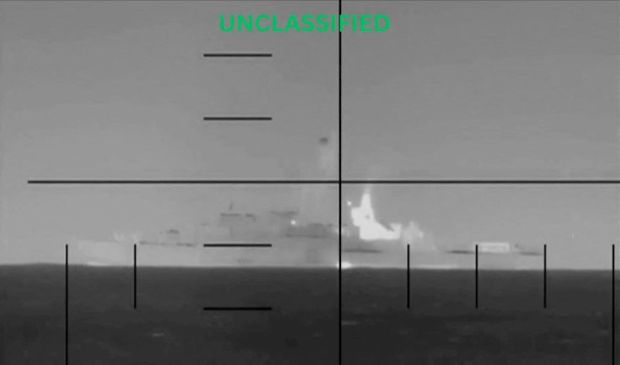
Sinking of the IRIS Dena and the lawlessness America has chosen
The UN Navy submarine torpedo that struck the IRIS Dena did not discriminate. It found an unarmed Iranian naval vessel carrying 180 sailors homeward bound from a multilateral exercise – Milan 2026 -hosted by the Indian Navy in the waters off Visakhapatnam. The ship was not a threat. It was not armed for combat. It was returning, in the ordinary course of naval routine, from an exercise built on the principles of maritime cooperation and mutual trust. What the United States Navy did to that vessel and the men aboard it was not an act of war in any legally or morally defensible sense. It was an act of murder at sea.
We must say that plainly, because the language of geopolitics has a way of laundering atrocity into abstraction. ‘Targeted strike’. ‘Neutralized asset’. ‘Pre-emptive action’. Or as US War Secretary Pete Hegseth calls it ‘quiet death’. None of those phrases belong anywhere near the IRIS Dena. She was sailing in international waters. She carried no weapons of aggression. Her sailors were not combatants in any active theatre. Under every framework of international maritime law – the UN Convention on the Law of the Sea, the customary laws of naval warfare, the most basic principles of distinction and proportionality that civilized nations claim to uphold, this attack was illegal, unconscionable, and indefensible.
The Indian Navy hosted Milan 2026. The IRIS Dena was on Indian waters, participating in India’s exercise, sailing under India’s implicit guarantee of hospitality when she made her way home. That creates a moral and diplomatic responsibility that New Delhi cannot quietly set aside.
India has cultivated, with considerable care, a foreign policy identity built on strategic autonomy, the refusal to be absorbed into any single power’s orbit, the insistence on a rules-based international order, the championship of the Global South’s right to be heard. That identity is now being tested in the most direct possible way. An Iranian naval vessel attended India’s exercise and was torpedoed by a US Navy submarine on its return journey.
If India responds with studied silence, as it has done so far, or carefully calibrated diplomatic ambiguity, it will have communicated something devastating, that its commitment to international law is contingent, that its hospitality carries no protection, and that strategic autonomy means nothing when Washington is the party that needs to be confronted.
India must formally condemn this attack. It must demand accountability through every international forum available to it. Anything less is a betrayal of the sailors who came to its waters in good faith, and a surrender of the very principles India claims to lead on.
Sri Lanka sits at the crossroads of the Indian Ocean. Its waters, its ports, and its airspace are threaded through the arteries of global maritime trade. The island has historically navigated great power competition through a combination of careful neutrality and principled multilateralism, a posture that has served it well precisely because it signals to all parties that Sri Lanka’s waters are not a theatre for other nations’ wars.
That posture now demands a voice. Sri Lanka cannot watch a naval vessel torpedoed in its broader maritime neighbourhood, in waters connected intimately to its own strategic interests, and offer nothing but silence. Colombo should join any multilateral call for an independent investigation, raise the matter through regional forums, and reaffirm clearly and publicly that the Indian Ocean cannot become a permissive environment for unilateral military aggression. Small nations have more at stake in the rules-based order than large ones. They should be its loudest defenders.
There is a principle, long embedded in the laws of naval warfare, that warring parties must distinguish between legitimate military targets and vessels that pose no threat. An unarmed ship, positively identified, returning from a peacetime multilateral exercise, falls so far outside any credible definition of a military target that the decision to sink her raises questions that go beyond this single incident.
What signal does this send to every naval vessel now transiting the region? That participation in multilateral exercises makes you a target on the return journey? That international waters offer no protection if a superpower decides, for whatever operational reason, that your flag is sufficient cause? The chilling effect on naval cooperation, on multilateral exercises, on freedom of navigation itself, values that the United States has historically proclaimed as sacred, is incalculable. America has, in a single act, undermined the very norms it has spent decades insisting that others observe.
The broader conflict now consuming the Middle East was described, even by analysts broadly sympathetic to Western security concerns, as a war of choice. It was prosecuted at a moment of perceived Iranian vulnerability, with objectives, regime change, the decapitation of leadership, the permanent dismantlement of Iran’s military capacity, that go far beyond anything that international law recognizes as legitimate self-defence.
The sinking of the IRIS Dena is the latest and most viscerally unjust consequence of that choice. A conflict that did not need to happen, launched on a timeline chosen for strategic convenience rather than genuine necessity, has now killed 87 sailors (61 remain missing and 32 have been rescued) who were doing nothing more threatening than sailing home. Their families will grieve. Their names will likely never be read in any Western parliament. The superpower that killed them will issue, at most, a terse statement of justification and move on.
The United States and Israel bear direct and unambiguous responsibility for what has been unleashed. Not merely for the IRIS Dena specifically, but for the entire architecture of escalation within which this attack occurred. When you choose to go to war, when you make that choice deliberately, with alternatives available, you own every consequence that follows. Every sailor on that ship, killed, missing and injured. Every civilian killed by missile debris in UAE, Qatar and Kuwait. Every family shattered in a conflict that the architects of this war will never have to personally explain to a grieving mother.
The international community faces a stark and clarifying moment. Either the rules that govern behaviour in international waters mean something, enforced with consistency, defended with courage, applied without exception or they mean nothing at all, and the ocean belongs to whoever has the largest navy and the fewest scruples.
One hundred and eighty sailors set out for home, 87 bodies have been recovered, 61 are missing. The least the world owes them is the honesty to call what happened by its true name.
-ENCL

Comments are closed, but trackbacks and pingbacks are open.