

Sinhala Buddhist Nationalism: All dressed up and nowhere to go, yet again!

By Kassapa
Last week, this writer focused on how Sinhala Buddhist nationalism was being used as a tool by the ‘usual suspects’, the Rajapaksa school of politics, to try and capture the imagination of the majority community and claw themselves back into power and how the Samagi Jana Balawegaya (SJB), the main opposition party, at least in Parliament, and its leader Sajith Premadasa appeared to be blindly joining the bandwagon.
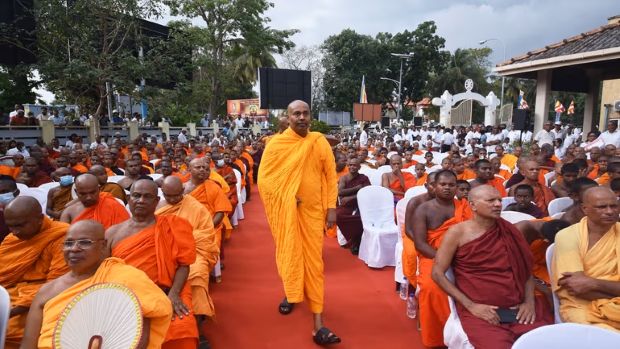
In the days that ensued, it was precisely this strategy that played out with predictable results, in three separate events. The first was the so-called Sangha convention called for by Muruttetuwe Ananda Thera, calling on the government to cease ‘insulting Buddhism’. A crowd of 10,000 monks was promised initially. Eventually, the turnout was less than 500 monks.
To make matters worse, one of the key speakers at the convention, Kotapitiye Rahula Thera, went viral talking about how sex education was unnecessary and, to prove his point, made a palpably false claim about Robert Knox describing train travel, when trains did not exist in the country during his time. The monk, a professor to boot, provided comic relief to those waiting to mock the convention.
More importantly though, the convention sent several key political messages. The paltry crowd proved beyond any doubt that majoritarianism no longer appeals to the majority of masses – or even a majority of Buddhist monks. Slogans designed to incite racial disharmony are being rejected by most people now. That seems to be an enduring pattern.
Premadasa was a notable attendee. Namal Rajapaksa, the heir apparent of the Sri Lanka Podujana Peramuna (SLPP) was conspicuous by his absence. Both are unofficial presidential aspirants for 2029. Premadasa, representing the right-of-centre SJB, supposedly a party with a liberal outlook and partnering with parties representing other communities, raised eyebrows with his presence. How could he be among them, many asked. This proves what was always suspected: his political judgment is appallingly poor.
That does not mean that Rajapaksa and the SLPP are any different. Hounded and thrown out of office primarily because of alleged corruption and confirmed economic mismanagement, they have resorted to the theme they know best: ‘elect us to save our race and religion’. The difference this time is that there is no traction for that slogan anymore. Instead, people are voting to save the nation from the Rajapaksas. That anti-Rajapaksa sentiment is still strong in the public domain.
The second event, not publicized as much, was a media briefing called by Galagoda Aththe Gnanasara Thera. There, he claimed he had no money to fight those who were allegedly slandering him on social and mainstream media. Holding up a sheet of paper that had his bank account number, he appealed for public donations.
Coming from a monk who once had presidents at his beck and call and whose racist rhetoric set villages on fire, it was a telling statement. It meant that money, which was never an issue for the likes of Gnanasara Thera when the Rajapaksas were in power, was now in short supply. Those who sponsored them generously were either more enlightened now or had tightened their purse strings after state power had changed hands. This is again evidence of a shift in racist sentiment in our society.
The third event, also last week, was the ‘birthday bash’ of Pitiduwe Siridhamma Thera of ‘Umandawa’ fame. The monk is renowned for his entrepreneurial skills but has also generated controversy by claiming he has attained ‘arahathood’ despite enjoying a very lavish lifestyle. In the latter incarnation he calls himself ‘Samanthabhadra’. This one of a kind personality has songs composed for him and statues built for him, such is his sense of inflated self-importance. What he does not lack however is money and political connections.
This was very much in evidence at the ‘birthday bash’. In attendance were former Presidents Mahinda Rajapaksa and Ranil Wickremesinghe as well as an assorted array of politicians from all major opposition political parties. There were open discussions about opposition forces pooling their resources to change the government. There was also no hiding the predominant sentiment at the event, that there should be a strong pro-majority community stance to try and mobilize support against the government.
The government therefore would do well to brace itself for a flurry of allegations that it is working against the interests of the majority community and the majority religion in the country. That will be the dominant theme of the opposition at the next national elections, come 2029. What remains to be seen is whether Premadasa and his SJB as well as Wickremesinghe and his United National Party (UNP) will join this chorus.
As we have noted before, whatever his other faults, Wickremesinghe has not played the racist card previously. It is still early to speculate whether he will still be active in politics in 2029 when he will be eighty years of age but even if he is, the desperate situation the UNP finds itself in may call for desperate solutions. Besides, these days Wickremesinghe is eagerly calling for as broad an opposition alliance as possible to defeat the ruling National Peoples’ Power (NPP) and that includes his past arch-rivals, the Rajapaksas.
Wickremesinghe is stubbornly sticking to this line, much to the chagrin of the SJB. That might suggest that if chauvinism and favouring the majority community is the only option for the UNP as it aligns with the SLPP, he could endorse that even if it costs him the support of the SJB.
This is despite overwhelming evidence- at the last major elections, in general public sentiment and on social media- that the majority of the voting public do not endorse racist majoritarian sentiments. In fact, they now abhor it and are able to call it out as a weapon used by rascal and rogue politicians to remain in power seemingly for ever.
The SLPP adopting this stance is, in a sense, understandable because they know nothing different. If the UNP and the SJB also continue their flirtation with this line of thinking, that will be their downfall and provide an easy passage for the NPP at the next national elections. Politicians from the UNP and the SJB may think they are smarter than the average voter. In fact, the reverse is now true.
– counterpoint.lk

Comments are closed, but trackbacks and pingbacks are open.