

How two powerful US allies came to blows in Yemen

By Vivian Nereim
RIYADH — As Saudi Arabia’s crown prince, Mohammed bin Salman, rose to power a decade ago, officials and pundits in Washington sometimes compared him to the de facto ruler of the neighbouring United Arab Emirates (UAE), Sheikh Mohammed bin Zayed Al Nahyan.
Both royals presented themselves as authoritarian reformers. In 2015, they teamed up in Yemen, launching a disastrous military intervention to beat back Iran-supported rebels, and later joined forces in a bitter political dispute against their neighbour Qatar.
But today, the two men are increasingly at odds, leading their oil-rich Persian Gulf countries into confrontation and competition with each other in the Middle East, Africa and beyond.
On Tuesday (Dec 30), long-simmering tensions burst into the open as a Saudi-led airstrike targeted a UAE shipment as it arrived in Yemen, with the accusation that the UAE was sending weapons to a separatist group.
It was the dramatic climax of a spat between the onetime partners, who now support opposing groups in Yemen and Sudan, have pursued differing oil policies and acted against each other in economic and trade matters.
Because of the vast global influence of Saudi Arabia and the UAE — as major energy exporters, with enormous sovereign wealth and diplomatic sway — the rift has the potential to move markets, derail investments and disrupt sensitive negotiations around the world.
For Washington, the rupture has the makings of a serious headache. Secretary of State Marco Rubio spent Tuesday working the phones with his Saudi and UAE counterparts.
Both countries have made extravagant promises to pour money into the United States, and they are key players from whom President Donald Trump hopes to win support for his Middle East policies, including in Israel and the Gaza Strip.
“No one in the Gulf wants to see another Gulf crisis, so everyone has an interest in containing this,” said Yasmine Farouk, director of the Gulf and Arabian Peninsula project for the International Crisis Group.
Still, a fundamental schism remains.
In his early years, Crown Prince Mohammed pursued an aggressive foreign policy, mounting the bombing campaign in Yemen within months of being appointed defence minister. But he has since looked to subdue regional conflicts in pursuit of his economic agenda at home.
In contrast, the UAE has become a regional maverick with what appear to be imperial ambitions. During the first Trump administration, it helped engineer a series of agreements through which the UAE, Bahrain and Morocco normalized ties with Israel, shattering a long-standing policy among many Arab countries.
The UAE government has also taken an increasingly active role outside the region and has invested heavily in Africa.
In recent months, the country has faced international outcry over its alleged role in Sudan. It has been accused of backing the Rapid Support Forces, a paramilitary force that is fighting the Sudanese military in a devastating civil war.
UAE officials previously denied that they provided support to the group, though the evidence is well-documented. Saudi Arabia has backed the Sudanese military and hosted peace talks between the two sides.
During a visit to the United States in November, Crown Prince Mohammed pressed Trump to help bring about a peace deal in Sudan. The potential involvement of the Trump administration would compound the international pressure on the UAE over Sudan.
“Someone’s giving them the money, and someone’s giving them the weapons,” Rubio said in November, referring to the players in Sudan. “And we know who they are.”
In recent years, the UAE has been “allocating its growing financial and military tools to fulfil its geoeconomic ambitions by projecting its influence,” Farouk said, while Saudi Arabia has focused on containing and managing regional crises.
“We are an influential country in the region,” Anwar Gargash, a senior UAE official, said in an interview with CNN in November. “Maybe somebody doesn’t like it. But matter of fact, we are. And, as a result, I think we have a regional view on what we want to see in countries around us.”
Bader Al-Saif, an assistant professor at Kuwait University, described the fault lines between the countries as a “difference in worldviews.”
Analysts and diplomats say that the actions of Sheikh Mohammed of the UAE appear to be ideologically driven, including by his opposition to political Islamism, which he views as a threat to the region.
The Saudi crown prince, by contrast, is a ruthless pragmatist, willing to shift his political positions as needed.
Their differing mindsets and strong personalities seemed to make collision inevitable at some point.
The first public indication that something was amiss came in 2019. As the Saudi-led campaign in Yemen faced growing international pressure over widespread death, hunger and disease in the country, the UAE withdrew most of its forces. But it also offered support to a separatist group, the Southern Transitional Council, which began openly fighting the Yemeni government.
Soon after, economic competition between the two countries heated up. Crown Prince Mohammed’s plans to turn Saudi Arabia into a global hub for business, artificial intelligence and tourism pose a potential threat to Dubai, the UAE’s major financial and aviation hub.
Saudi and UAE officials often say that competition between them is friendly and beneficial for everyone. Yet in 2021, the Saudi government began pressing international companies to relocate their regional headquarters from Dubai to Riyadh, the Saudi capital, and threatened to cut off access to lucrative government contracts for firms that did not comply.
The countries’ fiercest clashes have been in Yemen, the poorest country in the Arabian Peninsula.
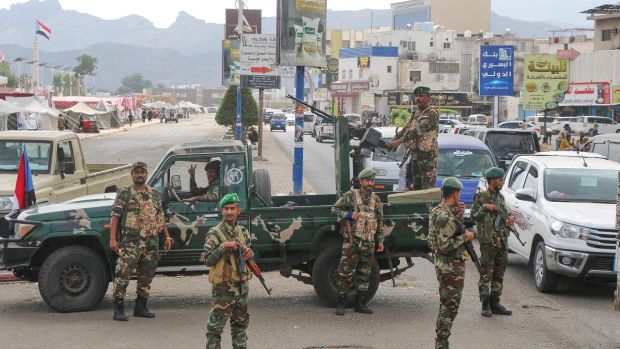
In December, the separatists swept through southern and eastern Yemen, seizing control of vast swaths of oil-rich territory in regions where Saudi Arabia had long held sway, and stating their intention to form a breakaway state.
Why the UAE supports the group is unclear, but analysts speculate that the UAE leadership could be attracted to the idea of holding sway in Yemeni port cities located on crucial global trade routes. UAE officials say they merely stand by Yemenis’ rights to security and self-determination.
Saudi officials described the separatist group’s recent moves as a security threat to the kingdom, which shares a long and porous border with Yemen. On Tuesday, when Saudi-led forces in Yemen bombed the UAE shipment, saying it contained arms bound for the separatists, the Saudi Foreign Ministry accused the UAE of pressuring the group into mounting their recent offensive.
The UAE government denied that and said the shipment did not contain weapons, but hours later it announced that it would withdraw its remaining military forces from Yemen “of its own volition”.
In the aftermath of the airstrike, Saudi and UAE commentators, who typically profess brotherly respect for each other’s countries, began shooting verbal salvos.
The allegation that the UAE had threatened Saudi security was “unfortunate” and untrue, Dhahi Khalfan, the outspoken deputy police chief of Dubai, wrote on social media.
Then he criticized Crown Prince Mohammed, albeit subtly — lavishing praise on a former Saudi ruler, King Abdullah bin Abdulaziz, whose memory is often invoked by Saudi critics of the prince.
“May God have mercy on King Abdullah bin Abdulaziz and grant him the highest levels of paradise,” Khalfan wrote. “It is in the darkest of nights that the full moon is missed.”
Saudi social media influencers insinuated that the UAE government was acting opportunistically and had delusions of grandeur.
“Punching above one’s weight is one thing. Believing it makes you a regional power is another,” wrote Saud AlDossary, son of the kingdom’s media minister.
Al-Saif expressed hope that the rift’s emergence “out in the open will accelerate a resolution, or at least a clearer modus vivendi.”
-New York Times

Comments are closed, but trackbacks and pingbacks are open.