

Building back better? Sri Lankans face challenges in recovery from floods, landslides

By Chin Hui Shan
BADULLA – Lush green terraces line the hillsides of picturesque Badulla, a highland region in Sri Lanka famed for its Ceylon tea.
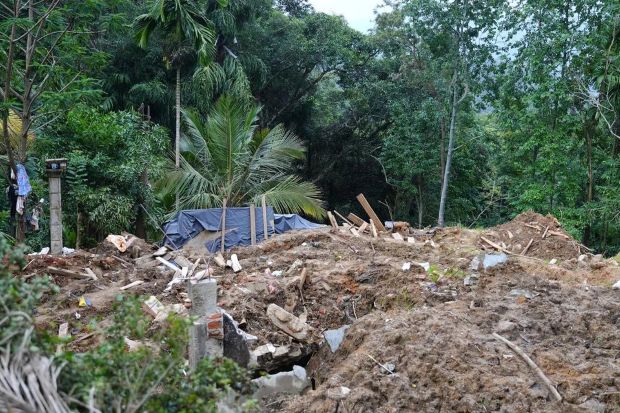
But traces of the disaster that blew through the region more than a month ago were still apparent when The Straits Times visited on Dec 22.
The landslides that toppled buildings and destroyed plantations left their mark throughout the area, with mounds of upturned soil and broken pieces of concrete seen strewn by the wayside.
These steep slopes, which made the region so conducive for tea plantations, were precisely why Badulla was so hard-hit when Cyclone Ditwah swept across Sri Lanka after making landfall on November 28.
The cyclone severely affected close to two million people across the country, killed more than 640 people and displaced over 66,000.
In Badulla, home to more than 800,000 people, the heavy rain from the cyclone triggered landslides that tore through the central tea-growing region.
Close to 92,000 people were affected in the Badulla district, according to the latest report by Sri Lanka’s Disaster Management Centre on Dec 17. A death toll of 88 was recorded in the district.
The disaster, described as the “largest and most challenging natural disaster” in Sri Lanka’s history, hit the South Asian nation less than a month after the UN climate conference COP30 concluded in Brazil.
Countries agreed at the summit that developing countries needed more help and funds to protect their people from the growing impacts of the climate crisis.
About a month since the cyclone struck, residents are still struggling to pick up the pieces – highlighting the long tail of disasters that are worsened by climate change.
Some residents are still living in makeshift accommodation, such as schools or religious facilities, as they await more news so they can find a suitable home.
The Sri Lankan authorities and non-governmental organizations like the Sri Lanka Red Cross Society say they are looking for shelters that can house affected residents for at least a year.
Karupiah Velayutham, who has been staying in a temple in Badulla for more than two weeks, said that his family is waiting for the government to determine whether his house is safe to live in or if they will have to relocate.
“Our things are in the house, but we have no means to get them,” said the 65-year-old, who works in a tea plantation, adding that there are cracks in the house. “The authorities will need to check the soil and inform us if we can build our house, whether it is good or prone to landslides.”
But such assessments, and the search for areas that residents can relocate to, will take time, especially since the area is prone to landslides, Badulla Disaster Management Centre deputy director E. M. L. Udaya Kumara said.
He was speaking to ST during a visit by the Singapore Red Cross to Sri Lanka to help with disaster relief efforts.
During the visit, a team of four trained responders from Singapore participated in distribution efforts and conducted a needs assessment to better understand the landscape and needs on the ground, among other efforts.
As of Dec 27, it has raised at least $200,000 as part of its fundraising appeal to help affected communities in Sri Lanka.
Another challenge to tackle is the reluctance of residents to relocate, Kumara added.
Ranjith Liyanage, chairman of the Sri Lanka Red Cross Society’s Badulla branch, noted that about 70% of the land in the region is prone to landslides.
One solution being piloted in certain countries to reduce people’s vulnerability to climate disasters is to relocate entire populations away from disaster-prone areas.
For example, Tuvalu, which is located between Hawaii and Australia, is dealing with sea-level rise by moving its people elsewhere as part of its efforts to tackle the threat of inundation.
But the situation in Badulla shows that climate adaptation has a psychological element too.
“Because of our culture, people are very close to each other. They are very reluctant to move places,” Kumara said.
The livelihoods of some residents are closely linked to where they live. Most residents working in the estate sector – which refers to working in large plantations like tea plantations – live near where they work, he added.
The final decision on whether residents have to relocate ultimately depends on the government, said Liyanage from the Sri Lanka Red Cross Society.
“The biggest problem now is rebuilding. People are waiting; they want to go back to their normal lives, but it takes time,” he said.
Fingerprints of climate change
Between November and December, cyclones and extreme monsoon rain have ravaged Sri Lanka, Indonesia, Thailand, Vietnam and Malaysia, killing thousands and displacing millions.
The recent deadly storms in Asia, including Cyclone Ditwah, were found to be “supercharged” by higher sea temperatures and made worse by rapid deforestation, according to a Dec 11 analysis by World Weather Attribution (WWA).
WWA is an international effort that analyzes the possible influence of climate change on extreme weather events.
Kumari Kotalawala, director for branch development at the Sri Lanka Red Cross Society, said that the country is experiencing more intense rainfall and higher flood risks, consistent with warmer ocean temperatures and more volatile monsoons.
“Several international updates explicitly note that storm impacts are being intensified by climate drivers, including rising sea temperatures, and Sri Lanka’s exposure to extreme weather is already high,” she said.
The latest disaster was reminiscent of the last major catastrophe to hit the country – the Indian Ocean tsunami in 2004.
Jagath Abeysinghe, senior vice-president of the Sri Lanka Red Cross Society, said that unlike that incident, which affected only its coastal belt, the recent cyclone affected almost all districts in the country, causing huge infrastructure damage and affecting livelihoods.
In Badulla, more extreme weather events are not the only climate change impact residents have to worry about.
For the agricultural region, erratic weather patterns are also eroding crop yields.
The recent cyclone also resulted in some plantations being destroyed. Access to some of the unaffected plantations for harvesting was also hindered by damaged roads.
Over the years, the yield of tea and crops like pepper has been reduced, according to the locals.
Kumara, who has been working in Badulla for 15 years, said: “Generally, pepper is a good crop for people to earn a lot of money. But in the last six years, the production has been very low because of climate change.”
Pepper is a sun-loving crop, and changing rain patterns can make it hard for this crop to thrive.
And while rainy weather is part and parcel of life in Badulla, things have become more unpredictable.
“But this time it was very critical, we had a very big rainfall,” Kumara added.
Building back better
As the nation continues to grapple with the aftermath of the cyclone, officials said that the country is now focusing on rebuilding.
“We have passed the emergency period. Now, we are in the rebuilding stage,” said Liyanage of the Sri Lanka Red Cross Society.
The first few weeks of the disaster involved residents enduring power cuts and days without communication. Search and rescue missions were in full swing.
“Rebuilding the country will be quite hard. It will take some time, but I think we can slowly get there,” said Rukshan Peiris, chairman of the Sri Lanka Red Cross Society’s Colombo branch.
The recovery process comes as Sri Lanka faces its worst economic crisis in decades, which would likely further strain governmental resources.
A Dec 22 report released by the World Bank Group showed that the cyclone has caused an estimated US$4.1 billion (S$5.2 billion) in direct physical damage to buildings and contents, agriculture and critical infrastructure.
Besides their short-term needs, such as medical care and temporary shelters, residents also face long-term problems, Peiris said. These include resuming their livelihoods and finding accommodation.
To help Sri Lanka minimise damage caused by disasters in the future, Kumari from the Sri Lanka Red Cross Society said climate-resilient infrastructure standards are needed to guide reconstruction efforts. Early warning systems that are accessible to all will also be key, she added.
Thakshayeni Skanthakumar, who was part of the Singapore Red Cross team which visited Sri Lanka, said: “After witnessing the families affected by the landslides, as well as the flooding, one thing that struck me is how they are all ready to forget this as a bad nightmare and get back on their feet.
“It is very heart-warming to know that the community, despite their struggles, have put it behind and are willing to come forward and get back to build back better as a nation.”
Among those who are determined to rebuild is car repairman R.A.R. Premadasa, whose three-storey abode, which housed two families in Pelgahatenna village, was destroyed by the landslides.
Yet the 78-year-old, who lived in the house for 50 years, had already resumed work on Dec 17 in a makeshift shelter, with equipment borrowed from a friend.
Currently living in a rented room near the village, he said that he had lost almost everything in the house, including original documents such as land deeds.
“(But) I have no regrets about this situation… I want to rebuild my life,” he said.
– The Straits Times

Comments are closed, but trackbacks and pingbacks are open.