


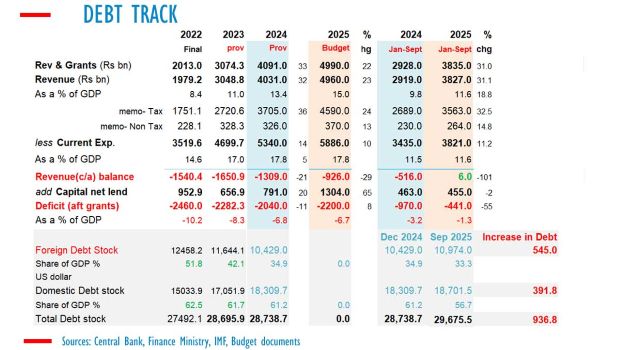
COLOMBO – Sri Lanka’s central government debt increased by Rs 936 billion in the first nine months of 2025, more than double the reported budget deficit of Rs 441 billion, official Central Bank data show, highlighting the impact of currency depreciation and monetary policy dynamics even as fiscal performance improved.
According to provisional data released by the Central Bank of Sri Lanka, the budget deficit narrowed significantly during the January-September period, falling from Rs 970 billion in the corresponding period of 2024 to Rs 441 billion in 2025. The improvement came despite a public-sector salary hike, supported by a sharp rise in government revenue.
Tax collections reached Rs 3,563 billion during the period, up from Rs 2,689 billion a year earlier, reflecting higher tax compliance and the continuation of post-crisis revenue measures agreed under Sri Lanka’s International Monetary Fund (IMF) program.
However, despite the improved fiscal position, total central government debt rose sharply, driven largely by an expansion in foreign debt in rupee terms.
Foreign debt increased by Rs 545 billion, reaching Rs 18,974 billion by end-September 2025, compared to Rs 10,429 billion at end-2024, even though Sri Lanka recorded a net foreign debt repayment of Rs 93.6 billion during the period.
Analysts attribute this apparent contradiction to the depreciation of the Sri Lankan rupee in 2025, which inflated the local-currency value of external liabilities despite repayments.
The deficit itself was financed mainly through domestic borrowing of Rs 515.3 billion, while foreign financing recorded a net outflow.
The rupee weakened during 2025 despite record current account surpluses and an improving fiscal balance, challenging conventional macroeconomic explanations that typically link currency depreciation to twin deficits.
Economic analysts argue that the currency’s performance reflects monetary policy choices rather than fiscal slippage or external imbalances.
Sri Lanka currently operates under a flexible inflation-targeting regime, introduced under the new Central Bank Act. Analysts argue that this framework does not legally obligate the Central Bank to run a deflationary policy to accumulate foreign reserves needed for sovereign debt repayments.
To build reserves from current inflows and support government debt servicing, the Central Bank would need to maintain a peg-like policy stance and operate at interest rates consistent with reserve accumulation, economists say.
However, following a policy rate cut in May 2025, reserve accumulation has fallen short of projections, despite higher tax revenues and external surpluses.
The Treasury has relied in part on purchasing dollars from the Central Bank to meet repayment needs, a strategy analysts warn could become unsustainable if inflationary open market operations resume.
President Anura Kumara Dissanayake, in his 2025 Budget speech, called for maintaining exchange rate stability, noting that currency depreciation directly affects food and energy prices and increases the tax burden required to service national debt.
Economists argue that responsibility for monetary stability ultimately lies with Parliament.
Analysts also flagged structural issues in Sri Lanka’s public finance framework, including the Central Bank’s de facto ‘government acceptance’ privilege, which mandates the acceptance of rupees for tax payments. Critics say this limits the Treasury’s ability to build non-debt foreign currency revenue streams.
While the Treasury does not routinely purchase dollars from the market to service external debt, other government agencies continue to buy foreign currency for imports, creating distortions that economists warn could raise the risk of a second sovereign default if policy inconsistencies persist.
As Sri Lanka continues its post-crisis adjustment under IMF supervision, analysts caution that fiscal consolidation alone will not stabilize debt dynamics unless accompanied by a coherent and accountable monetary framework that anchors the currency and supports long-term reserve accumulation.
–ENCL/EN

Comments are closed, but trackbacks and pingbacks are open.